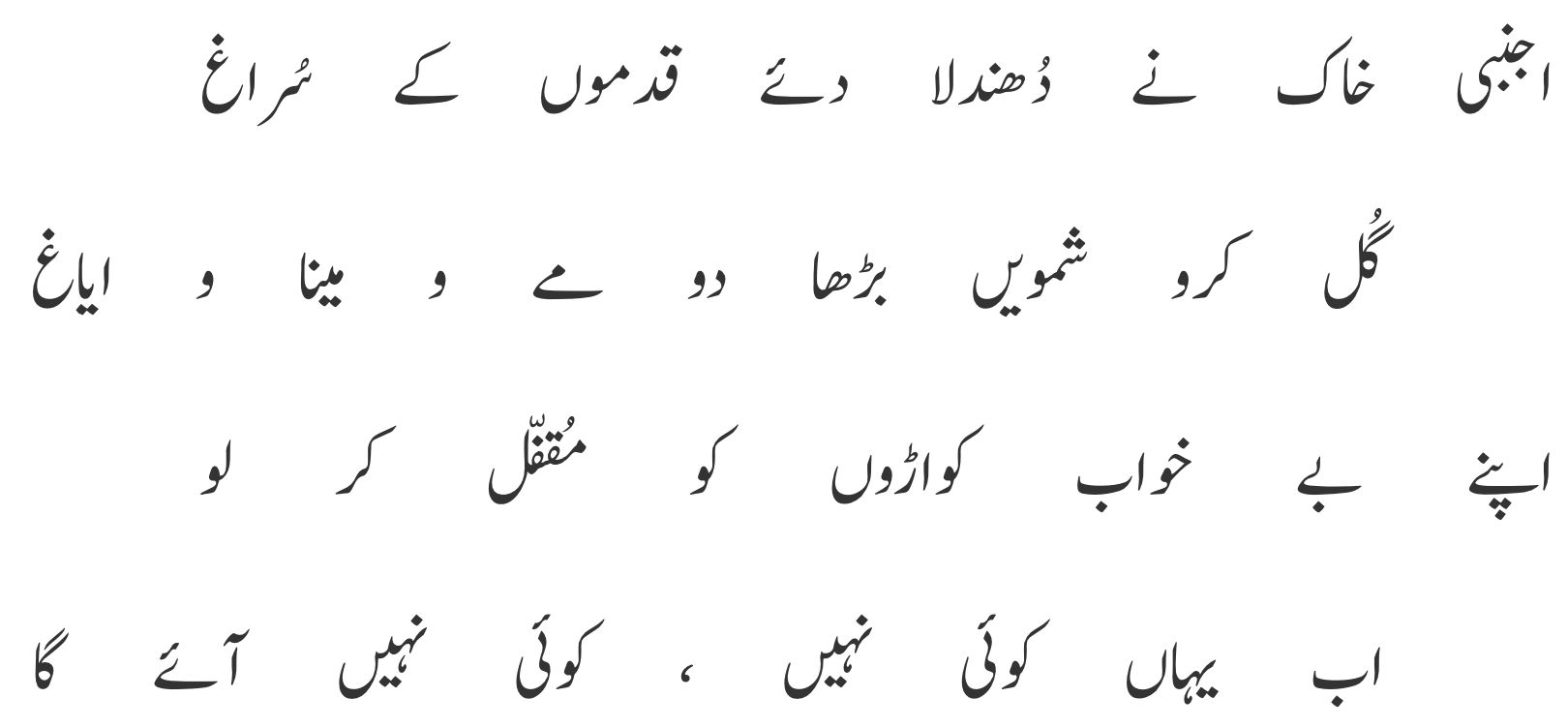
Animals live from day to day with whatever life offers them. They do not seem to look back to their past nor to a dreamy future ahead of them. Man is an exception in the animal kingdom. Seldom is he content with his present. Either he lives lost in the memories of the past or sustains himself with the hope that there are better days to come. Such hopes generally pertain to his economic, political or religious future. It is to his religious hopes that we now turn our gaze.
All major religions promise the advent of a Divine personage who would usher in a new era of hope for mankind and unite them under one Divine flag. This is the promised land which one day they all aspire to reach, govern and command. This is utopia, the meeting point of the hopes of all religions and this too, alas, becomes the parting of their ways. Only the dreams are shared but not their realization. They are unanimous in their belief that one Divine personage will certainly come as the saviour of the human race, but when it comes to his identity they could not disagree more with each other. Will he be Lord Krishna or Jesus Christ? Will he be Zoroaster or Buddha, or Confucius or Lao-tzu for that matter? Each is expecting a different person, under a different name and title; each is expecting him to belong exclusively to their own religious order. It is here that the gates one finds left open for the advent of the saviour begin to be shut again. They are seen shut from the vantage point of those who consider all other religions to be false except their own. The only gate they see open is their own; while their gate, as seen by others, is also shut. All who had joined in the chorus, singing the songs of the advent of a universal Redeemer, begin to sing their separate songs when it comes to his identity. Either he must somehow materialize out of their dreams, or they will accept none other. Alas, the latter is the only fate which they have carved for themselves. Why should God care for their pleasure if they care not for His? Let them create their saviour themselves out of the nothingness of their wild irrational hopes.
It is so intriguing to watch this wrangle on a global scale. After the dust of claims and counterclaims settles down, the only agreement the proponents of different religions reach is to continue to disagree even more vehemently. The Reformer they will accept has to be of their own faith and brand, or none other. Their talk is idle, their hopes are vain, their saviours dwell only in their dreams.
Can the Redeemer, whenever he comes, fulfil the hopes of all religions or will he meet those of only one? To whom will he actually belong, whose aspirations will he fulfil while all will be chanting by the fountain of hope: make them mine, make them mine, make them mine! The question which finally emerges is whether a single person is promised or many, simultaneously. God has no contradiction in Him, hence He will either send one person with a single message, or none at all. What would happen to different warring factions of various religions at such a time, each holding views divergent from the other? It is to this inherent contradiction in their attitudes that we shall now turn our attention.
The way they all envision the realization of their hopes is an impossible task. Take for example the case of the Jewish people, who have long been yearning for the advent of the Christ. For thousands of years they have been striking their heads against the Wailing Wall and still do so, beseeching the Christ to come. Never do they realize that he has come and gone but not in the way they had expected, nor in the manner and style they had assigned to his advent. Thus the gate they thought they had kept open lay practically shut and locked. How tantalizing it must be that the guest one so dearly awaits does not come though one sees no hurdle obstructing his path. In reality, all those who await the coming of any Divine guest are themselves responsible for placing impassable obstructions in his way. But somehow they remain unaware of what they do. If they could only realize that their expectations are impossible to be fulfilled they could at least rest in the sort of peace which follows despondency. The barriers help to relinquish hope and extinguish the flame of expectancy but only if they are recognized. If some people are oblivious to their existence, it is they who are to be blamed for their frustration. The Jewish people, for example, who await the advent of the Christ have not understood this hard, simple reality despite their wisdom. For them there is nothing but to weep and wail beside a wall of stones, beseeching the advent of a Messiah who can never come. For them, none will ever come.
But they are not alone in this inconsistency of being stupid and wise all at once. The case of all other religions who expect an ultimate Redeemer is no different from theirs. The actors are different of course, the acts are played in different garb, yet the drama remains the same. A Christ should have come to the aid of the Jewish people and did come but it was not the same Christ they were awaiting, so they failed to recognize him. They expected him to appear with a crown over his head seated on a royal throne. He would be a warrior Messiah, they believed, who would successfully lead the armies of the Israelites against the despotic rule of the Roman Empire. Two thousand years have passed since their rejection of Jesus(as) as Messiah, yet no Messiah of their expectation has come. History has changed the political geography of the world and the prophecy of the coming of the Christ has lost all relevance. There is no Judea or Palestine under the yoke of a Roman Empire from which the Jewish people are to be liberated. In fact, that Roman Empire which once ruled half of the world has completely disappeared from the map of the world. We still hear of deliverance, but it is a deliverance from the Jews, not of the Jews.
Although there was nothing wrong in their belief that Christ would be born like any other human child to a human mother, yet they attached some supernatural preconditions to his birth which could not have been realized. Their belief about the bodily descent of Elijah(as) before the advent of the Messiah, is just the case in point which effectively blocked the passage of the Messiah they awaited. So the Jewish position, vis-à-vis the advent of a Messiah, in reality turns out to be a denial of his advent altogether.
Turning our gaze from the Jews to the Christians, we find a situation not too dissimilar to the one described above. Imagine a Christ paying a second visit to earth in the grand style envisaged by the Christians who still await his literal second coming. A son of God descending in glory from heaven in a human form is an idea fit only for fiction, yet it serves to keep hope, or shall we say blind faith, alive. Looking at it from the rational vantage point of the non-Christian, the absurdity becomes even more glaring. No non-Christian, be he religious or otherwise, can share this belief because it speaks of an outrageous wedlock between spirit and matter. Yet the Christians see no element of irrationality about it because dogma has blinded them.
The same anomaly of the Jews and the Christians applies to the unreal and supernatural expectations of the followers of all other religions. Even a speck of irrationality in the beliefs of others offends their sense of right and wrong, while they are totally blind to the presence of the same in their own, however preposterous it may be. They could not have failed to detect the squint of their own eyes, if only they had looked at themselves through the eyes of others. Rationality would have helped each of them to realize that the literal revisit to earth by any prophet or so called god is illogical. Never has it taken place at any time, anywhere in the entire history of the world, nor can it ever take place in the future. Never was the founder of any religion sighted to have descended from on high; he always appeared through the normal course of human birth. Invariably, he launched a movement that had to strive hard for its survival against all odds. This is reality; any belief that does not conform to this must be relegated to the realms of fantasy. All such promises for the revival of religion must be rejected which offend rationality and have never before been employed by God in religious history.
The case of the Muslims seems to offer a rather strange exception to this general rule. Yet, on closer examination, one can discern practically no difference in their position and that of the others, except in the sequence. The Muslims begin by claiming that Prophet Muhammad(sa) is the last of all the prophets and his finality is absolute. The term Khatme-Nabuwwat, the finality of prophethood, is unanimously understood by all the mainstream Muslims to mean this. Despite this, they too await the descent of Jesus Christ(as), an old prophet of God. Will his advent not violate the finality of Prophet Muhammad(sa)? This is the most crucial question they must answer. In response to this evident contradiction, they propose that though a new prophet cannot be created, an old prophet can be brought back to fulfil new needs. By this strategy, they seem to have succeeded in keeping the door of prophethood (Nabuwwat) shut and sealed, while manoeuvring to furtively admit Jesus through the back door. The contemporary Muslims, whether they are Sunnites or Shi’ites, seem to share the same interpretation of finality (Khatme-Nabuwwat). All have faith in the re-advent of Jesus(as) as a prophet of God, whilst believing simultaneously in the absolute finality of Prophet Muhammad(sa).
The problem of inherent contradiction in their belief becomes even more pronounced when it comes to the prophesied advent of Al-Imam Al-Mahdi. As an Imam he is to be directly commissioned by God, and as such it should be incumbent upon every Muslim to believe in him. This aspect of his office will be further elaborated later on. It is briefly mentioned here only to emphasize that the office of Al-Imam Al-Mahdi, despite not possessing the title, holds the prerequisites of a prophet all the same. Having said that we must return now to the likelihood of the re-advent of Jesus Christ(as) and the form in which this may take place. The Ahmadiyya belief differs from the mainstream Muslims only in form and not in the act of his re-advent. The question is whether the form will be literal or metaphorical. Will he be the same person, or will another person be born reminiscent of the old one? Will he appear as a Christian prophet turned Muslim, or a Muslim prophet turned into the metaphorical image of Jesus Christ(as)? What will be his relationship to all other religions? These are the intriguing questions which must be fully addressed.
The stance of the Ahmadiyya Muslim Jamaat is singularly rational. In principle it accepts the claims of all religions who promise the advent of a universal Divine Reformer in the latter days. When the Hindus talk of the re-advent of Krishna, their claim has as much right to be accepted as that of the Christians when they speak of the second coming of Jesus Christ(as). Likewise the expectations of Zoroastrians concerning Zoroaster, if they too look forward to his re-advent, or the hopes of the Buddhists or Confucianists that a Buddha or a Confucius would reappear as the Promised Saviour should also be treated with equal respect. But the recognition of the truth of all such diverse and seemingly contradictory claims can only read sense if they are taken metaphorically and not literally. The only rational inference that can be drawn is that the Promised Reformer has to be a single person, embodying the advent of all. Otherwise, the literal fulfilment of all such prophecies is impossible because of the supernatural element intertwined with all of them. This is what the Founder(as) of the Ahmadiyya Jamaat put across to the people of the world with incontrovertible logic. The promise of the simultaneous advent of so many reformers could only be metaphorical and not corporeal. It was exactly in this sense that he claimed to have fulfilled the advent of Jesus(as) and the Mahdi as one person and also the advents of all others like Buddha(as), Krishna(as) and other promised reformers awaited anywhere on earth.
Leaving for a while the reaction this claim created among others, we begin with the account of the turmoil it created within the orthodoxy in Islam. They were not concerned with the re-advent of Buddha or Krishna or others in whom they did not believe but they were deeply concerned with Jesus(as), the prophet to the House of Israel. For anyone to claim to be the reborn image of Jesus(as) was far too much for them to digest. For the Jesus(as) of their dreams to be declared physically dead was an enormity absolute. For his likeness to be born among them was nauseatingly repulsive to the Muslims.
It should be remembered that prior to his above mentioned claim, the fame of Mirza Ghulam Ahmad(as) had spread far and wide in British India because of his book Barahin-e-Ahmadiyya. Paying tribute to the author of this book, Maulawi Muhammad Hussain Batalvi, a renowned Muslim scholar of the Ahle-Hadith sect, has introduced the author of this book to be the best defender of Islam, since the demise of Prophet Muhammad(sa).1 However in the midst of this popularity, when he suddenly pronounced Jesus(as), the prophet of Israel, to be dead instead of being alive in heaven, the position changed dramatically. The same scholars who had praised him with hyperbolical tributes changed their attitude diametrically. What was he as compared to their Lord Jesus Christ, the would-be Saviour of the world? Overnight his fame plummeted to earth from the celestial heights it had occupied. The image of Jesus had to be tossed back to heaven aloft; he who claimed to have come in his likeness should have been killed instead. The commotion stirred by Mirza Ghulam Ahmad(as) of Qadian was such as the like of which had never been seen before in the religious history of India. Against him, a pandemonium of abuse and vilification broke loose. The rising star of Muslim India, the most sought for leader of Islam, became the most hunted person, no longer deemed fit even to be called an ordinary Muslim. But it completely failed to cower him. Nothing could deter him from carrying forward the Divine task bestowed upon him.
The Christians did not lag far behind either in their hostile reaction. They left no stone unturned to destroy him and demolish his mission. Even fake charges of murder were pressed against him in the British Indian courts of law. But he remained completely unruffled, not in the least bit intimidated.
As though that was not enough, he further pronounced himself a manifestation of Krishna(as), the great Indian prophet who was idolized and worshipped as god incarnate. He personally antagonized the Arya Samaj, the most active and redoubtable sect of the Hindus, by launching a counteroffensive against their ferocious attacks on Islam and the Holy Prophet(sa). He also invited their leaders to a spiritual duel with devastating effect upon those who accepted it. In short, he claimed that all the prophecies relating to the Reformers of the latter days were applicable to only one person. Different names and titles mentioned in different scriptures were of no significance. All that was significant was that the Reformer, whoever he may be, must be commissioned by God as the universal Reformer of the latter days. To those who were prisoners of prejudice, he and his claims meant nothing and it was largely by them that he was rejected with unyielding antagonism. He was rejected like all the servants of God before him and was most certainly supported by God as He has always supported His servants.
It is amazing how people keep forgetting that all prophets of God are treated alike by Him. They too show no difference in their complete submission to Him. Likewise, the universal Promised Reformer will belong exclusively to Him and not to the various religious denominations who expect him to support their distorted beliefs. He will represent God, not those who no longer represent Him. He will only belong to all His servants but not to the self-styled masters of His servants.
The Unity of God and the institution of prophethood from among humans are the two fundamentals which belong to every religion. Names and titles differ but they matter not. What matters is for the claimant to be from God. Mirza Ghulam Ahmad(as) never claimed that he had become different persons with different names and titles moulded into one. But most clergy feigned to misunderstand him in this regard and incited the ignorant masses to jeer and mock him telling them that he claimed to be all the promised prophets kneaded into one person. The masses were rudely shocked. How could a Krishna, a Jesus, a Mahdi and a Buddha all become a single person? ‘The claimant has to be mad,’ some shouted in scorn. The treatment meted out to him is reminiscent of the same treatment meted out to the Holy Founder(sa) of lslam when he claimed the uncompromising Unity of God. The idolatrous priesthood wilfully distorted his message and made the people believe that he had forged all their gods into a single one whom he styled as Allah.
‘What! Has he made all the gods into one God? This is indeed an astounding thing.’2
It should not be difficult for an unbiased investigator to see the wisdom of Mirza Ghulam Ahmad(as) during all his disputations with his opponents. His position was always that of a rational person. Were it not so he could easily be proved wrong in most of his beliefs and contentions by the same instrument of rationality.
If he were wrong each religion would be visited by a separate reformer holding a different name, title and ideology. This would open a Pandora’s box of claims and counterclaims which once opened could never be shut again. Each claimant would proclaim himself to be the only true manifestation of the Promised Reformer. Each would invite all of mankind to himself as the only hope of their salvation. Each would declare all rivals to be mere hoaxes and impostors. The utter madness of this scenario is self evident. No man with any element of sanity can believe in a God who would split humans into hundreds of conflicting schisms and factions in His own name, with His own authority.
What manner of God would it be who would make Jesus descend among the Christians, issuing a call or the conquest of the entire world in the name of the Trinity—God the Father, God the Son, and the Holy Ghost? Having done that, He would hasten to incarnate Himself in the form of Lord Krishna upon Indian soil, assuring the Indian people that He is neither one, nor two, nor three, He is a multitudinous god whose persons and manifestations are hard to count. He is to be worshipped as trees, as snakes, as scorpions, as elephants and as the deafening thunderstorms. He is to be worshipped as a moon gliding in the stillness of the night. It is He who is also the sun and a countless number of stars in the heavens. On the earth He can clearly be recognised as the cows, the monkeys, the bears, the hyenas, the tigers, the horses, the donkeys, and limitless forms of other animals dwelling in the sea, on land and in the air. He is also to be worshipped as ghosts and other ghostly forms of human fantasy. ‘Run towards me’, He would claim, ‘and worship us’.
Before His voice is drowned in the tumult of chantings: ‘O Lord Krishna, hare-Ram, hare-Ram, we worship you one and all’, another voice would be heard gradually rising in crescendo as the voice of the Buddha. It would loudly reject the existence of all such godly figures as Lord Krishna had claimed. He would scorn at the very idea of the existence of God: ‘I am Buddha’, he would shout at the top of his voice. ‘I am no God, neither is there any God besides me. I am only the consummation of human wisdom. That is all you need to know on earth. Let us deny all gods together and celebrate our deliverance from the shackles of this human myth. I have come again to deliver you from God as I always did after every millennium, and there is none other besides me who can guide you as I can’.
Before he sinks into an all-pervasive silence and retreats into his inner void of eternal nothingness, another voice would rise loud and clear from the neighbouring country of Iran. It would be that of Ahura Mazda, the god of light, speaking through the mouth of Zoroaster. ‘The voice you just heard’, he would pronounce, ‘O children of Bharat and Tibet and China, must have been the voice of Ahraman—the god of darkness, the only god besides me. It had to be he, because there is none other except he and I. Listen carefully O children of Adam: God is neither one nor three, nor four or five. It is a folly to believe in any number of multiple gods. We are neither one nor many, we are just two and the rest is fiction. There is me—the god of goodness, and he—the god of evil, whose voice you just heard impersonating Buddha. He is the god of darkness, while I am that of light. He always denies me, he always rejects me. He always dissuades my servants from worshipping me. He informs mankind that there is none worthy of worship other than man himself. He occupies the seat of each man’s ego and in the name of that ego runs away with all the homage paid to it. Still god he is, I must admit, dark as the darkest night he may be. So bear with him, yet beware of him and worship only me’.
In the midst of the tumult created by the warring religious factions mentioned above, the world of Islam will also be stirred to action with the advent of the Mahdi. He will come brandishing his sword, if he is really as bloody as many of the mainstream clergy believe. He will issue the call for a Holy War fighting all the non-Islamic governments of the world.
In this paroxysm of religious madness, religion itself would become the ultimate target. Sanity would take flight from this arena of imbecility, beseeching God to rescue religion from the hands of its rescuers. Without urgent remedial measures by Him, the Hindu, the Christian, the Buddhist, the Zoroastrian, the Jew and the Muslim will all suffer alike.
No man with common sense would hold a brief for such senseless and irrational understanding of God’s designs. Rationality and common sense must be granted their due role in the interpretation of religious prophecies and parables. The golden age of the ultimate unification of man could only be consummated if a single Reformer appeared in the name of God, in a single religion of His choice. This, the only rational solution of the problems confronting the religious world of the latter days, has been firmly rejected by the very people who needed it for their survival. They continue to cling, instead, to their empty vision of a golden age which is nothing but a mirage.
The above scenario is a genuine attempt to explain the self-contradictory position of each religion regarding the role it will play in the ultimate redemption of mankind. They open the doors of hope and shut them themselves. The case of the Muslims is only opposite in sequence. They begin to shut the doors by pronouncing the absolute finality of the Holy Prophet(sa) and no sooner have they done so than they begin to open them again. In reality, however, their stance remains unchanged. Hence the drama played on the Muslim stage is essentially no different from the one played on the stages of other world religions. Despite declaring the total uncompromising finality of the Holy Prophet(sa) they cling no less eagerly to the figure of Prophet Jesus(as). They claim that he will certainly come after the Holy Prophet(sa) yet the manner they assign to his coming makes his coming impossible. Thus, for all practical purposes their position remains unaltered.
The finality of any prophet can be observed with reference to his message as well as with reference to his status. It is possible for a prophet to be final in his message and his status, yet it is also possible for another lesser prophet to come after him without violating his finality. It is this aspect of prophethood that we are going to thoroughly examine now.
The belief in the finality of the Quranic law and in the finality of the Propher to whom this law was revealed, is unanimously held by all Muslims. The Quran—a complete code of life—claims for itself a promise of eternal Divine protection from interpolation by human hands. If this claim is right, as the Muslims believe and demonstrate it to be, the bearer of such a book must be accepted as the last law bearing prophet. This is clearly understandable and is so endorsed by the entire world of Islam without exception. But from the non-Muslim vantage point, it is difficult to comprehend how any Book could fulfil the needs of all ages and defy the requirements for change during the times to come. Add to this the Quranic claim of universality and the problem will increase manifold. How can it be logically explained that any Divine Book could satisfactorily address the ethnic and parochial problems of all mankind alike? There are Europeans, Americans, Africans, Arabs, Russians, Israelis, and numerous people of Asian origin with different ethnic backgrounds and inherited cultures. Their political and social traditions also differ so widely that it is difficult to visualize how a single universal code of religious law could satisfy them with equal justice.
In answer to both these questions, the Quran claims that all its teachings are founded on the human psyche which is common to mankind and unchangeable in relation to time. Any teaching which perfectly corresponds to the human psyche becomes unchangeable. It is this principle that the Quran alludes to when it says:
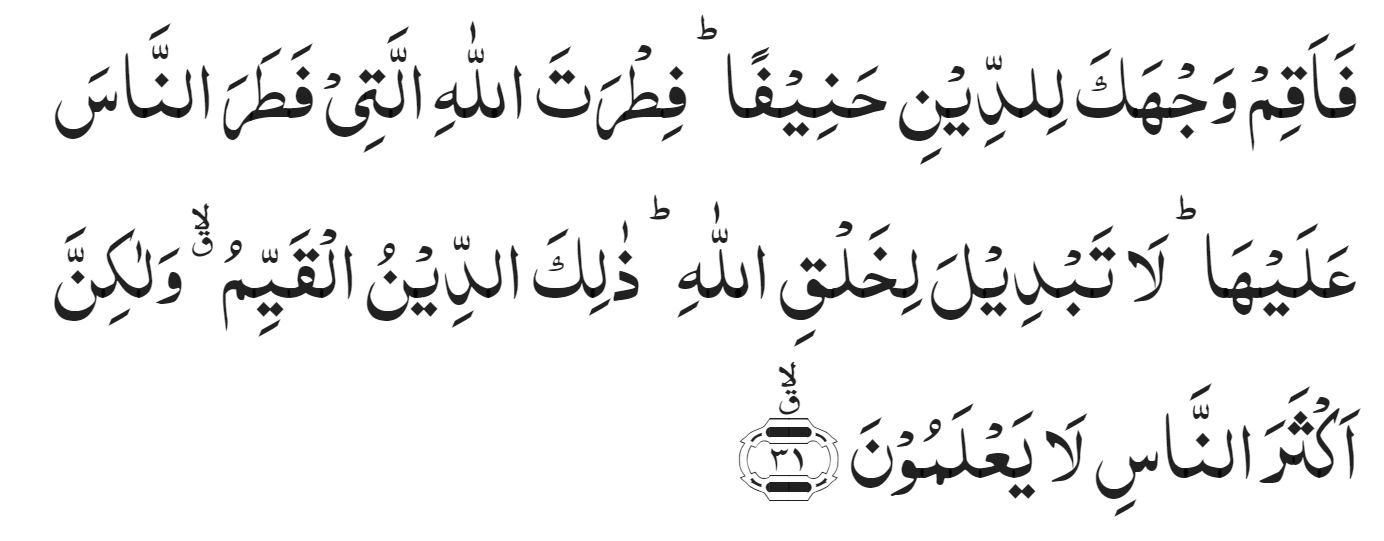
So set thy face to the service of religion as one devoted to God. And follow the nature made by Allah—the nature in which He has created mankind. There is no altering the creation of God. That is the right religion. But most men know not.3
Indeed the nature created by God cannot be altered. Even the atheist must concede that human nature has remained universally unaltered since time immemorial. But a Book of Law corresponding to this unalterable nature can itself be changed all the same by the interference of humans. The Quran takes care of this danger by declaring it is a well-protected book.

Verily, it is We Who have sent down this Exhortation, and most surely We are its Guardian.4
History has proved this claim to be right. Hence the Prophet(sa) who was bestowed this Book has to be accepted as the last law-bearer. Nothing in this claim is irrational, but when it is suggested that even non-law-bearing prophets cannot come, the jurisdiction of finality is overextended without any rational justification. No sooner have they made this claim of absolute finality than they venture to demolish it themselves. The cracks begin to appear the moment they hasten to exempt Jesus(as) from this all pervasive law of finality.
When confronted with this dilemma, they dismiss it with a mere wave of their hand as though it were no dilemma at all.
The reappearance of Jesus(as) as a prophet after Prophet Muhammad(sa) they argue, does not contradict his absolute finality on the following counts:
Jesus would be brought back from a stock of prophets who had already been commissioned before the advent of Prophet Muhammad(sa). Thus his finality will not be violated. It can only be violated if a prophet is raised after his advent even if that prophet brings no new law and is selected by God from within his own Ummah (people).
Jesus’ prophethood would be the one granted to him during his advent prior to Islam.
Moreover because during his second advent he would be subordinated to the Holy Prophet(sa), he would no longer be held as independent.
Hence by being an older prophet and by becoming subordinated, he would not violate the seal of prophethood. As such, their concept of finality only means that new prophets cannot be commissioned while old prophets can be brought back; but this is sheer absurdity. What manner of an All-Wise God would He be who would pass the verdict of absolute finality in favour of anyone despite His knowledge that a prophet would certainly be needed after him? The question of old or new is irrelevant. Central to the issue is the question of need.
The need for another prophet after the advent of the last is an intrinsically contradictory belief. Faced with this dilemma the Ulema always twist the issue by arguing that the need for the advent of a prophet may occur after the final prophet had come and gone. Yet, the absoluteness of his finality would remain intact as long as the new need is fulfilled by an old prophet. But anyone should be able to see through this transparent effort at cheating. The difference of old or new is just a childish attempt to confuse the issue. If Jesus(as) of Nazareth reappears and submits to the supremacy of Prophet Muhammad(sa), he would still be a prophet after him. To fulfil the new need by borrowing an old prophet from a bygone people is far worse than fulfilling the same need by raising a new prophet from within the people of Islam. If the former does not violate the Doctrine of Finality the latter most certainly cannot.
We may now be permitted to deviate from the issue of Jesus’(as) re-advent, but only for a while, to turn our gaze upon the status of Al-Imam Al-Mahdi.
According to the prophecies of the Holy Prophet(sa), Jesus(as) does not seem to be the only one whose appearance is predicted in the latter days. One finds the repeated mention of another Divine Reformer, under the title of Al-Mahdi, which means ‘The Guided One’. Most traditions speak of Isa(as) (Jesus) and Al-Mahdi (the Guided Imam) as two different persons. But there is one prominent exception. Ibn-e-Majah—one of the six authentic books of tradition—creates a strong impression that the two Promised Reformers would in fact be one person, only holding two different titles. The exact words of the tradition run as follows:
There would be no Mahdi other than Isa (Jesus).
This can only mean that the promised Mahdi himself is referred to as Jesus(as). However, Al-Mahdi is to be born within the Ummah, according to most traditions. How then, could he be the person of Jesus(as) if Jesus(as) is to descend from heaven after him? This can only happen if Jesus is a mere title which Al-Mahdi would possess together with his own so that no separate Jesus would descend from the heavens. His role will be performed by Al-Mahdi instead. It ensues that the prophet Jesus(as) would be born metaphorically, as Al-Imam Al-Mahdi within Islam. This leads us to the issue of determining the real status of Al-Mahdi. As will be shown presently, his status has to be that of a non-law-bearing subordinate prophet though the mainstream Ulema do not refer to him as such. In the case of Jesus(as), they can freely refer to him as a prophet because of the reasons mentioned above; but in the case of Al-Mahdi they cannot do so lest this admission should clearly clash with their Doctrine of Finality.
Their strategy regarding the Mahdi is completely different. For them, he will remain an uncrowned prophet to whom all attributes of a prophet are freely granted except for the title. It is like defining a man without calling him one, while calling him by any other name would not make him less than a man. The Ulema must realize that the status of Al-Mahdi must be determined by virtue of his attributes. His entitlement to the status of a prophet cannot be denied him as long as he functions as one. If the prerequisites of a prophet are combined in any person, then call him by whatever title you may, a prophet he would always remain. A denial of him, while he will be directly commissioned by God, will be tantamount to a denial of God. As such, whoever refuses to believe in Al-Mahdi as a subordinate prophet will lose his right to be counted among the true believers. Belief in him will be incumbent upon every Muslim, as admitted even by the orthodoxy. Thus he would enjoy a prerogative which is shared only by a prophet and by no one less than a prophet. The act of not granting Al-Mahdi the status he is entitled to enjoy can in no way deprive him of that right. The inconsistency in their beliefs will by no means become less glaring.
In Islam, the status of a prophet is the highest a man is granted. A prophet is not just a person who prophesies, he is the one who is specifically commissioned as such by God. All reformers are not essentially prophets but all prophets are essentially reformers. Revelation by itself does make one a prophet. Even non-prophets can be granted revelation and be blessed by communion with Him.
Revelation has a much wider field of application with many connotations such as dreams, visions, inspirations and even verbal addresses. As such it has never been denied by most scholars even in the medieval ages. The controversy only arose in relation to the institution of prophethood and it is this particular aspect of revelation that is being presently examined.
One can easily understand the wisdom behind the discontinuity of law-bearing prophets in the light of the foregoing discussion. The question which must be examined at length is, why should non-law-bearing prophets also be discontinued and why should the institution of prophethood in its entirety be brought to an abrupt end?
The history of religion proves beyond a shadow of doubt that it has never been essential for every prophet to bring a new law. There are many among them like Isaac(as), Jacob(as), Joseph(as), Lot(as) and Isaiah(as), who did not bring any new law. However, they shared with the prophets before them the distinction of having been commissioned by God as Divinely appointed spiritual leaders.
Two major attempts have been made by Muslim theologians and thinkers to logically justify the cessation of even non-law-bearing prophets. The first relates to the issue of the need for a new teacher. The advent of a perfect teacher and a perfect book, it is argued, obviates the need of any other teacher to follow. Of course, if it can be proved that the presence of a perfect book and the appearance of a perfect teacher are sufficient guarantees against any future moral or spiritual decline, then there is no reason why, after this, another prophet should ever be raised again. Regrettably however, this proposition can neither be proved correct theoretically nor historically.
This contention is insupportable because the bringing of a book of law is not the only function performed by prophets. Prophethood is a thing of many splendours. After the death of a law-bearing prophet, the mere preservation of his book and his traditions cannot offer a sufficient substitute for prophethood itself. The case in point becomes amply clear when we examine the conduct of Muslims after the demise of the Holy Prophet(sa). The progressive deterioration of Muslim society should be sufficient to prove this point. The difference between their moral status during the lifetime of the Holy Prophet(sa) and that of Muslims today defies comparison. The Book however remains the same perfect, unaltered, un-interpolated Book that it was fourteen hundred years ago.
The second justification in support of the Doctrine of Absolute Finality relates to the idea of the intellectual maturity of man. The chief proponent of this view is no less a person than ‘Allamah Iqbal claimed by some to be the greatest Muslim thinker of modem times. This doctrine of maturity is based on the assumption that the Holy Quran was revealed at a time when man had finally reached the ultimate stage of his mental and intellectual maturity. As such, he stood in no further need of day-to-day guidance by any Divine personage as did his ancestors of earlier ages. A beautiful philosophy but how hollow and empty of substance it turns out to be under closer scrutiny. The very premise that man has matured enough to be able to draw his own conclusions and chart his own course of conduct from the principle teachings of a perfect religion is challengeable on many counts.
It should not be forgotten that at every stage of man’s progress, he always considered himself to be at the summit of intellectual maturity. At every point in history, the generation which occupied it also considered itself to be at the pinnacle of human progress. Looking back from their vantage point, all previous generations must have appeared less mature and less advanced by comparison. Yet at no stage in the past has man behaved wisely enough to guide himself. Heads such as that of the Pharaoh’s were always raised in defiance of Divine guidance. All such rebels rejected the prophets of their time with the same inflated ideas of their own importance. All repeated the same claim over and over again that they had matured to take care of their own affairs. Nonetheless, history proves each of them to be wrong. It is so naive therefore, to consider the contemporary age as the only one in which man has finally become self-sufficient in every aspect of his moral and spiritual requirements.
As far as the concept of maturity is concerned, it is also falsified by the realities of history. After the passing away of prophets the division and multiplication of religious sects, based on doctrinal differences and varying interpretations, is a universal trend that has not spared the followers of any religion including Islam. Hence, it is not simply his intellectual maturity which helps man to draw right conclusions from the scriptures, he must also be Divinely guided.
If ‘maturity of man’ is taken to mean that he becomes independent in drawing his conclusions from the study of scriptures, then there must ensue a perfect unity of agreement on all the fundamental aspects of religious teachings. Alas, what we observe in real life fails miserably to support this view. Muslims, the proud recipients of the last perfect Book, are no less divided among themselves in the matter of interpretation than are the peoples of all other religions. To what avail therefore, is the so-called maturity of man? The history of religion proves that people once split into sects and schisms have never been reunified by human effort alone. The same inevitably applies to the Muslims today. Without the agency of a Divine Reformer, they cannot be assembled again under the single flag of Unity. But they have outrightly rejected this Divine measure, the only avenue of hope left open to them.
The existence of about seventy-two doctrinal divisions among them, despite a well-preserved book and a well-documented record of traditions, throws a dismal light on the Iqbalian philosophy of the maturity of man.
Their differences are not merely marginal. They are fundamental and deep-rooted, further multiplying and proliferating as time goes by. Add to this the moral destitution prevailing in the Muslim world and the tragedy of their lifeless existence becomes all the more pathetic. Commit their survival to the maturity of their intellect and perform ablution for their funeral rites, ‘ashes to ashes, dust to dust and earth to earth—Amen!’
What misery! Why can modem intellectuals not understand that the purification of a religious society is a task which the mere existence of a Perfect Book cannot perform? Were it so, the followers of Islam must have retained an exemplary state of ideological unity. This unfortunately is farthest from the truth.
All that can be said here in defence of the late Dr ‘Allamah Sir Muhammad Iqbal is that the idea of blocking the passage of Heavenly light with this balderdash did not originate from him. His mistake was to copy, rather blindly one must say, the great German philosopher Nietzsche. It was Nietzsche who had first employed the idea of the maturity of human mind in the modem age against any need of guidance from God. In fact, Nietzsche coaxed man to come to age and utilize his own faculties of five senses. Overman, or superman, is Nietzsche’s term for a man who reaches a stage of maturity where his senses are developed to the full. Such a man needs no God to guide him—a God which according to him is no more than a conjecture. Such conjectures were born out of an imperfect faculty of reasoning during an age when man had not yet matured enough to become his own master. Now that man had attained maturity, he concluded in his book Thus spoke Zarathustra6—the symbolic oracle of the wisdom of Nietzsche that there was no more need for holding onto conjectures.
‘Once one said God when one looked upon distant seas; but now I have taught you to say: overman (superman).
‘God is a conjecture; but I desire that your conjectures should not reach beyond your creative will.’7
‘Could you think a god? But this is what the will to truth should mean to you: that everything be changed into what is thinkable for man, visible for man, feelable by man. You should think through your own senses to their consequences.’8
‘God is a conjecture; but who could drain all the agony of this conjecture without dying?’9
The long and short of Thus spoke Zarathustra is a rebellion of Nietzsche against a conjectural god which in fact is the Christian idea of God, and to understand Zarathustra clearly as to why he rebelled against God, one must read the chapter Retired.10 But for our purpose it should be sufficient to note that the oracle of Nietzsche’s wisdom sets man free from being guided from on high. The maturity of his faculties is sufficient to guide him.
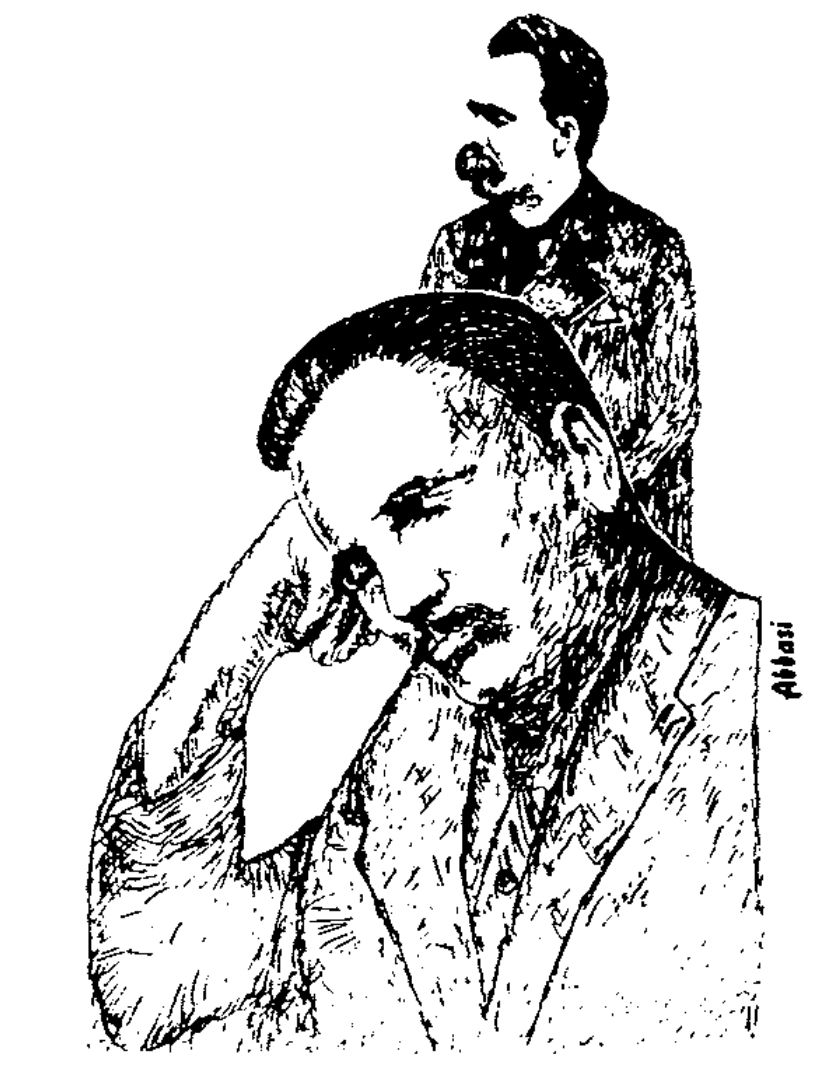
This exactly is the Iqbalian philosophy against the need of a prophet after man has matured to the maximum of his faculties. Instead of employing this borrowed philosophy for a categorical rejection of the need for God, ‘Allamah Iqbal neatly trimmed the maturity concept to suit his own purpose within the framework of Islam. He conceded that though man stands in need of a Perfect Master and a Perfect Book, once this objective is accomplished he requires no more to be badgered with any further interference from on high. But that is not all there is to it. The doctrine of maturity, as amended by Iqbal, does not merely do away with the need of prophethood, it does away altogether with the need for any communication from God even in the form of non-prophetic revelations. This has to be the only logical conclusion drawn from his doctrine of maturity. The maturity concept requires total independence of man from further Divine guidance in any form. He has become capable of taking all-important decisions for himself in the light of the guidance already vouchsafed to him. Man, Iqbal argued, is no longer a child to be walked with his little finger held in a prophet’s hand. Has he not matured to full adulthood, to shift for himself? A sound healthy logic it seems, but just one glance at the spiritual decadence and utter moral destitution of man today is sufficient to dispel this argument as entirely fallacious and conjectural.
Enough of Iqbal and his postulations. Let us now turn to Maudoodi, another renowned scholar of the mainstream Sunni Muslims. He pleads that the absolute cessation of prophethood after Prophet Muhammad(sa) has been a singular blessing of God upon mankind. It is a boon, especially for the Muslims, because it spares them the risk of rejecting a Divine messenger of God ever again. They are shielded from ever being accursed by God, as others before them were cursed, for committing the crime of rejecting the prophets of their time. Such a view deserves to be treated more by way of a joke rather than a legitimate argument.
Maudoodi’s philosophy, if accepted, would imply that the very institution of prophethood is a curse indeed otherwise its cessation could not have been claimed to be a blessing. This appears to be more in line with the thinking of St. Paul, who branded the law of the Torah as a curse and believed Jesus to be the redeemer because he did away with that law. If there were no law to be broken, argued St. Paul, there would be no sin to be committed.
The aery Maudoodi philosophy however, does not seem to originate from St. Paul alone. It also resurrects the image of Bahaullah. What the Messiah had done by rejecting the law of the Torah, according to St. Paul, Bahaullah claimed to have done to the Quranic law. Thus he pronounced himself to be the liberator of mankind from the bondage of the Quran. Nonetheless he did not imitate St. Paul entirely because St. Paul had never claimed a role of God personified for himself. He assigned this role of godhead entirely to Jesus. Jesus to him, was in fact a liberator who had undone the blunder committed by ‘God the Father’ against mankind. The very promulgation of Divine law was tantamount to the creation of sin. Hence, by cancelling the Divine law, what Jesus actually achieved was to have destroyed the very soil from which sin sprouted. By the same act of redeeming mankind he appears to have simultaneously redeemed ‘God the father’ from the folly of creating sin.
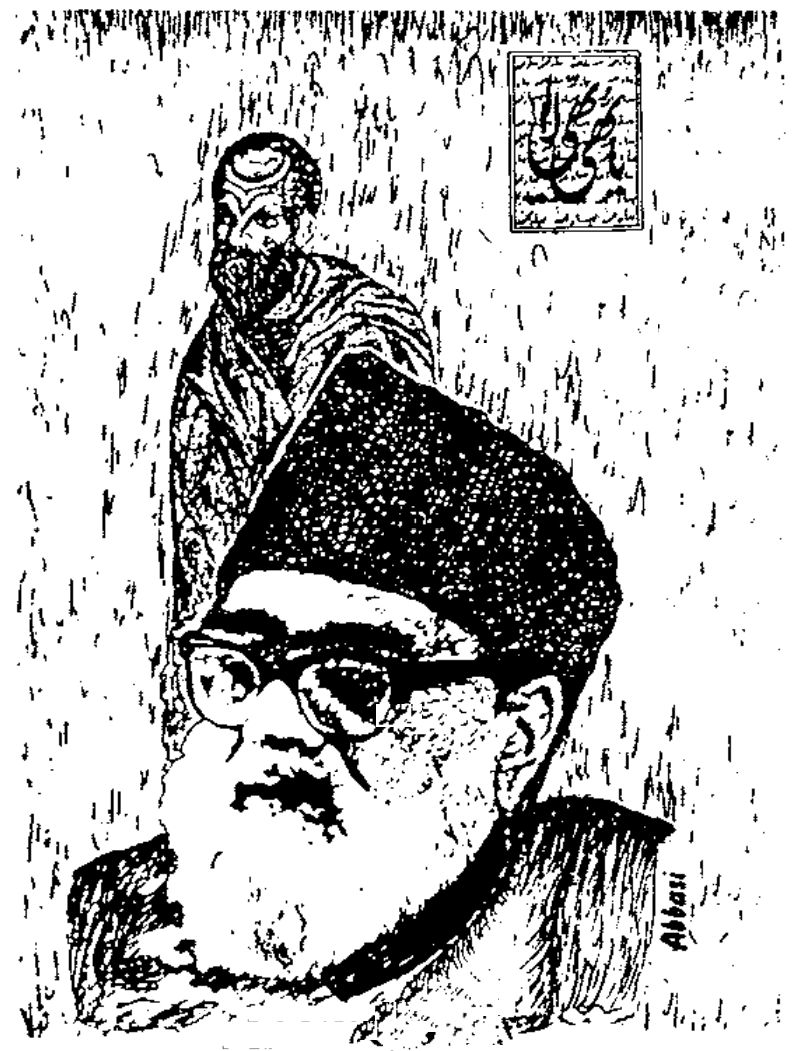
Bahaullah applied this philosophy only partially and argued that the Quranic law being too heavy and cumbersome had lost its relevance to the people of the modern age. So by liberating mankind from this exacting ‘burden’ he feigned to set them free, but not entirely so. He betook for himself the role of a new ‘Law-maker’, after cancelling the previous Law. But in the final analysis Bahaullah succeeded only in making a mockery of God and himself. The shariah that Bahaullah dictated to replace the law of the Quran was no more and no less than a blatant affront to common sense, reason and rationality.
Between these two modem day disciples of St. Paul, i.e. Bahaullah and Maudoodi, nothing seems to have been left of the religion of Islam. As for the Quranic law, Bahaullah claimed to have done away with it in the name of emancipation. As for the institution of prophethood, Maudoodi ventured to abolish it by virtue of the same Pauline philosophy. Both failed to achieve their objectives in the sight of God. Both were applauded as great heroes in the sight of men who were already spiritually diseased.
But Maudoodi did not follow St. Paul entirely. He did not go as far as to suggest that the Quranic law should be annulled by God, lest the people should incur His wrath by failing to abide by it. He only applied the Pauline principle to the institution of prophethood. Even if non-law-bearing prophets are raised after the Holy Founder(sa) of Islam, they are likely to be rejected by the majority of Muslims as prophets have been rejected before them. Thus according to Maudoodi’s logic, the threat of the curse would keep hanging over their heads like the sword of Damocles. In Maudoodi’s estimation by altogether doing away with the institution of prophethood after the Holy Prophet Muhammad(sa), God has bestowed untold blessings upon mankind, particularly upon the Muslims.
If the institution of prophethood is finally brought to a close, lest people should be cursed, it is tantamount to pronouncing prophethood itself to be a curse. Thus, the neo-Pauline philosophy of Maudoodi would require God to do away with the curse of prophethood altogether. What deliverance! What redemption! Good riddance is the other name for it!
But it should be clearly understood that this logic is applicable as much to the past as it is to the future. Why was Jesus(as) sent by God before the Holy Prophet(sa)? Does not the Holy Quran categorically denounce the Jewish people as accursed for the crime of denying him? And what happened to earlier peoples? Did they not defy the Divine messengers sent to them and mock and ridicule them? A sad reflection on human arrogance indeed! Thus declares the Holy Quran:
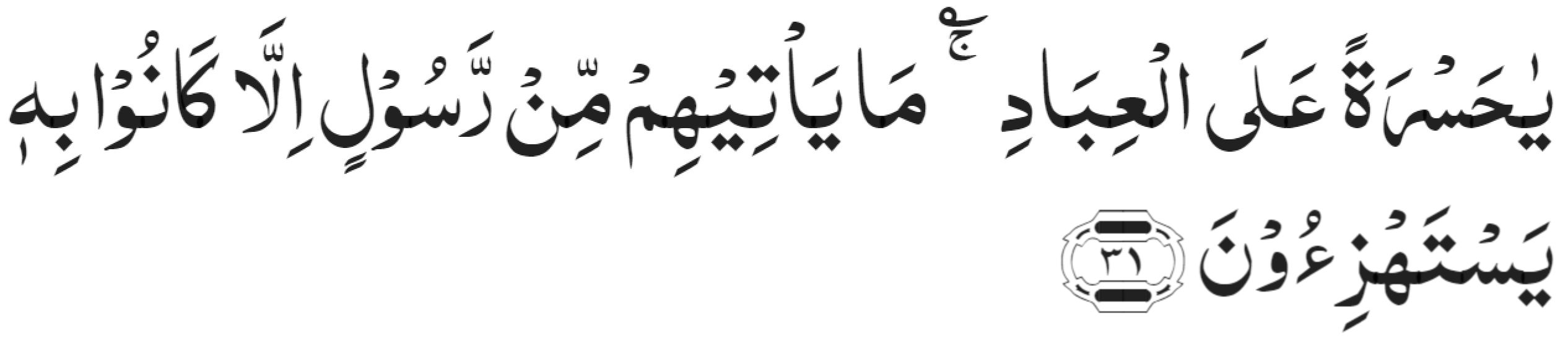
Woe to mankind. Never does a prophet come to them, but they scorn him and ridicule him!11
It is amazing why God did not think of bringing this curse to an end earlier in time. What happened to the Jewish people throughout the long history of their encounters with the prophets? Were they not cursed at the tongue of David(as)? What happened to the people of the Book between the time of Moses(as) and Jesus Christ(as)?
Was this universal human trend of treating all messengers of God inhumanly not sufficient to make God realize that prophethood was more of a curse than a blessing? Why was Noah(as) sent and why Abraham(as) and why Lot(as)? Did their rejection not cause the wrath of Allah to befall upon their people? But for some insignificant few, were they not obliterated from the face of the earth? Still, the idea that struck Maudoodi did not strike God. Was it because it was Maudoodi’s mind which had fabricated this myth of a god? Such infirmity of judgement behoves only a brainchild of his. God kept sending prophet after prophet but arrogant man continued to reject them, one after the other. The curse they thus earned cannot be blamed on the office of prophethood, they themselves are to blame.
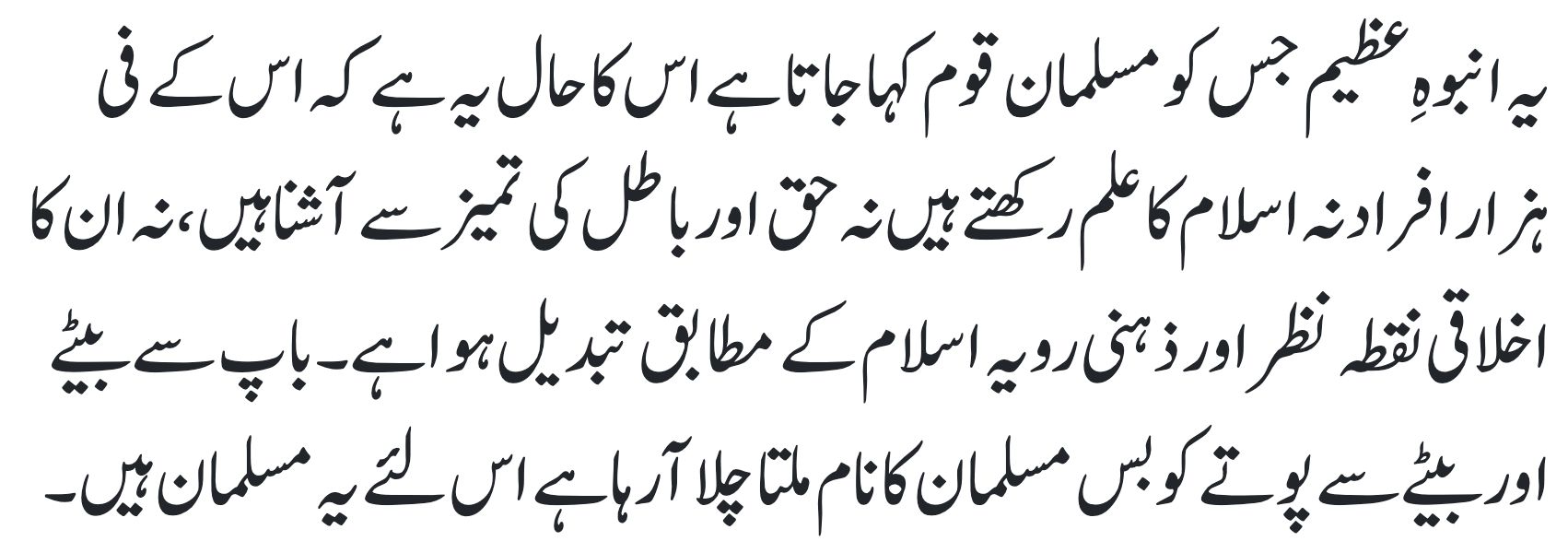
Again, if this argument is accepted as valid at any particular point in time, it must also be accepted as valid at all times since the advent of Adam(as). The fear of rejection of Adam(as) by his people, who would thus incur upon themselves the wrath of God, should have been enough justification for God never to have sent Adam(as) at all. If the fear that people should reject a lesser prophet from among the followers of Hazrat Muhammad(sa) is a legitimate reason for the cessation of prophethood altogether, then the same fear should have stood in the way of the advent of the Holy Founder(sa) of Islam even more powerfully. Is he not the best among all the prophets? Of course he is—as the entire world of Islam testifies. Being supreme among them, for him to be rejected was to earn the worst curse of God ever inflicted. Alas Maudoodi seems to have completely forgotten that not only was the Holy Prophet(sa) rejected by most of the world’s population of his time, but also his truth is still denied by three-fourths of mankind today. At best, it is just one-fourth of the human population which can be described as believers in the Holy Prophet(sa). But can they really be defined as Muslims? Is their faith in the Holy Founder(sa) of Islam genuine enough to include them among those who really believe? Maudoodi thinks otherwise. Out of the one billion population of the Muslims, nine hundred and ninety-nine in every one thousand are already condemned by him to be virtually non-Muslims:
‘This huge hotch potch body of the so-called Muslims is such as nine hundred and ninety nine out of every one thousand have no knowledge of Islam whatsoever. They are incapable of distinguishing right from wrong. Nor have their moral and mental attitudes been in the least Islamicised. From father to son, from grandfather to grandson, they have only inherited a Muslim name and no more.’
From Maudoodi’s account of the scheme of things, God had better not send any Divine book or messenger lest His poor creatures should be cursed forever.
Yet Maudoodi believes in the justification of God sending all His prophets since the time of Adam(as) to the time of the best among them. If their rejection brought a curse from God on those who rejected them, what exceptional harm would it do if one more like them is added to the list. But the paradox in Maudoodi becomes more of an eyesore when he is discovered to believe in the re-advent of Jesus Christ(as) as a prophet of God.
If instead of the old Jesus(as), a new non-law-bearing prophet was to be raised from among the people of Islam, how could he in any way alter this eternal grand plan of cursedness? Why should only his advent be objectionable while all those before him since the time of Adam(as) served the same Divine decree of a perpetual curse?
The belief that the last prophet, Muhammad(sa), has already come and gone and the assertion that Jesus(as) would descend to earth as a prophet after him are so inconsistent that they cannot be owned simultaneously. In fact this cocktail of two unrelated issues was made by some Ulema of the late medieval times. At the time of the revelation of the Holy Quran any connection between the two was unthinkable.
For the sake of the unfamiliar non-Muslim reader we need to explain the historical background of this issue lest they should fail to understand what the row is all about. The verse  (Khatamun-Nabiyyeen) is one of the most fundamental verses of the Quran which is profoundly rich in meaning and contains many possible connotations. But none of its connotations can even remotely be related to the so-called ascent of Jesus Christ(as). Hence the Mullah’s plea that Jesus(as) was lifted to the fourth heaven because this verse of finality was to be revealed by God is absolutely ridiculous and melodramatic. This so-called bodily ascent of Jesus has nothing to do with this verse nor with any verse in the Quran. The idea of raising Jesus Christ(as) to heaven had never occurred to God. The entire Quran and the traditions of the Holy Prophet(sa) absolve God of this absurdity by a total absence of any such reference to the ascent of Jesus(as). For the Mullahs to maintain that God had lifted him to forestall the problem created by this verse is a blatant lie and an unfounded allegation against the Quran. Thus it is the Mullah who is creating the problem himself and resolving it in the name of God. To bind this unfounded conjecture to one of the most fundamental verses of the Quran is an act of abomination. The reasons which motivate the medievalist clergy to do this and the deceptive manner in which they attempt to fuse these absolutely unrelated issues is the main subject of discussion here. Having familiarized the reader with the background, now we proceed to tell the tale of the Mullah’s desperation. With this in mind we hope that the reader will fully understand that which follows.
Despite the fact that the imagined ascent or descent of Jesus(as) has nothing to do with the independent declaration of the Holy Prophet’s(sa) finality, the clergy still assert that there is a definite link between the two. Prophet Jesus(as), son of Mary, they insist, will be personally brought back from the heavens because no new prophet can be raised after Prophet Muhammad(sa). This ingenious device of bringing an old prophet back to earth instead of raising one from the Ummah to meet the new need may seem highly laudable to the Muslim orthodoxy but their enthusiasm cannot be shared by ordinary humans. No one with an iota of common sense can attribute this cheap act of trickstering to God the Almighty, the All Wise. Only the Mullahs can and this exactly is what they attempt to do. By connecting the return of Jesus(as) with the finality of the Holy Prophet(sa), they think that they have rescued God from the consequences of a premature declaration of finality. Thus, the clergy believes that they have saved God from a grave dilemma of contradiction. This has to be the brainchild of a half-wit Mullah to whom it rightly belongs. The promise of finality to any prophet by God, despite His knowledge that it could not be kept, is inconceivable of Him. To make a show of keeping the promise by bringing an old prophet after the demise of the last one is sheer mockery. Thus, judging God by his own standards, the Mullah first attributes a shameful act of contradiction to Him, then comes forward to help Him save His face from it. This blatant attempt is not made without a purpose. To the Mullah it is a great idea having multiple advantages.
It saves the life of Jesus from an ignoble death upon the cross and frustrates his enemies’ attempts to prove him false. Imagine their exasperation at finding Jesus escape their clutches by vanishing into thin air (if there is any air at all in the fourth heaven where he is assumed to have ascended). But this measure must also have created another small problem for God. When and why he should be brought back to earth must have been the question. After all he could not be left abandoned in his heavenly confine till Doomsday. As far as God is concerned the problem does not exist. As far as the Mullah is concerned the problem is created by him to hide his own contradiction of believing in the finality of the Holy Prophet(sa), as well as believing in the re-advent of Jesus(as) as a prophet after him. That is the only reason why he connects the verse of Khatamun-Nabiyyeen with the imaginary ascent of Jesus(as). He does it with a cunning deceitfulness which cannot be detected by the ordinary Muslim masses. The following is the case he builds:
Jesus was lifted to heaven with a purpose and will be brought back finally to earth.
The coming of an old prophet after the last one had appeared would not break the seal of his finality.
The need for a new prophet in the latter days will be fulfilled without creating any dilemma of contradiction in God’s Decree.
There are some who kill two birds with one stone but the orthodoxy seems to know how to kill three with one! In reality however, by shifting the twist of their own mind to that of God, they commit an unpardonable act of blasphemy.
We believe that by concocting this mindless exercise and spinning such a bizarre tale the most prominent advantage the Mullah gains, among others, is to escape the possibility of any Divine authority to be ever imposed upon him. Good riddance once and for all from the institution of prophethood and the danger of ever losing his absolute command over the ignorant Muslim masses. The belief that a two thousand year old prophet would come again has the inherent guarantee that no prophet would ever come again. Thus the Mullah’s grip on Islam will be perpetuated and he will forever retain his despotic authority over the unsuspecting Muslim masses.
The dead never return from their otherworldly abode. Once departed, none has ever paid a second visit to begin mixing with the living. Never has God brought back any dwellers of the past. Those who literally await the return of Jesus may continue to do so till eternity. He will never come, nor will the Mullah ever quit his demagogic command over the Muslim world. Left forever at the mercy of the Mullah, who knows no mercy, the masses are duped to wait in vain for the return of Jesus(as) bearing a cup of elixir in his hand. Islam will continue to suffer year after year, century after century under the despotic rule of the Muslim clergy.
Looking yet again at the same question of Jesus versus finality, the solution proposed by the Mullah is untenable anyway. To borrow an old prophet from the bygone Ummah of Moses(as) for the completely different requirements of the Muslim Ummah of the latter days can in no way resolve their problems. A borrowed prophet, they fail to understand, will be the one who will violate the sanctity of the Holy Prophet’s(sa) finality and not the one who is born and raised within his Ummah as his spiritual son.
Over and above what has been discussed, it must be noted that in the context of the present discussion mere chronology cannot determine whether a prophet is old or new. If a prophet comes again with exactly the same attributes which he had during his first advent then of course his visit could be treated as a repeat visit. But, if before his second advent, he has been radically changed in his physical characteristics and aptitudes and his attitude to his enemies has fundamentally changed, he can in no way be described as an old prophet come again. In addition, the spiritual status he holds, the message he delivers, the miracles he works and the authority he exercises over the whole of mankind has no similarity with the Jesus(as) of the New Testament. It is also worthy of note that the Jesus(as) whose advent was promised by the Holy Prophet(sa) has a completely different identity from that of the previous Jesus(as). The promised Jesus(as) would not be a prophet of Israel any more. He will no longer be subordinate to the Torah, or to the Gospels he himself taught. Nor will he be confined to the domain of the House of Israel. If, despite all this, the Mullah must insist that the Promised Jesus(as) is the same Jesus(as) of Israel then they must admit that before being brought back to earth he would be completely reconditioned and recommissioned in all the essential features of his prophethood. If that is not the advent of a new prophet, what else is? No Mullah would concede that such a Jesus as the one described could ever be assimilated into Islam without compromising the principle of the Holy Prophet’s(sa) finality. What remains for them is only to believe that Jesus(as) would return to earth without any change wrought in him. Once here, he would be budded onto the tree of Islam and re-grow as a reformer fit to be called a universal Muslim prophet. We should be permitted to draw the attention of the Mullah that even then, he will remain foreign to Islam, unable to shed his non-Muslim personality of an Israelite. His case would be like that of a bud from a tree of a different species grafted onto the stem of another. If a lotus can be grafted onto a cherry tree, or a blueberry to a pineapple bush, only then can one visualize a pre-Islamic prophet grafted onto Islam. But to what avail. The grafted stem can never lose its identity. What would grow out of Jesus(as) even when bonded to Islam, would still be a Jesus(as) of lsraelitic identity.
Jesus(as), therefore, even if physically transferred to the world of Islam, can never change his true identity. The Quran will continue to describe him merely as a prophet to the children of Israel. Any infuriated Muslim divine could stand up to defy his claim on the basis of this Quranic injunction alone, if he ever returns. He will be roundly denounced as an impostor. By what authority, he will be questioned, did he abrogate the proclamation of the Quran that he was merely a prophet to the House of Israel? As long as the Quran defines him as such, his identity will never be changed; he was and will always remain a prophet to the House of Israel.

… a Prophet to the children of Israel … 13
Ours is an age when the fundamentalists have overexcited the sensibility of the Muslim masses to the issue of blasphemy. Evidently, the life of Jesus will not be safer in the hands of Muslim fanatics than it was in the hands of the Jewish people. Moreover, he will have to face other multifarious dangers which he did not encounter during his first advent. The world of Islam is split into schisms far more sharply and intolerantly than the world of Judaism was at the time of Jesus Christ(as).
The threat to his life will be grave no matter where he lands in a Muslim state—if he ever lands! If his landing strip happens to be in Iran, evidently he will be subjected to a gruelling examination regarding his doctrinal position. Does he believe in the twelve Imams or does he reject them? Does he believe in the Khilafat of Abu Bakr, ‘Umar and ‘Uthman or does he not? Does he believe in the unbroken continuity of succession of Hazrat ‘Ali to the Holy Founder(sa) of Islam? If he conforms to the Shi’ite beliefs in answer to these questions, the threat to his life will still not be averted because of the additional problem of the disappearance of the twelfth Imam. It will be demanded of him as to how he dared return to earth alone while their Holy twelfth Imam (Al-Mahdi) is still in hiding somewhere in space. Without the personal testimony of that Imam to the truth of Jesus(as), he will most certainly be stigmatized and penalized for being false.
If he is found guilty of endorsing the right to Khilafat of the first three Caliphs, Hazrat Abu Bakr, Hazrat ‘Umar and Hazrat ‘Uthman (may Allah be pleased with them), he will be denounced even more vehemently as an impostor. After this, his being condemned to death would be but a routine procedure of Shi’ite jurisprudence.
However, if he descends in a Sunni territory while holding Shi’ite views, no sooner will he land than be despatched back to heaven. If on the other hand he holds Sunni views, his life will still not be out of danger because each of the Sunni sects dwelling in that country would require him to testify to the truth of their beliefs, or be rejected as a liar. It is hard to conceive Jesus Christ(as) converting to the Barelvi faith or becoming a Wahhabi fundamentalist the moment he touches down in their respective countries. Whichever of the two will he claim as his own? Either way it will be tantamount to bargaining for a death warrant issued by the clergy of the other.
The reason for this condemnation would not just be his belonging to a different sect; the reason for his condemnation to death would be his imposture as a true prophet of God. No true prophet of God can hold wrong religious views they will argue. Each sect would judge Jesus(as) by the testimony of their own beliefs; none will judge their beliefs by the testimony of Jesus(as).
There will also arise the question as to which school of jurisprudence he belongs. Will he belong to the school of Hazrat Imam Malik or that of Imam Abu Hanifa or Imam Shafe‘i or Imam Ahmad bin Hanbal? Having had no experience of such juristic wrangles, he will find himself helplessly trapped in the middle of this rigmarole. How he would wish that he had never ever returned to earth! Even if he is accepted by the sect whose garb he finally decides to wear, he will be strongly rejected by the remaining seventy-one sects. Over and above this will he not continue to confront the danger of rejection by all on the basis of the Quranic verse mentioned above, which declares him to be merely a prophet to the House of Israel?
The shout of ‘Go back to where you really belong’ may be heard from the mouth of any fanatic in the assembled crowd. ‘Take off and re-route your flight to the State of Israel,’ may well be curtly demanded of him. ‘If you are man enough to face a retrial at their hands, go to the Jewish people and prove your true identity.’
What shall God do at this new turn of events one wonders. Will He command the angels to hasten to Jesus’(as) rescue once again, lifting him to the same remote celestial abode? Or will he be abandoned by God to shift for himself at the mercy of the Muslim or the Jewish clergy? Whether he will be re-crucified by Israelite soldiers in the state of Israel or whether he will be hung till death by a Muslim hangman, is a question which only the future will tell—if he ever visits this miserable world of ours again. Far more than his previous advent, he will find the new one to be a mission impossible.
On a more serious note, we beg to remind the reader that when religion is interpreted without rationality, when faith is divorced of reason, all that they give birth to are myths without legitimacy and legends without substance. Mindless trustees of faith succeed only in making a mockery of Divine wisdom.
The great scholars of medieval ages who failed to understand the true import of such prophecies can genuinely be excused. Theirs was a different age. Their understanding of the world and the cosmos around it was as yet merely conjectural. But the contemporary medievalists who are born and raised in this age of enlightenment have no justification for their gross misreading of Divine prophecies. The soul of holy Jesus(as), the true servant of God, has undoubtedly returned to Him to occupy the lofty station he is assigned. The Jesus they await is a mere fantasy of their own minds. What does one care therefore, if that phantom figure is crucified or stabbed to death or hung a thousand times! The whole episode of Jesus’ bodily ascent and preservation somewhere in space, merely to fulfil the future need for a prophet, is so provocative to the human sense of propriety! Add to this the impunity of their attributing this nonsense to God and wonder what stuff their minds are made of!
Let the world of Islam get rid of this fantasy once and for all and let the clerics who nurture it get lost. The death of their age will usher in the age of the revival of lslam.
Last, but not least, there is yet another strong objection against the suggestion that a prophet of Israel could be somehow trimmed to fit into the robe of a Muslim prophet. How can the orthodox clergy forget that during his absence from earth the Holy Quran could not have been revealed to Jesus simultaneously with the Holy Prophet Muhammad(sa). This angle of observation raises many difficult questions for the clergy to answer. The foremost among them is the issue of his conversion. When and from whom did he learn that the greatest of all the prophets had appeared down below on earth? Did he testify to his truth forthwith becoming a believer? If he did become one—the first ever in space—how did he learn to practice Islam without knowing anything of the Quran?
As such, whether the Quran was revealed to him directly by God through the Archangel Gabriel, is the highly crucial question which must be addressed and answered.
If the Quran was revealed to him while he was still in space, he would certainly have become a partner prophet to Prophet Muhammad(sa), like Aaron(as) was to Moses(as), both enjoying an almost similar status. If the Quran was not revealed directly to him through the archangel, what would be the nature of his faith before his return to earth? Had he remained a Judeo-Christian while Islam had been declared by God as the last universal religion of mankind? Was he treated as an exceptional case and allowed to remain a non Muslim after the advent of the Holy Founder(sa) of Islam? If not, then one cannot escape the logical conclusion that the Quran must have been revealed to him somehow.
Will the Mullahs suggest that instead of the archangel, the Holy Prophet(sa) should himself have delivered the message to him? But the problem is that when the Holy Prophet(sa) delivered the message of the Quran to his companions no intermediary agent was required. Whatever was revealed to him through the archangel, he directly passed it on to his companions. But Jesus, according to the medieval Mullahs, was sitting high above somewhere in the heavens with no possible direct link with the Holy Prophet(sa). So there are only two options left. Either he should be considered as totally unaware of the revelation of the Quran till his eventual return to earth, or the Quran should only be revealed to Jesus as a message from the Holy Prophet(sa). But how can this message be lifted to him while in space unless the archangel is again involved in this exercise? The scenario which develops is so insulting and so abhorrent that a true believer cannot entertain it even for a moment. Imagine the archangel delivering the Holy Quran to the Holy Prophet(sa) and then begging him to recite it back to him so that he could deliver it to Jesus as a message from the Holy Prophet(sa) and not from God.
Returning to the issue of Jesus’ conversion to Islam, if the Quran was not revealed to Jesus at all, but he believed in the Holy Prophet(sa) in a vague nondescript manner, then at best he could be described as a non-practising Muslim with no knowledge of Quranic teachings. The common herd of Muslims anywhere on earth could claim a better status in Islam despite their ignorance. How would a Jesus such as this be welcomed back to earth by the great Muslim theologians and clerics of the time? To redress his ignorance will he be rushed to the presence of the Imam Al-Mahdi the instant he lands so that he could be initiated without further loss of time? No sooner than he accepts Islam, will he be offered the chair of judgement over all the conflicting Muslim sects? When and by whom will he be taught Islam fast enough to discharge such grave responsibilities with absolute precision and perfection?
If the clergy insist that he must have been recommissioned as a Muslim prophet, while still in space before his descent to earth, then how could he be treated as an old prophet of the pre-Islamic era?
To conclude, the borrowing of a prophet from a pre-Islamic era requires that either he is recommissioned in space as a new prophet in Islam after the advent of the last Prophet, or he is to be converted after his descent to earth and then recommissioned as a Muslim prophet.
However much this bizarre idea of inherent contradictions may appear devoid of all common sense to the rest of the world, the orthodox clergy is not perturbed in the least. Reason and rationality have no role to play in their understanding of Divine prophecies. They take them literally without ever realizing what damage this may do to the cause of Islam. It is this madness which is largely responsible for all the chaos we observe today prevailing in their perceptions, hopes and aspirations.
All said and done, the borrowing of a non-Muslim prophet from a pre-Islamic age does not transpire to be as profitable as it appeared to the clergy. It is a tribute to their relentless obstinacy that they would much rather have a convert prophet from space than a prophet born here on earth, within Islam. They do so because there are many more advantages from this fairy tale visit of Jesus to be gained. He, as a visitor from space, would not be the same ordinary human prophet as he was but would have amassed prodigal superhuman powers unheard of in the history of prophethood before his return to earth.
This mythical image of Jesus is evidently created by their same tendency to over-literalize prophecies. Evidently they do not care what price they have to pay for the folly of rejecting reason and rationality. To Jesus Christ they assign the task of salvaging whatever remains of the dignity and honour of Islam in the latter days. It will be he, they believe, who will launch a single-handed powerful offensive against the anti-Christ on a global scale. Having roundly defeated and destroyed the anti-Christ—the one eyed monster, Jesus will hand over the keys of his world dominion to the people of Islam, and will also distribute the immense treasure and riches which he will have amassed. Thus all the spoils of his war against the anti-Christ will he lay at the feet of the Muslim Ummah.
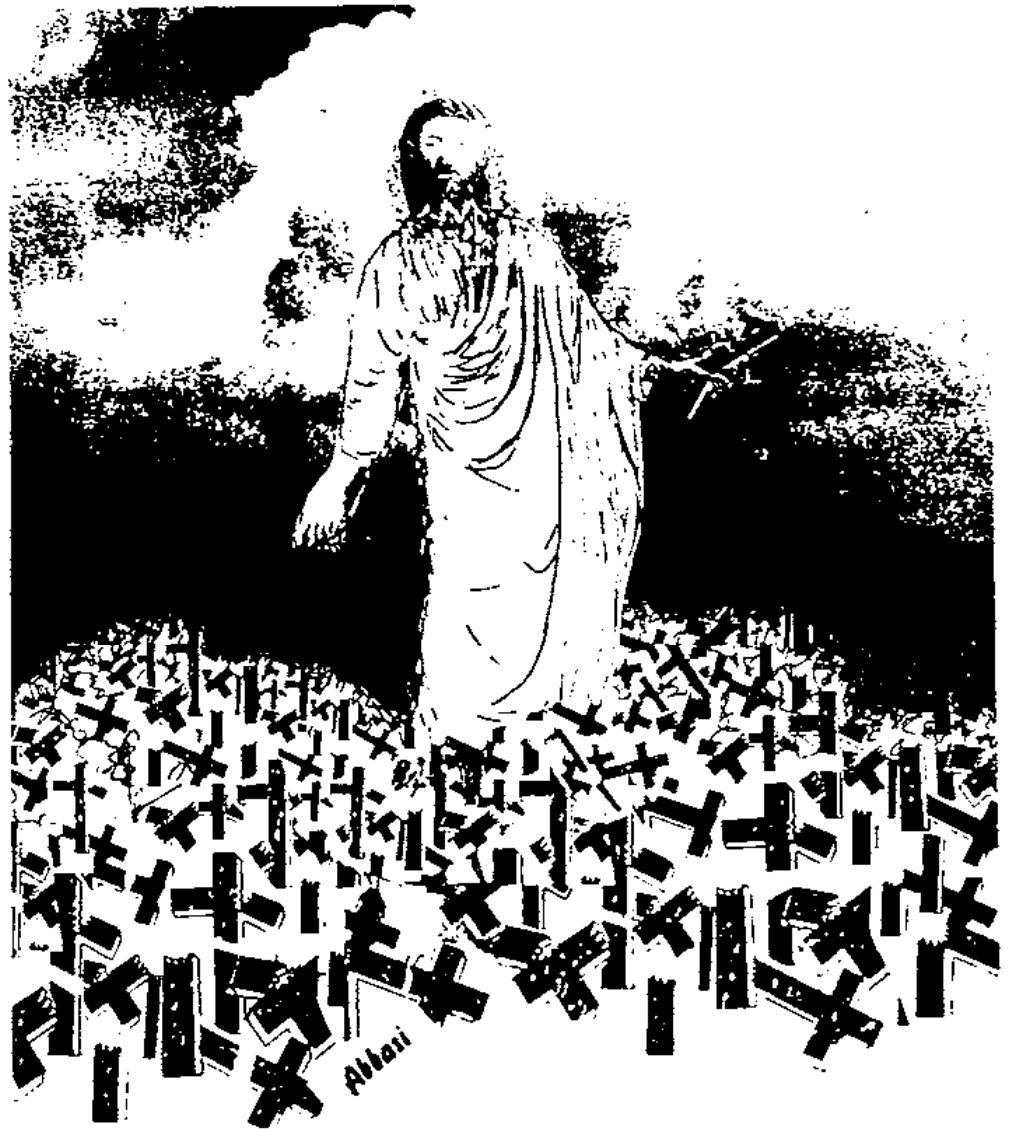
The orthodoxy’s vision of Jesus’ re-advent when he will literally smash all the crosses in the world to smithereens.
Having resolved their political and economic problems, he will turn his full attention to such prophecies as relate to religion. He will start by launching his campaign against Christianity. His strategy will be to break every cross in the world, whatever material it is made of. He will visit every cathedral, every monastery, every church, every temple, every Christian hermitage. He will walk every street of every township and stare at every passer-by in search of any cross. Ladies perhaps will become the prime object of his scrutiny because he will be aware of their despicable habit of having crosses engraved upon their jewellery and ornaments. He will take care of the fact that they also wear crosses hanging around their necks. Thus he will snatch away every bangle, every bracelet, every pendant and earring with the sign of the cross upon it. Woe to the ladies who dare to cross the path of that Jesus, but where can they escape and hide, the poor defenceless wretches? He will enter every house and search every cabinet and jewellery box. Every wall and every comer will be scanned. Crosses must be literally broken and wiped out from the face of earth. Until he has accomplished this task to the full he will not rest in peace. This is the vision of the Muslim orthodoxy of the mission of Jesus Christ if ever he returns to earth, but that is not all.
Having completely disposed of the symbol of Trinity, he would then turn to another task which prophecies assign to him, if they are taken literally. He will lose no time in beginning to kill every non-Muslim inhabiting the world. Either they must convert to Islam or they must die—these will be their only options. He will go about this slaughtering business in a rather unusual way. He will breathe fire like a mythical dragon, while no myth has ever presented such a dragon before, even in the wildest tales of fantasy. His blazing breath will scorch to death innumerable infidels even when they are miles away from him. Those within the reach of his sword, will have their heads stricken off and made to roll. He will identify them unmistakably because on the forehead of each non-believer would appear the imprint in bold: Al-Kafir, the non-believer. Thus he will leave none alive except the Muslims, and the de-Christianized Christians of course, who will be left without a single cross to worship. Hence the curtain will fall upon this unique carnage by the imaginary Jesus, filling the entire earth with fetid odour, an obnoxious stench of rotting bodies, some slaughtered, some scorched to death. Hatred will generate more hatred, bloodshed will lead to more bloodshed.
The last gory act of Jesus upon the earth will be to annihilate the species of swine. No quarter will be granted to pigs. All boars and all sows and all their brood will be put to the sword—each one of them. Hand on sword, fire in breath, Jesus will visit every township, every village, every street, every house every shack and every sty in search of the hiding rascals. He will visit every wilderness, will thrash all the bushes of Africa, and will hunt for them in the rain-forests of South America. China will not be spared for that matter, nor will Japan. The islands of the South Pacific will also be combed where the flesh of pig is considered a highly prized delicacy.
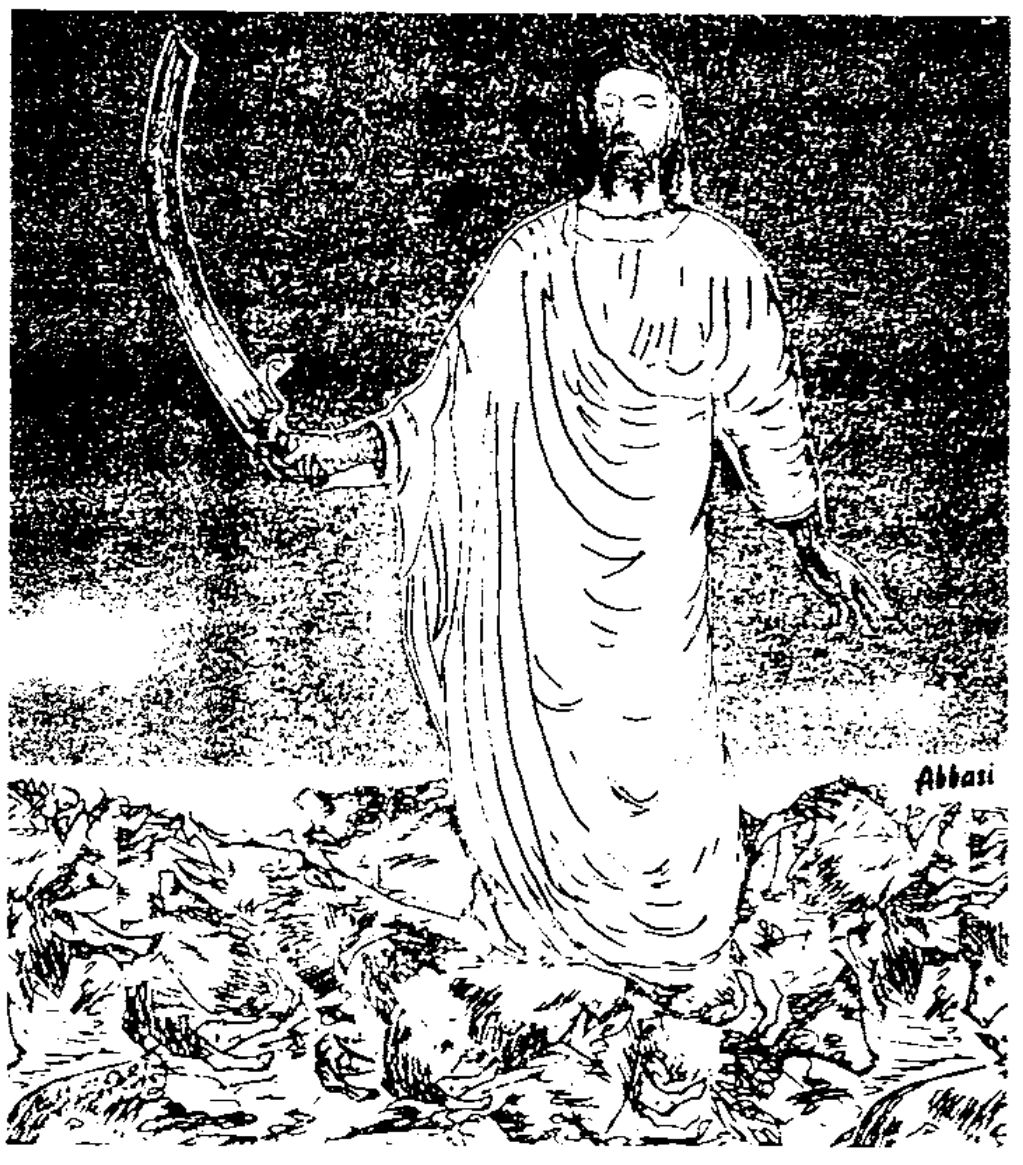
The imaginary Jesus as painted by Christian artists, is shown in the vision of the Muslim orthodoxy as carrying a sword in hand during the carnage of the swine.
Evidently no prophet of God in the entire history of mankind has ever performed such bloody, filthy feats as are attributed to the Jesus Christ envisioned by the Muslim orthodoxy. This is what the clergy in Islam have done to the profound wisdom of the Holy Prophet(sa). They have failed to penetrate across the bodies of letters to reach the soul and spirit of the prophecy they contained.
The real task assigned to the Promised Christ in this prophecy was to purify the human society from inhuman behaviour and some evil habits which the swine symbolizes. There are many animals and birds which steal the fruits of the farmer’s labour for the sake of their survival but do not destroy the crops and trees just for the fun of it. The swine stands out among all the animals in this destructive tendency. The swine is also notorious for eating the corpses of its young ones. No other non-marine animals are known to devour their young ones when they die. A bloodthirsty lion, or even a ferocious wolf, will rather die of hunger, woefully sitting beside the dead bodies of their brood, than to even dream of eating their flesh. Dogs do not eat the corpses of their dead puppies either. Pigs and boars, it should be remembered, are vegetarians, yet by some devilish instinct they relish eating the corpses of their young ones. Evidently therefore, the message implied in this prophecy has to be to wage a Holy War against the perverted habit of humans to be inclined to genocide and to feel free to usurp the rights of the weak. The pig’s habit of eating its own piglets could be likened to the child abuse of the modem age. Child abuse may be directed against one’s own children or against the children of others, either way it is swinish in character. Recently it has become a subject of common talk in modem society, so needs no further elaboration. No other animal can match humans in this ugliness.
War against evil has always been the occupation of prophets. As such, Jesus Christ in his second advent would be no oddity among them if his second advent is understood to be metaphorical. But a Jesus such as the one who is idolized by the Muslim clergy—a literal murderer of the swine—is what they need and await to welcome. The moment this apple of their eyes arrives and discharges his task of eliminating the pig species from the animal kingdom, he must needs be applauded. So will he be applauded and befitting homage would be paid to his last glorious days spent on the planet earth.
Glory be to Lord Jesus will be chanted over sea, over land, over hill, over dale. The church bells will not toll for the carnage he will make but the minarets will resound with the shouts of the Muezzin heard far and wide, Allah-O-Akbar, Allah-O-Akbar, God is the Greatest, God is the Greatest—and glory be to our saviour the Lord Jesus Christ.
Lastly, before Jesus’ departure from earth, there is yet another highly important business for him to conduct, but in this he must be assisted by the Mullah. Throughout it has been only Jesus Christ serving the cause of the Mullah. Let the Mullah serve his cause now, for once at least! All that Jesus would demand of the Mullahs after his global exploits would be to help him in the task of getting married. After the ruinous trail of rampage and bloodshed that he would have left behind, marriage would not be an unwelcome change for him.
If the Mullah has any serious regard for the literal fulfilment of prophecies he must find him a highly gifted young Muslim damsel who should not fail to bear him children. Christ is about to be married! Some great Mullah must be found to read his wedding sermon and enquire from the would be father-in-law of Christ if he consents to give the hand of his daughter to that of Jesus. After his consent would come the turn of Jesus, at last, to confirm the proposed marriage. What happy moments, what ecstasy! After a celibacy of two thousand years or more he would stand up and nod his head in affirmation “Yes I do, O loving Mullah, yes I do”. In what better manner could the exploits of Jesus Christ be celebrated than that! From North to South, from East to West, hymns will be sung in his praise and marriage songs will fill the air with their sweet melody. All that is left for him is to hopefully wait for the delivery of his blessed first-born with a holy string of other sons and daughters to follow. Thus by producing children at the ripe old age of two thousand years plus, he will create the greatest of all the miracles he had ever worked. His spirit has always been strong but the flesh too would not lag behind in strength it seems. What a miracle indeed that the passage of time makes him grow even stronger, while old age is left buried far behind in the land of his youthful first advent. Finally, the hour of death will arrive, but what a glorious enviable death it will be! Blessed be the day he was born and blessed be the way he will die.
This is the enchanting tale of Jesus which, if ever realised, the Mullahs will always tell their pupils in every Madrasah of Islamic instruction, year after year, generation after generation.
A more gruesome example is hard to find in the entire history of religion of how Divine prophecies are mutilated out of shape, by a mindless materialist clergy. But this is not a prerogative of the Muslim clergy alone. Whenever and wherever the priesthood takes over the command of religious orders they are likely to turn facts into fiction and realities into myths. This is the price man always pays for entrusting his faith to a hierarchy divested of common sense and reason, unable to distinguish between fair and foul. Whatever their business, rationality is not a commodity in which they trade.
The most tragic of all the religious leaders of the world is the case of the Muslim priesthood. The vain hopes they build for the ultimate victory of Islam are based utterly on misconstrued prophecies turned into mirages and illusions. They are no longer fit to lead any religious order, let alone Islam! They are no longer fit to follow any prophet of God, be he old or new.
Their vision of the final victory of Islam, attained entirely by the might of Jesus, absolves them of any role to play in the final struggle for the victory of Islam. In truth, what they need is not a prophet but an enslaved giant. They fail to realize that the type of Jesus for whom they aspire has never appeared in the entire comity of prophets before. No prophet is mentioned in the Quran or in any other scripture who would fight single-handedly for the supremacy of his people while they sit idly by. This is what the Jews demanded of Moses(as) and were denied. If the final victory of any religion can thus be achieved without blood, sweat or toil, where is there room for a prophet of God who invariably calls to the path of sacrifices? Their vision of a prodigal Jesus corresponds to a genie rather than that of a Divine Reformer. The real issue with them has never been a choice between an old prophet or a new one, it has always been between a genie and a prophet. Their attitude is reminiscent of a tale from the classic work of A Thousand and One Nights.
Once upon a time, so it is narrated, a magician in the guise of a vendor roamed the streets of Baghdad shouting at the top of his voice, ‘Old lamps for new! Old lamps for new!’ Many a housewife rushed to the door to have her old lamp swapped for the new ones he offered. A happy bargain indeed, they thought, and so it was. Yet there was one exception. Little did one of the housewives know that when she exchanged her old lamp for a new one offered by the swindler, the old lamp she was giving away had imprisoned in it a genie with almost unlimited powers. She had no idea that the owner of that lamp could also become the master of the genie. Hence, the interest of the swindler was in the prisoner of the lamp, not in the lamp itself. If that genie could be possessed by swapping a million new lamps for one that is old, no greater bargain could be conceived.

In reality the Mullahs are neither interested in a new lamp lit by the light of Muhammad(sa) nor are they interested in the old lamp of the Ummah of Moses(as). All they are interested in is the prodigal Jesus of their fancy deemed to be trapped therein. No Divine torch of prophethood means anything to them. A prophet is not what they care for and a prophet is not what they require. All that they need is a giant slave who would lead them to all the worldly riches at their bidding.
Political and economic domination of the world is their only ambition for which they are most ill-equipped. All that they are trained for is the letting of Muslim blood at the hands of other Muslims butchered by the knives of others Muslims.
Any bloody revolution brought about by Mullahcracy in any Muslim country should not mislead others. In no way can it upset the balance of power in the world. To dream of world domination without scientific and technological advancement, to hope for tilting the existing balance of power without boosting their own economy and revolutionizing their industry; to challenge the might of great world powers without the capability of manufacturing highly advanced and sophisticated military hardware is ultimate madness. What little, one may ask, do they have to achieve their goal?
The Mullahs must realize that their blatant distortion of the great prophecies of the Holy Founder(sa) of Islam will not go unpunished. It will bring them and those whom they lead to nothing but utter ruin. This is the price they must pay for the crime of perverting the wisdom of God. Let them stand on a comer and watch the days and nights slip by. Let them watch the heavenly tracks and strain their ears to listen to the descending footsteps of their mythical saviour from the voids of space. Let them live on and on in hope, and perish again and again in despair, generation after generation after generation. None will ever come to rescue them from the entangled web of their own twisted vision and contradictions between their ideals and practice. Every moment that passes, every second that ticks by, the fear of God is fast vanishing from their daily life. Honesty, justice, selfless sacrifice, mutual brotherly love and respect for other’s property have become values of the bygone days—still dearly remembered, but widely shunned. With what yearning they are talked about, with what love and tenderness they are treasured, but only in the storehouses of memories!
Theft, robbery, murder, child abuse, abduction, fornication, adultery, prostitution, fraud, and deceit are only registered by those whom they strike. Others live with them in an unholy alliance. Gang rapes committed in broad daylight by the very custodians of peace; bribery, corruption and brazen-faced violations of law by their lordships, who are supposed to be the defenders of justice—a society where the wardens of peace lynch and murder peace, a society where disorder is the only order of the day. Yet strangely enough, it is not altogether bereft of its sense of right and wrong. It hates the evil it generates itself, it abhors the horrors it commits. It is sick to death of the pollution it exhales. Everywhere, everyday the evils are decried by the very people who exude them. They are castigated, condemned and censured at such tempo as its resonance can be heard from one end to the other, from the lofty legislative chambers to the lowly shacks of the destitute. Yet how dearly they are embraced at the same time, how firmly clasped, how faithfully adhered to in everyday life at all tiers of society! Their deeds display what their mouths condemn. This is the lie they live or the death they daily die but call it life. Where are the custodians of Muslim values and where are the torch-bearers of decent conduct? Are there any who would lose a single moment of their sweet sleep over these bitter realities? Why should it matter anyway, and what do the Mullahs care! What difference could it make to a society which has been induced to believe that the hour of Divine Decree will finally strike and Jesus(as), son of Mary, will descend from his heavenly abode to raise Muslims such as these to the lofty chambers of command. It would be they who would carve and shape the destiny of the world. Thus the Mullahs lullaby the Muslim masses to sleep ‘until such time as the Lord of the Christian West will desert their cause and rise in full glory as the Lord of the Muslim East’. Why then, should the Mullah ever bother about the moral destitution of the herds he leads? Why work for their reformation and strive hard needlessly to redeem them from their hopeless state of morbidity? Patience, patience, is the only panacea—just wait for the hour to strike!
Woe to such an hour of destiny if it ever strikes! Damnation is the name for it. For the creatures of Allah to be subjected to the rule of the Mullah is sheer abomination. Jesus Christ! Could he ever permit himself to stoop so low! Could he ever be a party to such a blatant crime! No—not he! Jesus or no Jesus, no prophet of God would ever debase himself to champion the cause of a depraved people. It is a task fit only for a power-hungry demagogue who would not be reluctant even to become a king of beasts let alone of a beastly people. With or without the help of a Jesus he would not hesitate to step upon the shoulders of prophets to achieve his ambition.
The Mullahs’ dreams are madder than those of a mad hatter’s but how can they ever be realized? Mad dreams never turn darkness into light, nor do they ever break the dawn of a new day. It is always the dawn of a new day which breaks and shatters such dreams. Let the Mullah sleep forever. Let the empty chambers of his brain be filled with as many illusions as would feed upon his limitless craving for power. Let the people of Islam wake up and wish him to sink into a deep sleep till Doomsday. Let the sleeping Mullah lie and sink into a deeper sleep. And let him leave the Ummah of the Holy Prophet(sa) alone to begin to see the light of the day.
In the end, we turn to the issue of non-prophetic revelation. It is hard to entertain the idea that the phenomenon of non-prophetic revelation should also come to an end with the ending of prophethood. Continuity of Divine revelation is indispensable for supporting a profound unshakeable belief in God which cannot be attained with the help of rational investigation alone. Hence, revelation must always play a major role in strengthening belief in the existence of an Omniscient, Omnipotent God.
Revelation is not confined solely to the office of prophethood. It is simply a means of communion between God and man. It is a universally shared experience; to deny it is to deny the testimony of millions of people from all ages, all over the world.
It is mostly bestowed upon such servants of God as have attuned themselves to His will with unreserved dedication. Those who do not believe in God, or only believe in Him impersonally with just a vague notion of His existence, are least likely to be blessed with the honour of revelation. The same applies to the excessively sinful people, entirely given up to the vain pursuits of material gains and worldly pleasures. Yet even such as they are not altogether denied an occasional glimpse of His Grace. None can stop God from bestowing true dreams, visions and verbal revelations, whenever and to whomsoever He pleases.
Revelations are not always indicative of the piety of the person who receives them. They work sometimes as a reminder to humankind at large that God does exist and that He is free to communicate with whomsoever He pleases. Such sample communication is not a prerogative of any particular religion or country or age. It is common to all. Had it not been so, the very faith in the existence of God and the institution of revelation would have faded out of existence. Specimen revelations are like odd, unexpected showers in the midst of a desert, creating life-supporting oases in the vast deathly expanse of a sandy wilderness.
Some non-believers however, dismiss this universal testimony as mere psychic illusion. Of course, psychic illusions cannot be ruled out, but the evidence of Divine revelation is so distinctly different from ordinary psychic ravings that one should not be confused with the other. The difference is as wide and clear as that between life and death or between light and darkness. However, it is also true that the evidence of genuine revelation becomes rarer to find as we move away from the age of a prophet. The growing influence of materialism acts upon the people as a poison which pollutes their minds and corrodes the purity of their hearts. Faith in Divine revelation dissipates by the same proportion. An ice-age of scepticism eventually sets in and an era of spiritual death begins. All that survives is falsehood and deception. Hypocrisy infiltrates and desecrates religions. Most believers are merely so-called; their way of life gives a lie to their faith. Truth practically vanishes from all spheres of human occupation. Doubt, even disbelief, begin to encroach upon the territories of faith. Godliness beats retreat. Yet the communion between God and man never ceases altogether. Revelation continues to resuscitate faith. As for those who glow with His love, even amidst total darkness, God reveals Himself to them with unmatched brilliance. The sample sprinkling of revelation upon an age of doubt and ignorance is not to be compared with the expression of love from God to His devoted servants. This is the consistent message of the Holy Quran. It clearly promises the believer the blessings of Divine revelation unceasingly at all ages. It admonishes the Holy Prophet(sa) to proclaim:
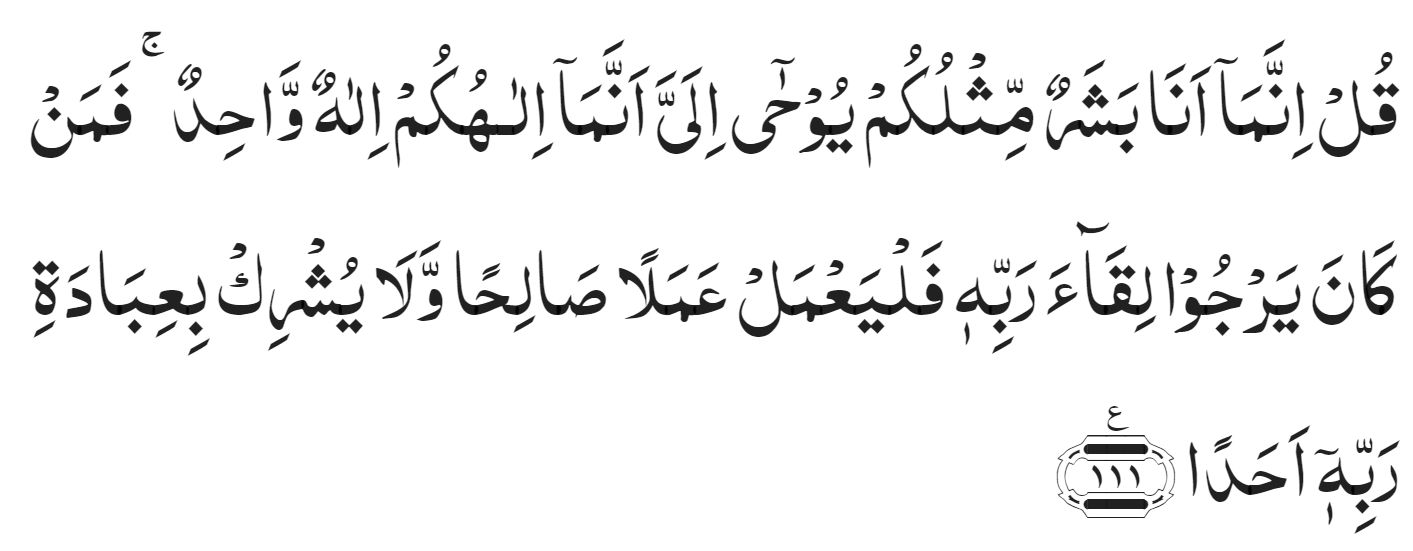
Say, I am but a man like yourselves, only I am recipient of revelation which admonishes that your God is only One God. Hence whoever among you desires to meet his Lord (as I have) then he too should perform righteous deeds and may not join partners in the worship of his Lord.14
The expression desires to meet is evidently linked to the preceding mention of revelation. But the decision concerning anyone’s worthiness in this regard always lies with God and not with man.
The same promise of revelation is vouched even more clearly in other verses to all such believers as remam steadfast in their loyalty to God at times of trials:
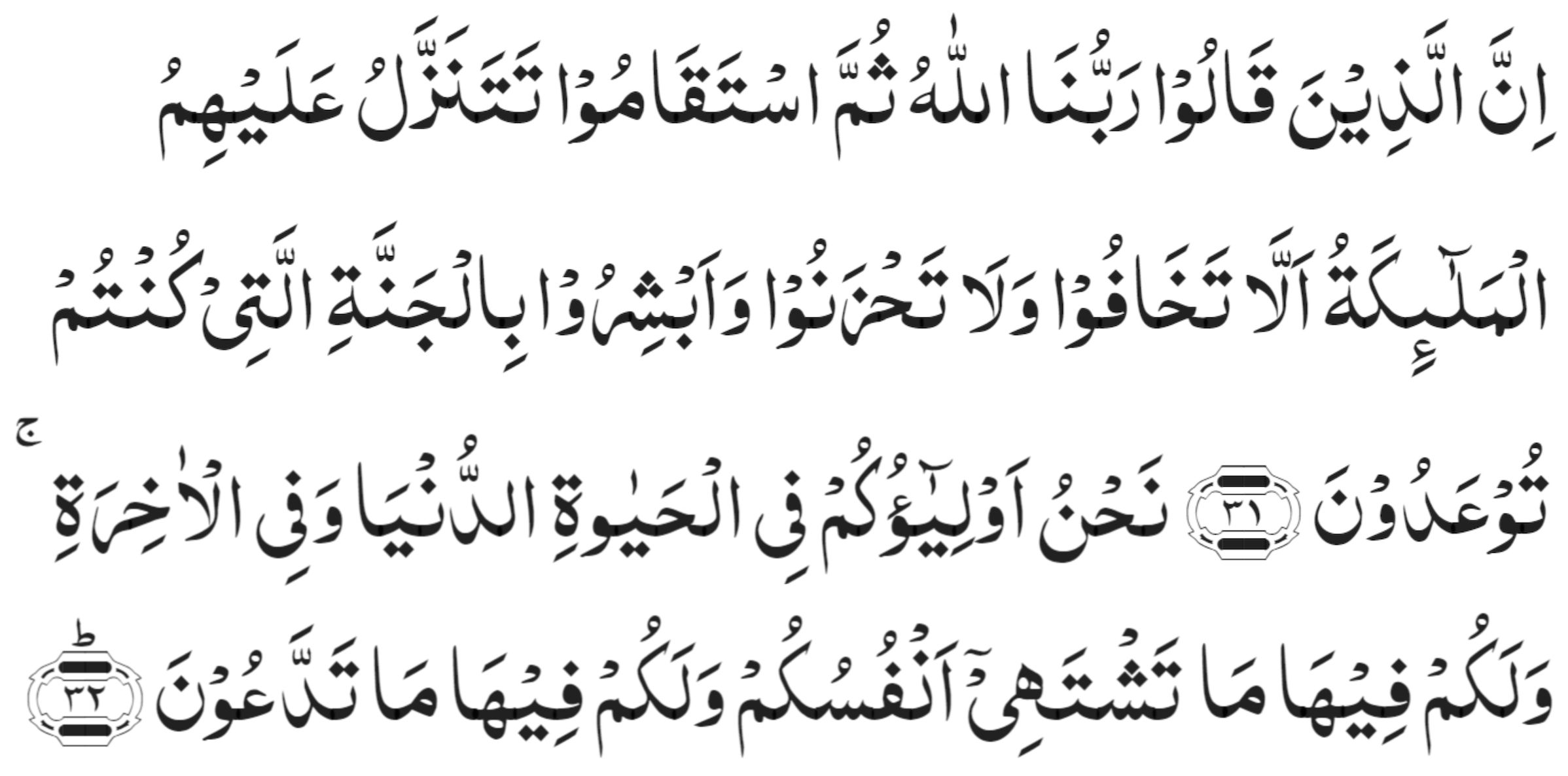
Verily those who proclaim that God is our Lord and then hold fast (to this claim), angels descend upon them incessantly saying ‘Do not fear nor grieve; but rejoice in the Paradise you were promised.
We remain your friends in this life and in the life to come … ’15
These verses leave no room for doubt on the issue of continuity of revelation. The Quran further states:
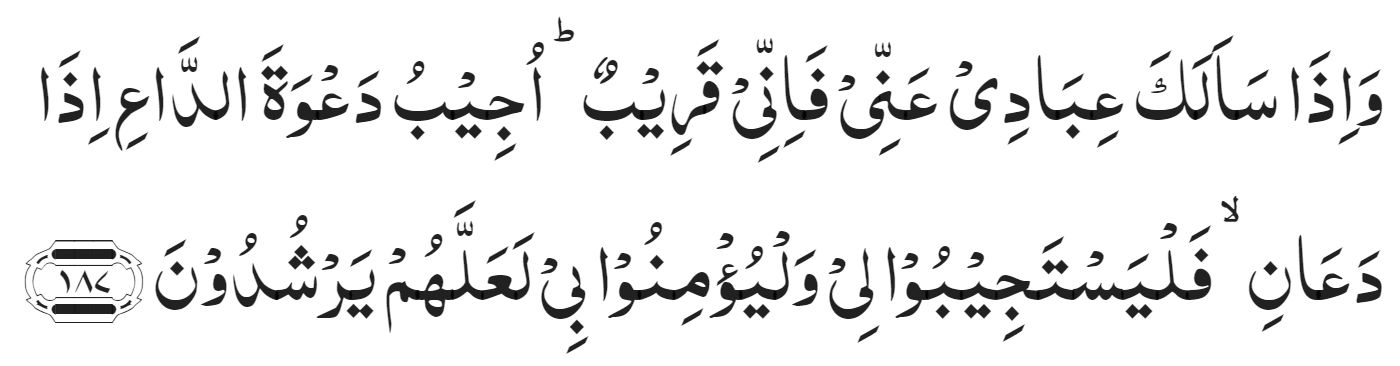
When My servants ask thee about Me, tell them, I am close, I do answer the call of the caller when he seeks Me. So they too should respond to Me … 16
Here the promise of revelation is widened to include all servants of God who sincerely seek Him and submissively respond to His Call. This is a universal promise, not confined to any particular age or people.
Islam, in short, is a religion of eternal hope which does not relegate communion with God only to the past. His interest in human affairs as a Benign Mentor shall never cease. He is accessible when sought for and responds when prayed to. He is Eternal, none of His attributes will ever die.
Man shall always stand in need of Divine revelation. After the institution of prophethood, it is revelation which keeps the lamp of faith alight above all other means of rational and philosophical investigation. Through revelation, man is reassured of the existence of a Living God. He bestows such signs of nearness to Him as are not only subjective in their nature but are also objectively verifiable. Revelation builds faith on solid belief, dismissing all wavering doubts. The greatest tragedy of contemporary Islam is for it to fall under the ominous spell of medieval clergy and modem intellectuals. To the medievalists goes the lion’s share of the kill but the great thinkers like ‘Allamah Iqbal and theologians like Maudoodi are not far behind in vying for the leftovers. Iqbal as an able disciple of Nietzsche, forever does away with the need of Divine guidance. Maudoodi, a cross-breed of Pauline and Bahai wedlock, does away with prophethood lest its denial should make it a precursor to the curse of God. So between these two stalwarts nothing is left of prophethood or revelation leaving Islam emptied of all hope. The real import of their philosophy could not be summed up better than in the following words of Faiz Ahmad Faiz, one of the greatest Urdu poets of modern times:
Alien dust has obscured every footprint.
Extinguish the lamps and take away the goblets and pitchers of wine.
Shut your sleepless doors and lock them up.
None will come! No one will ever come!!
Alas prophecy and revelation, the very soul and spirit of every living religion are thus expunged from the body of Islam. A zombie-like existence is all that is left into the bargain. An exasperating, meaningless semblance of life! Why can they not read the message writ large on the wall of history?
Remove revelation altogether from religious experience, and faith would be reduced to myths and legends. Do away with Divine revelation, and the spiritual life would forthwith lose its meaning, and religion its purpose.
Revelation enlightens belief, illuminates the soul and blows the breath of life into faith. In the pitch darkness of materialism, when despondency is compounded by atheism, it is revelation which sheds the light that turns despair into hope and the night of disbelief into a day of belief. What the sun is to the day, a prophet is to religion. What stars are to a moonless night, revelation is to the obscurities of faithlessness!
Bring to an end prophethood, block the passage of revelation, and call it a Doomsday! Nothing will remain but stark death!
Adieu!
1 BATALVI, MAULAWI MUHAMMAD HUSSAIN, Isha‘at-us-Sunnah (June/July/Aug, 1884) No. 6, Vol. 7, p. 169
2 Translation of 38:6 by the author.
3 Translation of 30:31 by Maulawi Sher Ali.
(Note: The author has replaced the word ‘Allah’ by ‘God’)
4 Translation of 15:10 by the author.
5 Sunan Ibn-e-Majah. Kitabul-Fitan. Babo Shiddatiz-Zaman
6 Zoroaster, a great Prophet of Persia, is understood by many Zoroastrians to be a dualist. Many others insist he was a monotheist. His name is spelt and pronounced differently. We have adopted Zoroaster, the English version, with which most people are familiar. Nietzsche, however, refers to him as ‘Zarathustra’. In this context we have used his term with his spelling but the person is the same.
7 KAUFMANN. W. (1976) The Portable Nietzsche. Penguin Books. England, p. 197
8 KAUFMANN, W. (1976) The Portable Nietzsche. Penguin Books. England, p. 198
9 KAUFMANN, W. (1976) The Portable Nietzsche. Penguin Books. England, p. 198
10 KAUFMANN, W. (1976) The Portable Nietzsche. Penguin Books. England, p. 370-375
11 Translation of 36:31 by the author.
12 MAUDOODI, SYED ABUL-A‘ALA. Musalman Aur Maujoodah Siyasi Kashmakash. 1st ed. Vol. III. Published by Maktabah Jama’at-i-Islami, Dar-ul-Islam, Jamalpur, Pathankot, p. 130
13 Translation of 3:50 by the author.
14 Translation of 18:111 by the author.
15 Translation of 41:31-32 by the author.
16 Translation of 2:187 by the author.
17 FAIZ AHMED FAIZ, Nuskhah Hai Wafa, from poem ‘Tanhai’.