The greatest benefit that one attains by engaging in dhikr is that the pleasure of Allah the Exalted is achieved. This does not mean that this is a virtuous act and so, like other deeds, God can be pleased by its performance, but rather by doing this, God is especially pleased, and the greater the value of the deed, the greater the value of the reward.
God Almighty says about dhikr at one place in the Holy Quran:

—Surah al-‘Ankabut, 29:46
Meaning that the remembrance of Allah is the greatest.
At another place He says:

—Surah at-Taubah, 9:721
That the greatest reward is the pleasure of Allah; for, the reward of the greatest can only be the greatest, not the smallest. Thus, both these ‘greatests’ have informed us in exchange of what the pleasure of Allah can be had.
In this verse, God Almighty, by mentioning other things that are a reward of the remembrance of Allah:  has told us that the
  [‘pleasure of Allah’] is another new thing and is the greatest of all. And, in reality, for the servant of God, the greatest of rewards is that Allah be pleased with him. To achieve this great reward God Almighty says that if one engages in the remembrance of Allah, then this other akbar [greatest], which is the pleasure of Allah, will be granted to you.
The second benefit is that through it, one attains comfort of the heart. Thus, Allah the Exalted says:

—Surah ar-Ra‘d, 13:292
Hearts find comfort in dhikr. Why? This is so because anxiety develops when man thinks that he is about to be destroyed by some calamity and if he believes with certainty that there is a remedy for every calamity and ailment, then he will not become anxious. Thus, when someone remembers Allah and understands that Allah possesses unlimited powers and can remove all types of ailments, his heart tells him that when he has such a God, then what is the need for him to become anxious about any difficulty? He will Himself remove it. In this way he finds comfort.
The third benefit is that Allah becomes the Friend of His servant who remembers Him, and He remembers him in His Court even while he remains yet in this world:

—Surah al-Baqarah, 2:153
O My servants! You should remember Me; I will remember you. And remembering by God Almighty is simply that He grants one an audience in His presence. Just as for a worldly king’s remembering someone means exactly this—that such a one is called into the king’s court—so does God Almighty do the same.
The fourth benefit is that the remembrance of Allah saves man from evils. Thus, God Almighty says in the Holy Quran:

—Surah al-‘Ankabut, 29:46
God Almighty says to the Holy Prophet (sas) that the Book that God has given to him, he should recite it unto the people and establish Salat. Salat saves one from indecency and manifest evil. And to engage in the remembrance of Allah is [a] very great [virtue] and Allah is well aware of what one does.
As I have stated earlier, Salat is also a form of remembrance of Allah. Hence, from this it becomes established that the remembrance of Allah guards against indecency and evils. Why? For the reason that the remembrance of Allah is a weighty weapon and when struck upon the head of Satan, he dies and cannot incite one towards evil.
The fifth benefit of the remembrance of Allah is that through it the heart is strengthened, and the power to battle evil develops. Man does not lose, he rather stands firmly in combat, as Allah the Exalted says:

—Surah al-Anfal, 8:46
O Muslims, when you go to contest a power and it is mighty, what you should do is commence engagement in the remembrance of Allah in abundance. The result of this will be that your enemy will be uprooted and you will prevail over him.
The sixth [benefit] is that the person who remembers Allah attains success in all of his undertakings, provided that he remembers Allah with sincerity of heart. The proof for this is also found from this very verse which I have cited in connection with the fifth benefit where Allah the Exalted says:

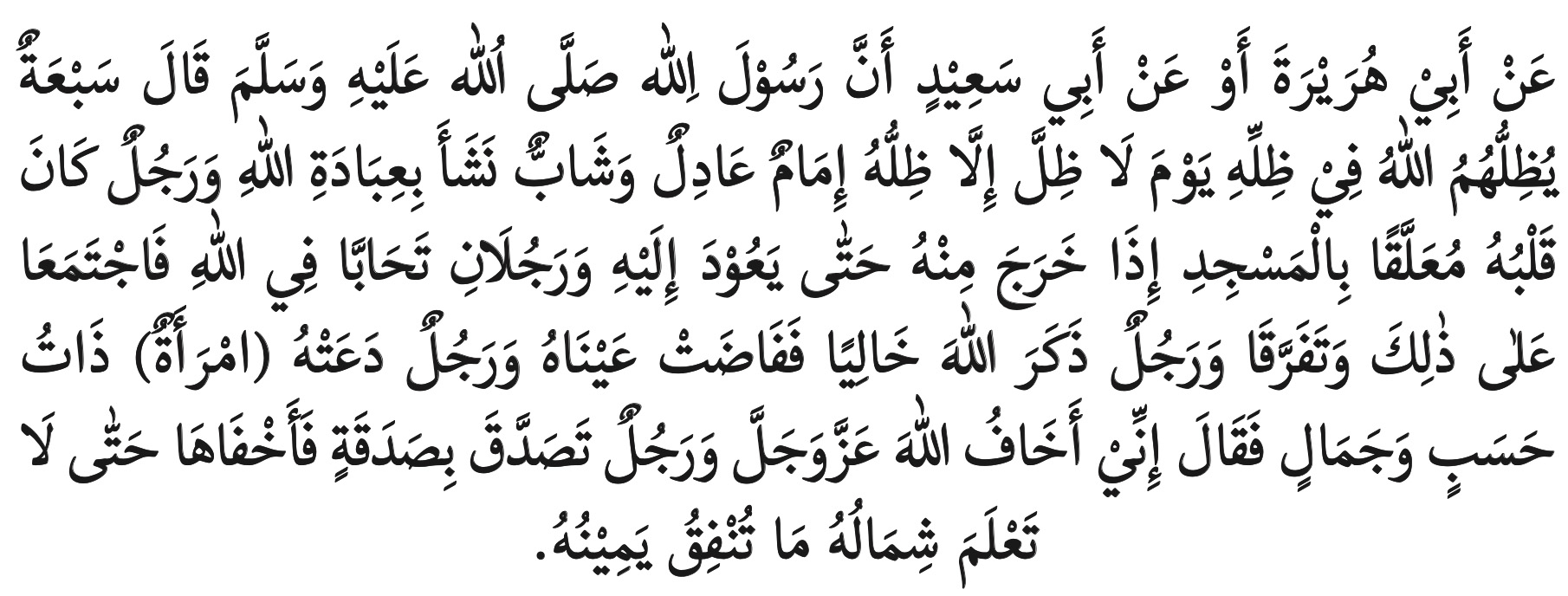
The seventh benefit is that the Holy Prophet (sas) says that on the Day of Judgement, seven people will be under the shade of Allah and among them will be the one who remembers Allah.4 The Holy Prophet (sas) says that it will be such a dangerous day that all Prophets will be fearful and God Almighty will, on that Day, be Wrathful as never before because all the mischief-makers will be presented before Him. The sun will draw very close. So given this situation, it can only be imagined how fortunate would be the one who is provided the shade of Allah on that Day!
The eighth benefit is that the prayer of one who remembers Allah is accepted. The prayers that are mentioned in the Holy Quran are preceded with dhikr, viz. tasbih [glorifying Allah] and tahmid [praising Allah]. The first prayer is indeed Surah al-Fatihah. It starts with:

Then comes the part in the middle, which is half for God Almighty and half for man:

Then is said:

This is a prayer. So, Allah the Exalted put dhikr first and then prayer. We observe in this world as well that when a needy person comes to anyone, he first praises that person and then submits his request.
Thus, when a man goes into the presence of Allah he should first acknowledge the power and authority of God Almighty and admit his own humility. The Prophet Hazrat Jonah, peace be upon him, also prayed to God for himself in the same way:

—Surah al-Anbiya’, 21:888
He first expressed the glory of God, and then he laid out his own condition.
Then, the Holy Prophet (sas) says:  ; meaning, God Almighty says that, ‘He who remains busy in My remembrance, receives more from Me than the one who keeps asking.’ [Ash-Shu‘abul-Iman, Bab 10 fi Mahabbatillah, Fasl fi Idamati Dhikrillah, Vol. 1. p. 413, Hadith 572, edition 2000 Beirut]
This hadith does not mean that we should not pray, because Surah al-Fatihah—which is the Mother of the Book—contains prayer along with dhikr. And prayers have been taught in abundance in the Holy Quran and the Hadith. The meaning, rather, is only that—compared to the person who does not engage in the remembrance of Allah and only prays—that individual receives more, who also engages in the remembrance of Allah apart from praying, and saves time from the time he devotes to prayer and spends it in the remembrance of Allah.
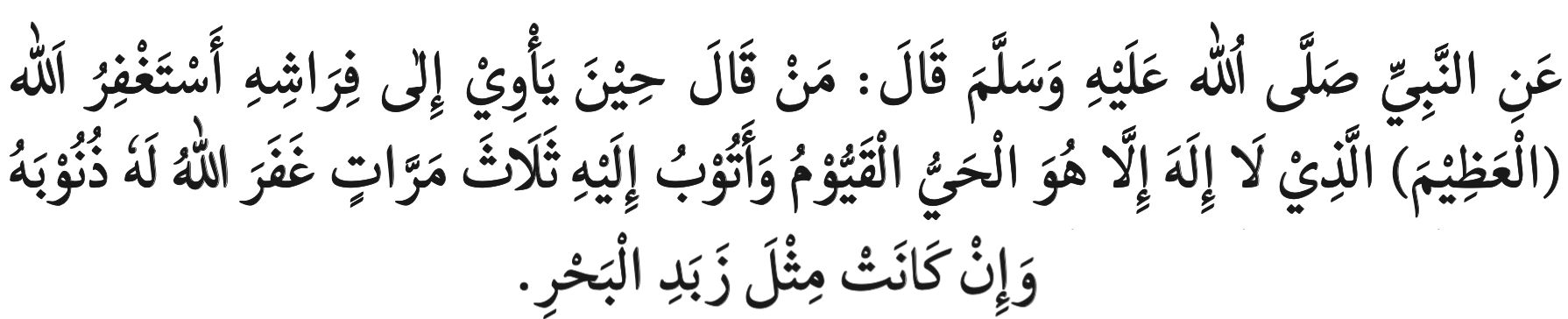
The ninth benefit is that sins are forgiven. The Holy Prophet (sas) has said that the sins of the person who performs takbir [reciting Allahu Akbar—‘Allah is the Greatest’], tahmid [praising Allah by reciting Alhamdulillah—‘All praise belongs to Allah’], and tasbih are forgiven even if these sins are innumerable like the foam in the sea.9
The tenth benefit of dhikr is that it sharpens the intellect. One who remembers Allah discovers such verities and points of wisdom that leave the person himself amazed. Allah the Exalted says:
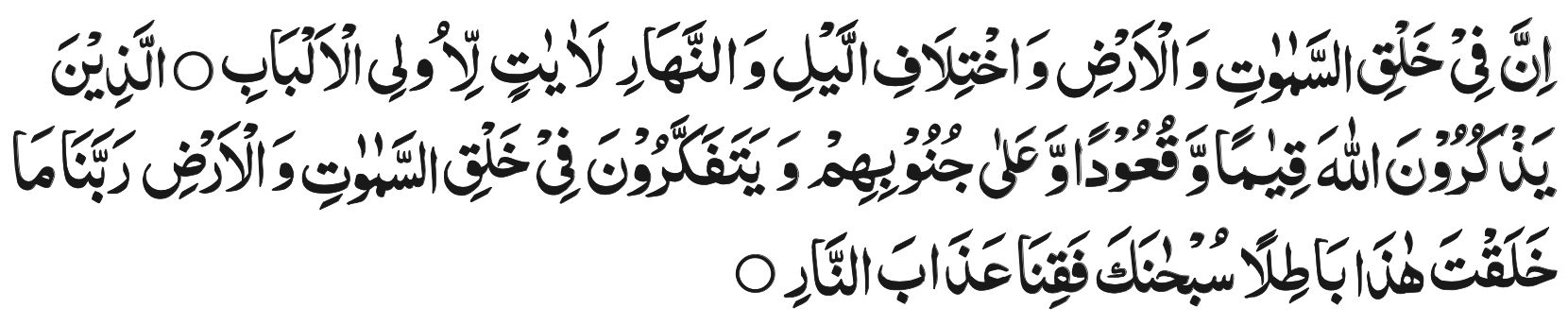
—Surah Aal-e-Imran, 3:191–192
Meaning that there are many Signs in the creation of the heavens and the earth and in the alternation of night and day, but only for those people who possess intelligence. Then, it is stated that the people who possess intelligence are those who remain engaged in the remembrance of Allah and in pondering on the works of God.
The eleventh benefit is that righteousness emanates from it. We find in the Hadith:

God Almighty says, ‘When a servant of Mine remembers Me in his heart, I too remember him in My heart.’ For example, when man says Subhanallah, meaning, ‘Holy are You, O Allah!’ then God Almighty also says concerning that servant of His that may he also be bestowed with purity. And when God Almighty utters it, then that person certainly attains it.
Then He says, ‘When My servant remembers Me among the people, I remember him among those people who are better than those among whom he mentioned Me’; meaning, among those who are righteous and virtuous, and the world acknowledges that he is righteous (Sahīh al-Bukharī, Kitābut-Tauhīd, Bāb Qaulillāh Ta’ālā wa Yuhadh-dhirukum-Allāh Nafsah; Hadith 7405).
The twelfth benefit is that love grows because it is a rule for man that the object that he constantly remains in touch with, he cultivates a love for it, so much so that he even begins to espouse a love for the village or town that he lives in. Thus, when a servant of Allah remembers Allah morning and evening, and in fact, at all times, and mentions His name, then gradually, the love of Allah the Exalted goes on growing in his heart.