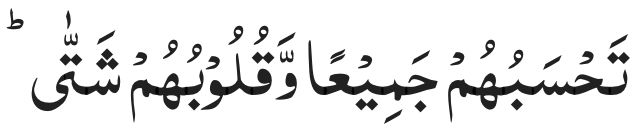
“Thou thinkest them to be united, but their hearts are divided.” (59:15)
Jama‘at-e-Ahmadiyya occupies a unique position in the world of Islam. It is not just like one of the 72 other sects. To understand the Ahmadiyya position in relation to the rest of the Muslim sects and in relation to Islam as a whole, we suggest that the whole scenario should be observed from different vantage points.
To begin with, let us examine the position of Jama‘at-e-Ahmadiyya in relation to the other 72 sects from the vantage point of the scholars of the most predominant sects and the leaders of some powerful Muslim states.
To an observer from this angle, the Jama‘at-e-Ahmadiyya would appear to be the blackest of the black and the ugliest of the ugly. It will appear to have no relation whatsoever with Islam—an outcast which was implanted in the world of Islam only to create rift and disorder and to play the most damaging role of a western spy in the world of Islam.
Members of such a Community as this, the great clerics of the predominant groups will tell you, are not only non-believers in the true sense of the word pukka kafir, but also they must be considered by every Muslim as worse than Christians, Jews and idolaters—even atheists!
No wonder, the ulema would tell their followers that the great Muslim states of Pakistan and Saudi Arabia and their camp-followers have officially declared this Jama‘at to be a non-Muslim Community which deserves to be uprooted and tossed out of the pale of Islam. Such roundly-condemning statements would always be followed by intriguing tales of the so-called Ahmadiyya beliefs. It would be difficult to exhaust the catalogue of these alleged beliefs in a brief space, but a sample of them is presented below.
It is alleged that Ahmadis do not believe in the Khatm-e-Nabuwwat of Hazrat Muhammad (sas) and do not accept him as Khatamun Nabiyyin.
That they consider the claimed “revelations” of Mirza Ghulam Ahmad as equal in rank to the Holy Quran and believe it to be a Book of Sharia.
That Ahmadis have a different Kalimah from that of all Muslims (La ilaha Illallahu Muhammad-ur-Rasulullah).
That the mode of worship of Ahmadis is different from the Islamic mode of worship.
That their founder, Mirza Ghulam Ahmad of Qadian, by claiming to be a prophet after the Holy Founder of Islam (sas), committed an unpardonable sin, so much so that he and his followers, according to Islamic Sharia, have forfeited their right to live.
That Mirza Ghulam Ahmad, not only insulted the Holy Prophet Muhammad (sas) by claiming to be his equal, but he also claimed to be his superior and freely insulted other prophets like Jesus Christ (as) as well.
That his attitude to the holy progeny of the Holy Prophet (sas) was also insulting to the extent of being intolerable.
That he also insulted and abused all ulema of Islam.
That he did not stop short at abusing the ulema but also abused the whole Muslim umma.
The list of allegations is not exhausted, of course; but enough is enough. The blood of the reader may be boiling already and seething with rage: What a man and what a Jama‘at! No wonder, one may observe, that ulema had declared this Jama‘at to be the worst of communities ever founded.
So, the reader can well imagine how, looking at the Ahmadiyya Muslim Jama‘at from this vantage point of utter hatred and mad hostility, this Jama‘at appears to be a manifestation of the devil himself.
Now let us change the vantage point and observe the Jama‘at from a different angle and try to understand Ahmadiyyat from the point of view of Ahmadis themselves.
First of all, it is surprising to note that all the above allegations are emphatically denied and rejected by the members of this rapidly growing international Jama‘at. This denial does not bring the matter to a close, however; because other questions are immediately raised. For instance, one may ask, if all the above-mentioned allegations are totally false, then why should the ulema hate the Ahmadiyya Muslim Jama‘at as they do and what do they gain by concocting such false stories about Ahmadiyya beliefs?
The matter becomes more complicated and incomprehensible when one recalls that it is not the ulema alone who have joined forces to make this community a target of this most incriminating propaganda but many Muslim states as well support and finance anti-Ahmadiyya campaigns throughout the world, foremost among them being Saudi Arabia and Pakistan.
In response to the questions raised above, the following is the Ahmadiyya position:
It is the fundamental human right of every person to declare his own beliefs or to deny any. No man, nor any government for that matter, is empowered to attribute to a person and/or to a community, any beliefs which they fervently and vehemently deny. Hence, just the denial by the Ahmadiyya Muslim Jama‘at should be considered valid enough to absolve them of these accusations.
Ahmadis point out that the biggest crime that a man has ever committed to turn both foes and friends against him has always been the crime of falsely claiming to have been raised by God as an Imam and divine representative.
Ahmadis support this statement by pointing to the history of religions so accurately preserved by the Holy Quran.
Turning to the question put to them, they in their turn, ask, what crimes were committed by Adam, Noah, Abraham, Moses or Jesus (peace be on them) and, above all, by the greatest of Prophets, the Holy Prophet Muhammad (sas)?
Were they not abused, were they not insulted, were they not persecuted and tortured, were they not deprived of all their fundamental rights and even declared to have forfeited their right to live? All sorts of allegations were hurled at them. They were accused of crimes they had never dreamt of. They were alleged to hold beliefs which they never held. Many among them were treated as foreign spies and were compelled to leave their homelands.
The atrocities committed against these claimants and their adherents are innumerable but the one and only “crime” they committed was none other than their belief in One God and in the fact that He had raised a Messenger to reform society. This is the “crime” which prophet after prophet and their adherents are alleged to have committed!
When one scans the history of religions, one cannot fail to notice that all the prophets of God, though accused of creating disorder and disunity, do in fact become instrumental in uniting a society which before their advent was already shattered into sects and schisms with an ever-growing tendency to fall further apart in dogmas and practices.
Had Jesus (as) not been raised, no power on earth could have united the warring factions of the Jews. Thus, it was only the hatred of Jesus (as) that brought about the great miracle that those who could not be united for the love of Moses (as) were suddenly brought together and behaved like one people by their hostility to Jesus Christ (as), the Messiah and Messenger of Allah.
It is only in this negative way that the prophets of Allah unite a people. According to the Holy Quran, such bridging of gaps and of differences only creates a semblance of forged unity while in reality such people remain disunited.
“Thou thinkest them to be united, but their hearts are divided.” (59:15)
This is the unchangeable verdict of the Holy Quran.
However, it is not only this ostensible unification of a divided people in this negative sense that is brought about by the Messengers of Allah, but there is also another type of brotherhood which is created by such godly people in the positive sense and which is, in fact, one of the ultimate objects of their advent. This process of creating one umma out of chaos is not brought about suddenly. Instead, it is a process which is accomplished through a long and painful journey of human sacrifices.
The Holy Quran refers to this creation of one umma out of a scattered people and declares that it is only God Who can transform hatred into love. This power of God when it works through the institution of prophets, works wonders.
Addressing the Muslim brotherhood of the time of the Holy Prophet (sas) the Holy Quran says:

“And it is by the great mercy of Allah that thou art kind towards them, and if thou hadst been rough and hardhearted, they would surely have dispersed from around thee. ” (3:160)
The above seems to be a sufficient and befitting answer to the allegation that Ahmadiyyat was created by anti-Islamic powers to produce rifts and divisions in the world of Islam.
These rifts and divisions were already prevalent before Hazrat Mirza Ghulam Ahmad claimed to be the Imam Mahdi (as).
The Ahmadiyya Muslim Jama‘at is the only community in the whole world today which can be described as one single brotherhood in the style of the brotherhood which was created by God through the blessed agency of the Holy Prophet (sas).
Again, it should have become very clear from the above that people, religious or otherwise, always show hostility to those who claim to have been raised by God to fulfil their appointed task. So it is a futile exercise to search for reasons other than this.
To adjudge the truth or falsity of these allegations and their denials by the Ahmadis, the latter claim that the most sensible thing to do is to read the entire text of the writings of the Founder of the Ahmadiyya Muslim Jama‘at from which some out of context passages are selectively quoted by the anti-Ahmadiyya ulema. Ahmadis claim that anyone who could find time and patience to investigate the truth in the prescribed manner would immediately reach the conclusion that the short excerpts picked and presented by the anti-Ahmadiyya ulema from the writings of Hazrat Mirza Ghulam Ahmad are always quoted out of context and are twisted and distorted to a degree that they lose all bearing to the intent and purpose of the writer.
On the contrary, the profound writings of Hazrat Mirza Ghulam Ahmad of Qadian bear incontrovertible testimony that the allegations are all false and that rather the opposite is true. Some relevant passages are quoted below for the reader to form his own judgement.
“We do believe that there is none worthy of worship except God Almighty and Sayyidna1 Hazrat Muhammad (sas), the Chosen One, is His Messenger and the Khatamul Anbiya’. We believe that Angels are a reality, that Resurrection is a reality and that the Day of Judgement is a reality; that Heaven is a reality and so is Hell. We do believe that whatever the Glorious and Majestic God has stated in the Holy Quran and whatever our Prophet (sas), has stated is all, according to the aforementioned statement, the truth. We do believe that the person who subtracts an iota from the Islamic law or adds to it as much, or lays the foundation in any manner for the rejection of Islamic injunctions, or attempts to declare unlawful what has been made lawful in Islam, is an infidel and a renegade. We admonish our Jama‘at that they must adhere tenaciously to the fundamental article of Islamic faith, “There is no God but Allah; Muhammad is the Messenger of Allah,” and that as long as they live they shall die holding fast to this belief. Also, they must have firm faith in all the Messengers of Allah and revealed Books authenticated by the Holy Quran. They should strictly abide by the Quranic injunctions, observe Prayers, keep Fast, pay the Zakat and perform the Hajj. They should practice Islam by fully complying with all the injunctions, obligations and prohibitions prescribed by God and His Messenger. In short, all such matters on which there is consensus of belief and practice among our righteous predecessors, and all those matters which are considered Islamic on account of the collective judgement of the umma should be accepted, as a matter of course, to be a part of faith. We call to witness the Heaven and the Earth that this is exactly our faith.” (Ayyamus Sulha, Ruhani Khaza’in, Vol. 14, p. 323)
“We are Muslims, we believe in God Who is One, and we also believe in the Kalimah. We believe that the Quran is the Book of Allah and Muhammad (sas) is His Prophet and Khatamul Anbiya’. We believe in the existence of the Angels, in the Day of Judgement, and in the existence of Heaven and Hell. We say our daily prayers, keep fast during Ramadan and turn towards Ka‘bah to pray.
“We consider it our duty to refrain from whatever Allah and His Prophet forbid us to do and do whatever they command us to do. We have no authority to add or detract anything from the Islamic Sharia. We accept as part of Islam all that has come to us from the Holy Prophet (sas), whether or not we understand its raison d’etre. By the Grace of Allah, we are true believers, Muslims and believers in the Oneness of God.” (Nur-ul-Haq Part I, Ruhani Khaza’in, Vol. 8, p. 7)
“We would like to inform our readers that we hold Jesus Christ (as) in high esteem and genuinely believe that he was a true prophet and beloved of God.” (Nur-ul-Quran Part II, Ruhani Khaza’in, Vol.9, p. 374)
“Of all the revealed Books which we find today, it is only the Holy Quran whose claim to be the Word of God is established on the basis of irrefutable arguments. The principles it lays down regarding salvation correspond exactly with the dictates of truth and human nature. The doctrines it propounds are so perfect and well founded that they are supported by powerful and irrefutable evidence. Its injunctions are based on absolute justice and its teachings are completely free from the contamination of shirk—associating partners with God and innovative deviations. It is a Book in which there is great eagerness to manifest the Oneness and Greatness of God and to emphasize the perfection of the attributes of the One and Only God. It is a Book which has this outstanding quality that it is filled entirely and purely with the Unity of God and does not permit any blemish or defect or shortcoming or aspersion to be ascribed to God Almighty. Also, it does not impose any doctrine perforce.
“On the contrary, it establishes in advance the truth of what it teaches.
“It proves its aims and objectives with reasons and explains every principle it enunciates, it leads man to firm belief and absolute understanding of realities. Thus it removes, with the help of self-evident signs, all defects, impurities and irregularities which infest human beliefs, practices, words and deeds. It also teaches all etiquettes which are essential to actualize human potentialities.
“It resists every evil current today with equal force. Its teachings are straight, powerful and well-balanced as if they were a reflective mirror of nature itself and a true copy of the law of nature. It is like an enlightening sun for the inner eye and perceptive faculty of the heart.” (Barahin-e-Ahmadiyya, Ruhani Khaza’in, Vol. 1 pp. 81-82)
“There have been millions of pure-hearted people in the world and there will be many more in future, but we have found the best of them all and the choicest man of God, whose name is Muhammad (sas).
“Leave aside any mention of the holy ones from among those whose circumstances have not been described in detail in the Holy Quran, we shall speak of only those Prophets who are mentioned in the Holy Quran like Moses, David, Jesus and others, peace be on them.
“We affirm it on oath, calling God to witness, that if the Holy Prophet(may peace and blessings of Allah be upon him), had not come into the world, and the Holy Quran had not been revealed, and we had not seen with our own eyes the blessings that we have witnessed, the truth of all past Prophets would have remained doubtful to us. No truth can be attained from mere stories, for it is quite possible that they may not be true and it is also possible that the miracles that are attributed to these Prophets might be exaggerations, for no sign of them is visible today. We cannot even ascertain from the Scriptures revealed in the past that God does exist, because we are not assured that God speaks to man. But with the advent of the Holy Prophet, peace be on him, the truth of all these stories was confirmed. We now realize not merely as a statement, but as a matter of experience, what converse with God means and how God’s signs are manifested and how prayers are answered. All this we have discovered by following the Holy Prophet (may peace and blessings of Allah be upon him). What others relate as stories we have witnessed it all. We have attached ourselves to a Prophet who actually shows God to us.” (Chashmah-e-Ma‘rifat Part II, Ruhani Khaza’in, Vol. 23 pp. 301-302)
“All ulema are not the same: Some of them are God-fearing while others are wrongdoers. Those who fear Allah, we always think well of them; Allah will soon guide them and they shall perceive the truth. When they are told to declare this man a kafir who is claiming to be the Messiah, they say ‘We will not say anything without full knowledge, and we fear Allah’.” (Al-Huda, Ruhani Khaza’in, Vol. 18 pp. 320)
The foregoing quotations from the writings of Hazrat Mirza Ghulam Ahmad, the Promised Messiah are so self-explanatory, so powerful and convincing that it is impossible for an honest man not to be deeply influenced by their sincerity and devotion. With that we rest our case regarding the real faith of Ahmadiyya Muslim Jama‘at and leave it to the readers to draw their own conclusions. We hope and pray that Allah may lead them to the truth.
Now we turn to another aspect of the issue involved in this controversy. Although from the study of Islamic history one may not find another example of the entire Muslim umma joining their forces against one single Muslim community, it is not correct to claim that the entire Muslim umma has remained united even on the interpretations of the fundamental beliefs. Again it is wrong to conceive that no Muslim saints and scholars have ever been treated with such uncompromising hostility before as the Founder of the Ahmadiyya Muslim Jama‘at and as his adherents are being treated today.
In fact, any impartial student of Islamic history is bound to draw the tragic conclusion that, in every period and every century of Islamic history the ulema of the time always picked as their target, some contemporary saints and scholars and treated them with such cruelty that even reading such accounts makes one shudder. Again it is a matter of great wonder that these persecuted scholars of each century later on emerged in the sight of posterity as the greatest sons of Islam of their respective times.
Following are some examples to prove the case in point:
The third Caliph, Hazrat ‘Uthman, the fourth Caliph Hazrat ‘Ali and Imam Hussain (may Allah be pleased with them) were all branded as heretics and apostates by the obsequious section of the ulema.
The great Sufi Junaid of Baghdad, Muhammad AI-Faqih, Imam Malik Bin Anas and Imam Shafi‘i, all were learned scholars and saintly men, who were branded as apostates and heretics.
Imam Abu Hanifah, the founder of the Hanafite School of Jurisprudence, was branded as an apostate and an infidel. He was arrested, imprisoned, tortured and poisoned. He died in prison when he was praying.
The great Imam Bukhari whose Sahih Bukhari is regarded as next only to the Holy Quran, was also branded as an apostate: 3,000 ulema and mullahs gave evidence of apostasy against the Imam. He was exiled from Bukhara to Khartang. Even there he did not have peace from his persecutors and he prayed in anguish to Allah for refuge. He was soon gathered to his Creator.
Another great scholar and a savant was Imam Ahmad Bin Hanbal. He was imprisoned and shackled and made to walk from Tarsus to Baghdad where during Ramadan he was lashed in the burning sun.
Mansur A1-Hallaj was the famous Sufi of his time. He was arrested, imprisoned, lashed. His limbs were severed and he was eventually hanged.
Even the famous and renowned Imam Al-Ghazali did not escape from the bigoted mullahs. They branded him as an atheist, a free thinker and an apostate whose books were declared unorthodox and un-Islamic. His books were ordered to be burnt and Muslims were forbidden to speak to him. His followers, if any, were ordered to be beheaded.
Hazrat ‘Abdul-Qadir Jilani, who became known as the Sultan of Sufis was also denounced as a heretic and an apostate by more than 200 ulema.
Sheikh ‘Abul Hasan Shazli and Sheikh ‘Aziz Bin ‘Abdus-Salam were both notable Sufi saints and authors. Yet they were declared heretics.
Nizam-ud-Din Auliya’, the sultan of saints of Indian fame, was also branded as a heretic.
Imam Ibn-e-Taimiyyah was a highly distinguished scholar, who was imprisoned for a long time in Egypt and was tortured. He died in prison.
Shams Tabreiz was a noble saint of his time and was the mentor of many who became famous saints later. He was skinned alive.
Jalal-ud-Din Rumi, famous Sufi saint and author of the well-known Mathnawi, was declared an apostate, along with his followers.
Those dubbed as ‘heretics’ in this century were two important personages: one was Imam Ibn-e-Qayyim, who was imprisoned, humiliated, lashed and tortured. The other was Sufi Taj-ud-Din Sibki, who was also harassed by the mullahs.
Maulana ‘Abd-ur-Rahman Jami, a popular saint, was accused of heresy.
Maulana Ahmad Bihari (India), a venerable sage, was martyred in Delhi for his supposed blasphemous writings.
Sufi Ba Yazid Sarhaddi went to Peshawar to preach his views. He was declared a renegade and an apostate.
Sage ‘Ali Thani was the Mujaddid and Reformer of this century. He was accused of heresy by the Muslim clergy before the Imperial Court of Delhi. He was imprisoned.
Sufi Sarmad, an Armenian Muslim who had migrated to India, was attacked by the mullahs and sentenced to be beheaded.
Muhammad Bin Ibrahim was a Persian exegete whose life was devoted to making the teachings of Islam easily understood by the common people. He was opposed by the clerics who declared him an infidel.
Maulana Ma‘sum ‘Ali Shah Mir was a Sufi in Deccan, South India where he got into debate with the clerics. They contrived to convince the king, ‘Ali Murad Khan that he was a backslider and a traitor to his kingdom. The Sufi was murdered and the ears and noses of his followers were cut off and their beards shaved off.
Shah Wali-Ullah of Delhi was Mujaddid and Reformer of the century. He translated the Holy Quran in Persian—the then official language of India. This enraged the mullahs who stated that the Holy Word of God should not be translated from the original Arabic. They engaged ruffians to kill him, but he miraculously escaped unharmed.
Sheikh Muhammad Bin ‘Abdul Wahhab was a Najdi Arab and a Reformer of Islam of the age. He was also the founder of the Wahhabi Movement. He was declared a heretic by the Mufti and Imam of the Holy Ka‘bah in Mecca. As is well known, most of the Arabs of Saudi Arabia, including the Royal Family, are Wahhabis now.
Maulawi ‘Abdullah Ghaznawi, a steadfast scholar of Islam, was attacked by the half-educated mullahs at the Afghan Royal Court and was exiled. He was exiled in the reign of one Amir and when he returned during the reign of the next Amir, he was insulted, humiliated and thrown into jail where he died.
Maulana Muhammad Qasim Nanutwi was a disciple of Shah ‘Abdul Ghani of Delhi, the Founder of the famous Deoband (India) Seminary of Islamic studies. Maulana Qasim was a popular Muslim leader and a formidable debater and a scholar. He was declared an apostate and an infidel by twelve ulema of Mecca and 32 of Medina, because he held that the coming of a prophet could not and would not abrogate the position of the Holy Prophet Muhammad as Khatamun Nabiyyin, Seal of the Prophets.
In fairness, one should grant the opponents of the above-mentioned great servants of Islam the credit of possessing some measure of honesty in their mad antagonism; they attacked these scholars on the basis of what they actually believed and the controversy which ensued was about which of the two opposing views was true according to the Holy Quran and the Sunna.
Of course the clerics transgressed and showed little understanding or sympathy for others’ point of view and tried to impose their own arbitrary conclusions upon them. But at least they displayed the decency of not attributing to their opponents such beliefs and doctrines as were not professed by them.
Alas, the same cannot be said about the contemporary opponents whose sole purpose in life seems to be opposition to Ahmadiyyat by all means—fair or foul.
This brings to mind the history of prophets and the treatment they received at the hands of their enemies particularly those of the Holy Prophet Muhammad (sas).
There is yet another way to investigate and enquire into the truth or otherwise of the claim of Hazrat Mirza Ghulam Ahmad that he was appointed by God Himself. One should study the Holy Quran regarding such controversies and seek light and guidance from the Word of God itself.
When somebody claims to be from God, in order to judge the truth of his claim, the right approach would be to try and find out whether God has really spoken to him or not. His claim should be accepted or rejected on merit. But rejection should not mean physical assault on him and on those who accept his claim.
In short what is the right attitude prescribed by the Holy Quran which should be adopted by the society which is invited to God by such a claimant?
The situation is not new of course and the Holy Quran, with reference to the history of such people, lays down very clear and unambiguous instructions.
When anyone claims to be from God, how should he be treated by those whom he addresses? This is the paramount question which should be resolved before we proceed further.
The Holy Quran is very specific about it. When Moses addressed Pharaoh and his people and claimed to be the vicegerent of God, their immediate reaction was to attempt to have him murdered for this ‘false’ claim.
This situation provides us with a very interesting study. If anyone claims to be a Messenger of God and the people believe him to be definitely false, do they have the right to murder or otherwise punish such a claimant?
The same question is raised by the Holy Quran in relation to the situation mentioned above and it is categorically answered once and for all.
When the elders of the people and Pharaoh were plotting to murder Moses, a wise man from amongst them—who had secretly believed in Moses—strongly counselled them to refrain from such a folly.
The powerful argument he gave was this: Either Moses is false in his claim or not. There is no third option. If he is false, then he has committed a crime against God and hence, it is for God to punish him. He will be punished for his crime, and not you; so why should you bother?
But also remember this: If he happens to be right, then God’s wrath which he has been promising, is bound to befall you.
What a wise counsel indeed! How logical and how just! A counsel which was considered worthy of being recorded in His Eternal Book, the Holy Quran.
This advice is as good today as it was in the time of Moses.
The case of Hazrat Mirza Ghulam Ahmad’s claim belongs to this category and should be treated alike by all those who have any regard for the Word of God.
Another guiding principle which has been very clearly laid down by the Holy Quran is the natural conclusion of the same argument which was put forward by that wise man of the time of Moses.
Applying this principle to the claim of the Holy Prophet, the Founder of Islam, God declares,

“And if he had forged and attributed any sayings to Us, We would surely have seized him by the right hand, and then surely We would have severed his life-artery, and not one of you could have held Us off from him.’’ (The Quran 69:45-48)
As against the claim of non-believers of Mecca that the Holy Prophet Muhammad (sas) had concocted the entire Holy Quran by himself, God declares that even if he had falsely attributed to Us a single statement, We would certainly have held him by the right hand and severed his life-artery. In that case, none among you, even if he had so desired, could have stood between our punishment and him (the ‘so-called false claimant’).
Obviously, this is the development of the same theme as related above. Hence, it becomes evident that if Hazrat Mirza Ghulam Ahmad was a false claimant, as a large section of the Muslim clergy would have us believe, then it was none of their business to obstruct or to attempt to bring him any harm. The right to punish belonged to God and God alone. And if He had decided to destroy him, no power on earth could have stopped God from doing so.
It is interesting to note that Hazrat Mirza Ghulam Ahmad of Qadian (as), who claimed to be the Promised Messiah and the Imam Mahdi, himself suggested the same line of action to his most hostile opponents. He wrote:
“O ye people, be certain that I am being helped by a Hand Which shall always support me. If your men and your women, your youth and your elders, your commoners and your elite, all join together to pray for my destruction, to the extent that through constant prostrations noses start to rot and hands become useless, even then Allah will not listen to your prayers and He will not stop until His will is accomplished.
‘‘And even if not a single human being supports me, the angels of Allah will be with me.” (Arba‘in, Ruhani Khaza’in, Vol. 17 p. 400)
It is not intended to discuss at length all the arguments in favour of Ahmadiyyat in this short treatise. What we most humbly wish to point out is the fact that blind hostility to any claimant to prophethood, however wrong one may consider him, is not a wise policy and is against the clear dictates of the Holy Quran. One should study and explore and investigate like an honest enquirer after the truth and, what is more, pray to Allah for guidance.
Before we close this short introduction to Ahmadiyyat, let us now turn to the question of its distinctive features. We have mentioned some of the false allegations against Ahmadiyya beliefs. Now, we briefly list some of the distinctive features of the Ahmadiyya beliefs which are not in agreement with the beliefs of many majority sects.
The Ahmadis, however, claim that although in some areas of doctrines they do not agree with majority sects, yet their beliefs are founded entirely on the Holy Quran and upon the Traditions of the Holy Founder of Islam which, according to them have been misunderstood and misinterpreted during the course of history by ulema of later periods.
Ahmadis believe that Jesus Christ (as) was a prophet of God, with messianic stature, yet he was a human being and had no supernatural powers as against the rest of the messengers of Allah.
Jesus Christ (as), according to the Ahmadiyya interpretation of the Holy Quran and Traditions, did not die upon the Cross and his opponents failed to murder him. He was delivered from the Cross in a state of coma and was mistaken for dead by the onlookers. This confusion is referred to in the Holy Quran under the words  i.e., the matter was made obscure to them.
The Ahmadis believe that he lived many more years after the Crucifixion and migrated to find the lost sheep of the house of Israel—the ten Tribes that had migrated to eastern lands. The reader may refer to Jesus in India3 and relevant literature on the topic.
As against this, most of the non-Ahmadi scholars belonging to majority sects believe that Jesus was saved from death upon the Cross in a completely different manner: A Jew was transformed by God into the image of Jesus so perfectly that when Jesus was bodily lifted to heaven by angels and this imitation of Jesus was planted in his place, everybody was completely duped and misled. So, it was not Jesus who was crucified. He was lifted to heaven and preserved somewhere in space for his future descent on earth in the latter days.
Ahmadis, however, interpret the Traditions of the Holy Prophet (sas), concerning the second coming of Jesus, figuratively. They believe that Jesus being dead cannot come to this world again. Instead someone like him, with his characteristics would be raised from amongst the followers of the Holy Prophet (sas) who would be entitled ‘‘Messiah’’.
The non-Ahmadi scholars on the other hand, interpret this prophecy literally and believe that Jesus Christ (as), who by now seems to have completed his 2,000 years somewhere in heaven, would descend bodily on earth and lead the Muslim umma to victory against Christendom.
This division between the Ahmadiyya theology and non-Ahmadiyya theology continues in the same direction and covers many more areas of belief. While the emphasis of the Ahmadiyya interpretation is on the spiritual and metaphorical nature of prophecies, the non-Ahmadiyya theologians rigidly stick to the literal, verbatim understanding of the same.
Another illustration would further clarify the case in point. In numerous Traditions of the Holy Prophet (sas), it is mentioned that the second coming of Jesus Christ (as) would take place for three main reasons:
Breaking of the Cross
Extermination of swine (domestic and wild boars, etc.)
Annihilation of the Antichrist
According to the Ahmadiyya understanding, the breaking of the Cross does not mean the literal breaking of crosses made of wood or metals but it refers to such powerful arguments as would break the backbone of the faith of the Cross.
The non-Ahmadi scholars suggest that Jesus would literally perform this act of breaking all crosses: So he would roam the earth far and wide and would not rest until the material figures of the cross are physically broken in the whole wide world.
The same difference of interpretation applies to other prophetic functions of Jesus Christ (as). Ahmadis interpret the word ‘swine’ as a symbol of uncouth and impure conduct. By the slaughtering of the swine, they mean the purification of the corrupt and their moral reformation.
The opposite school of thought would not let Jesus come to rest after his long awaited descent from heaven until (after finishing the task of Breaking the Cross!), he has literally performed the gigantic task of chasing and killing every swine on earth, domesticated or otherwise!!!
The same applies to the third duty assigned to Jesus Christ (as).
But perhaps the intricate nature of the concept of the Antichrist would require more elaboration as to the nature of Antichrist according to the prophecies of the Holy Founder of Islam (sas).
The Antichrist is described in the Traditions as a great and oversized giant, with his right eye being blind but the left eye having been gifted with a special and supernatural power of sight. With his left eye, he would be able to see far and wide like an exceptional story-telescope. He would also be able to penetrate, with the sight of that eye, the hidden objects beneath layers of earth. That giant would be so tall that his head would be touching the cloud line. He would also possess a donkey as oversized and supernatural as himself. The donkey is described in detail in different Traditions. What emerges from the study of these traditions is summed up below:
That donkey would be exceptionally huge. He would depend for his energy on fire power and not on fodder as ordinary donkeys do. He would have side openings in his belly through which passengers would be able to enter and sit comfortably inside his belly which would be illuminated from within.
This donkey would travel so fast that it would cover journeys of months’ duration by traditional animal mounts, in days or even hours. It would stop at different stages for picking new passengers, and will always announce its departure before it resumes its journey. This unique donkey would not only travel fast on the surface of the earth but would also be able to fly above the cloud line.
The distance it would cover will be so vast that his one foot will be in the east and the other in the west. That is to say, his hops would be that wide.
The tale does not end there. It further speaks of the same donkey as being able to swim across oceans, but would not sink except for its knees. On some of his future sea journeys, he is described as carrying mountains of wheat and corn to poorer nations whom Dajjal (the Antichrist) would like to decide to feed by way of aid.
This is the Antichrist and his donkey as described in so many Traditions of the Holy Prophet of Islam (sas). It is this Antichrist whom ultimately Jesus (as) would destroy in his second advent.
Of course, according to Ahmadiyya understanding, this prophecy points to future modes of travel invented by such Christian powers as have distorted the faith of Christ (as)—who never claimed to be the son of God and believed himself to be a humble human being and a Messenger of Allah. Such Christian powers are referred to as Antichrist.
All the contemporary modes of travel, originally invented and manufactured at large by great Christian powers, be they trains, buses, ships and aeroplanes, all perfectly fit the image of the donkey of Antichrist we find described in the Traditions.
Finally, the non-Ahmadi scholars of the majority sects would violently oppose this interpretation as absurd and roundly condemn Ahmadis for such misleading interpretations; for their part, they are entirely convinced that literally a huge giant as described above would also, possess a donkey of the above mentioned dimensions which would eat fire and carry its master over its back and help him conquer the world and bring to their knees the super powers of the world. Then and only then would Jesus Christ (as), again literally and bodily the same Jesus (as), descend from heaven to destroy this ultra super-powerful giant, single-handedly, of course.
About the concept of Imam Mahdi, there are differences. These differences also hinge on the question whether the prophecies about Imam Mahdi (as) should be taken literally or metaphorically.
According to some traditions, the Promised Imam of the latter days—Imam Mahdi—would distribute such unlimited wealth in the world that people would refuse to take more.
According to the mainstream non-Ahmadi ulema, this prophecy again is to be fulfilled literally. They are expecting a Mahdi who would resolve all economic problems of the Muslim world in particular.
If this understanding is to be taken seriously, we should expect a complete collapse of the world economy and total chaos in the exchange system of values. If a people do not have to work to earn their living, why should they work at all?
If people do not work, either on the land or in industries, the entire system of production would come to a grinding halt. There may be as many buyers as one can imagine, but who would sell and what would they sell? If someone requires to buy even an egg for billions of dollars or roubles, none would be mad enough to sell because he too would have mountains of wealth received from Imam Mahdi.
Ahmadis, on the other hand, interpret these prophecies in a far more rational way. They consider the language of these prophecies as a religious metaphor which should be understood in the same allegorical way.
They believe that what the Prophet of Islam (sas) said was that like all other prophets of God, Imam Mahdi would also distribute unlimited spiritual wealth and like the people of earlier history the people of Imam Mahdi’s time would also refuse to accept spiritual treasures.
This phenomenon is most beautifully described in the Holy Quran:

“And when We bestow favour on man, he turns away and goes aside.” (17:84)
Another difference between Ahmadi and non-Ahmadi interpretation relates apparently to the two reformers mentioned above under the title Jesus (as), Son of Mary and the Imam Mahdi.
As other Muslim scholars have already taken the rigid stance that Jesus (as), Son of Mary (as) being the personal name of the first Messiah, they must accept it literally that the same Messiah of old would personally return to earth. As such, instead of one, there will be two sharing the same age. One would descend from heaven after the birth of the giant Antichrist and his donkey of gigantic proportions, and the second, the Imam Mahdi, who would be born in the umma of Islam.
Because of the same literal emphasis, these scholars would have us believe that the two spiritual titles are not given to the same Reformer of the latter days, but that actually two different persons would come to serve Islam simultaneously.
Ahmadis understand this differently, and because they believe and prove it from the Holy Quran and the Ahadith that the Jesus (as) of old most certainly died much before the advent of the Holy Prophet Muhammad (sas), as the Holy Quran declares:

“And Muhammad is only a Messenger. Surely, all Messengers have passed away before him.” (3:145)
Therefore, as promised, Jesus (as), Son of Mary (as) has to be a figurative name or a title given to the Imam Mahdi himself. This kind of usage occurs in all languages. If someone, in his literary aptitude shows close similarity to Gogol, it will be no wonder if people start showering him with the title of Gogol.
So, according to Ahmadi interpretation, the old Jesus (as) being dead, it is only the Imam Mahdi who would also perform the task entrusted to Jesus (as).
In this connection, amongst other arguments, the Ahmadis point out to a Hadith of Ibn-e-Majah which informs us:

That is to say, Mahdi and ‘Isa (as) would not be two separate persons. (Ibn-e-Maja, Kitabul Fitan, Babu Shiddatizzamani)
There are many other differences of course, invariably based on differences of interpretation. But, to close this discussion, we quote, last but not least the difference which has been so much exploited for some time past, i.e., the belief in the Holy Prophet (sas) being the Khatamun Nabiyyin.
According to non-Ahmadiyya interpretation, it only means the last and final in time, which leaves no room whatsoever even for a subordinate prophet in Islam. To believe in such a possibility is sheer, outright heresy, they assert.
Ahmadis, on the other hand, point out that the most outstanding and essential meaning of the word Khatam is not ‘last in time’ but ‘the ultimate in status’. Hence, according to numerous Arabic usages, the word Khatam has always been applied to such scholars of unique distinction as reach the very summit of excellence in their branch of knowledge, so that they stand supreme and excel all others.
For instance, Avicenna, the Father of Medicine, is referred to as Khatamul Atibba’, which means ‘Khatam of Physicians’. Obviously, it does not mean the ‘last’ of the physicians!
Similarly, Mutanabbi, one of the greatest Arab poets, is entitled ‘Khatamush-shu‘ara’, which most certainly does not mean ‘last of the poets’.
Again, according to a reported tradition of the Holy Prophet of Islam (sas), Hazrat ‘Ali (may Allah be pleased with him) was referred to as Khatamul Auliya’ or Khatamul Asfiya’. Ahmadis point out that it could not have meant by any means that after Hazrat ‘Ali (God be pleased with him), no holy person or Sufi would ever be born in Islam.
We regret that in this short essay we cannot quote other similar examples, but to sum up the Ahmadi point of view, it should be well understood that Ahmadis believe the Holy Founder of Islam (sas), to be Khatamun-Nabiyyin in every sense of the word. According to them, he is Khatam the best of all the Prophets of Allah. He is Khatam in the sense that he is the possessor of the Seal of Prophets. Without his certification, no one on earth will be considered as a true prophet.
He is also Khatam in the sense that like the signet ring, he can create his impression of his own character on everyone who is worthy and willing to receive it. He is Khatam in the sense that his is the best and everlasting message, and his word the best and everlasting word.
No one can annul a single jot of the Holy Quran or cancel a single word of the Founder of Islam. So, in this sense, he is the last and final law-bearing Prophet whose authority remains valid till the end of time.
This means that after him no independent law-bearing prophet can ever come. But for a subordinate prophet to be born in his umma, in complete subordination to the Quran and the Sunna, cannot be ruled out.
Maulana Rumi says, when referring to the Holy Prophet (may peace and blessings of Allah be upon him):

He has been raised to the station of Khatam by the grace of God. There can never be his like before him or after.
Again he says:

When a master excels all others in his art, don’t you use the word ‘khatam’ to convey the idea that he has excelled all others in his domain? (Mathnawi, Vol. VI, p. 8, 1917 Ed.)
And the greatest of the Muslim Sufis, Hazrat Ibn-e-‘Arabi, has so clearly explained:
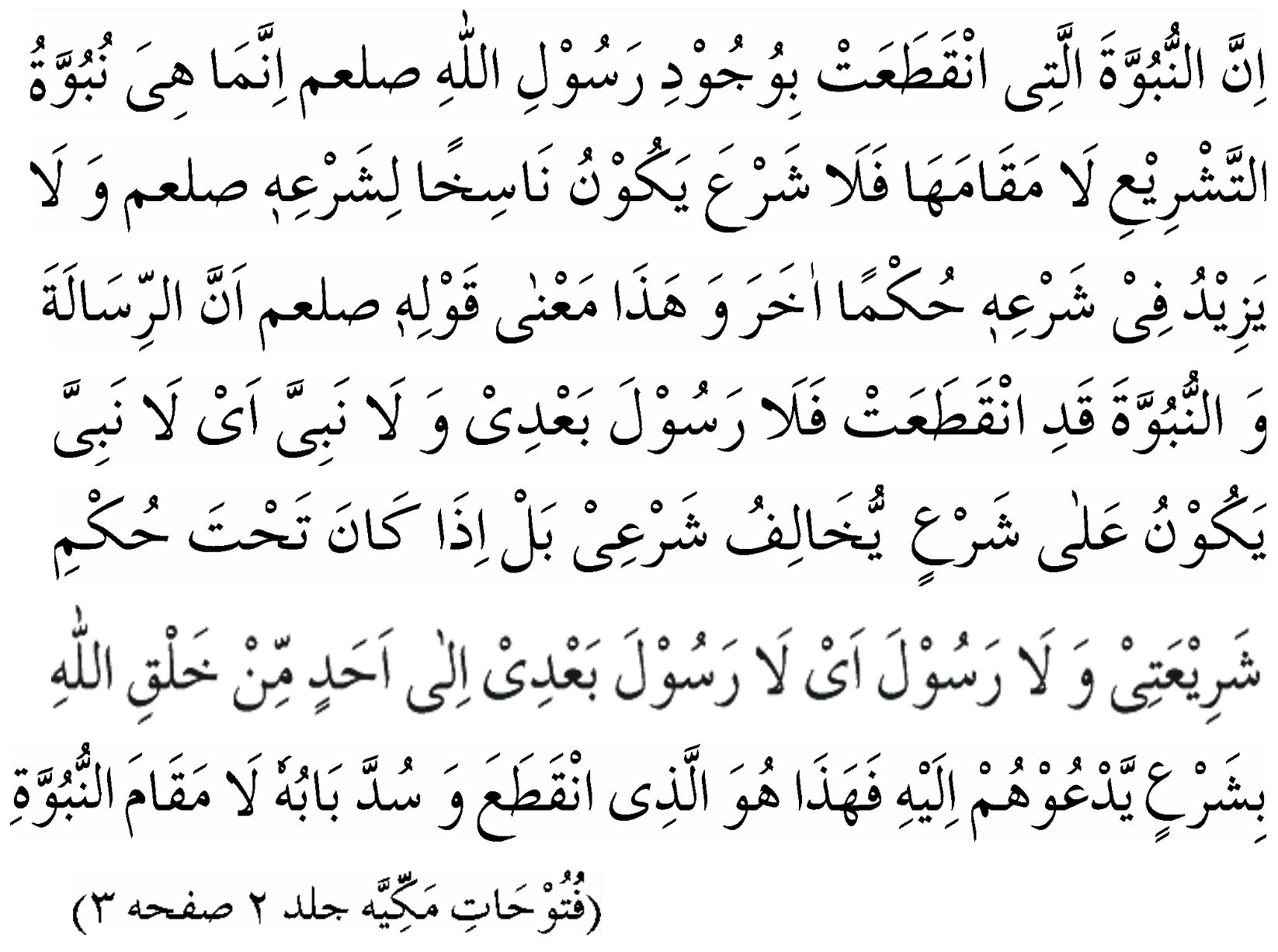
“The prophethood that came to an end with the advent of the Holy Prophet (sas) was the law-bearing prophethood and not the institution of prophethood itself. No law can now cancel the Law of the Holy Prophet (sas) or add any injunction to it. This indeed is the meaning of the saying of the Holy Prophet (sas), ‘La nabiyya ba‘di’ (there will be no prophet after me). This only indicates that there shall be no such prophet who shall introduce a different Sharia. But whenever there appears a prophet, he will follow my Sharia.” (Futuhat-e-Makkiyyah, Vol. 2, p. 3)
In the light of the above, if one genuinely desires to understand the Ahmadiyya point of view, it will further help to visualize the position and status of Imam Mahdi in Islam. If he is to be raised and commissioned by God as Imam of the latter days, and if by virtue of the same, no one is permitted to reject him, then, in essence, this is subordinate prophethood.
Prophets, one may recall, enjoy two distinctions over the rest of mankind:
They are always directly appointed by God.
Rejecting them is a grave sin in the sight of God. Hence, in the final analysis, the Ahmadiyya belief in the status of Imam Mahdi cannot be considered, even by the farthest stretch of imagination, to be in violation of the Khatm-e-Nabuwwat of the Holy Prophet Muhammad (sas).
Of course there are some other differences of minor nature for which one has to study the Ahmadiyya literature.
The demarcation line will always remain to be the same between the Ahmadiyya and non-Ahmadiyya theology. The non-Ahmadis insist on literal acceptance while Ahmadis interpret religious terms in the metaphorical and spiritual sense. This gives their beliefs a rational quality compatible with logic and science and realities of nature. Ahmadis insist that religious terminology must be interpreted in a figurative and spiritual sense and should not be taken at its face value alone. The non-Ahmadi scholars on the other hand insist that only the surface meanings of words are acceptable and that to delve deeper into their underlying sense is a futile exercise.
Yet, they themselves at some places abandon this hard and fast rule and are compelled to look beyond mere words. For instance, according to the terminology of the Holy Quran, wives are fields for fertilization; also husbands are the wives’ clothes and vice versa.
Similarly, the Holy Quran tells every human being:

‘And everyman’s works have We fastened to his neck’ (17:14)
Of course, these statements have to be interpreted. On this there are no two opinions.
Herein are the salient features of the Ahmadiyya view of the Shia sect of Islam:
The Founder of the Ahmadiyya Muslim Jama‘at loved the Holy Prophet Muhammad (sas) intensely and profoundly. So intense and profound was this love that by virtue of it he also loved and held in high esteem not only all the spiritual relations of the Holy Prophet (sas)—i.e., all true Muslims—but he loved doubly those who were, in addition, his blood relations.
Regarding the family of the Holy Prophet (sas), the following excerpt truly reflect the feelings of the Founder of the Ahmadiyya Muslim Jama‘at:
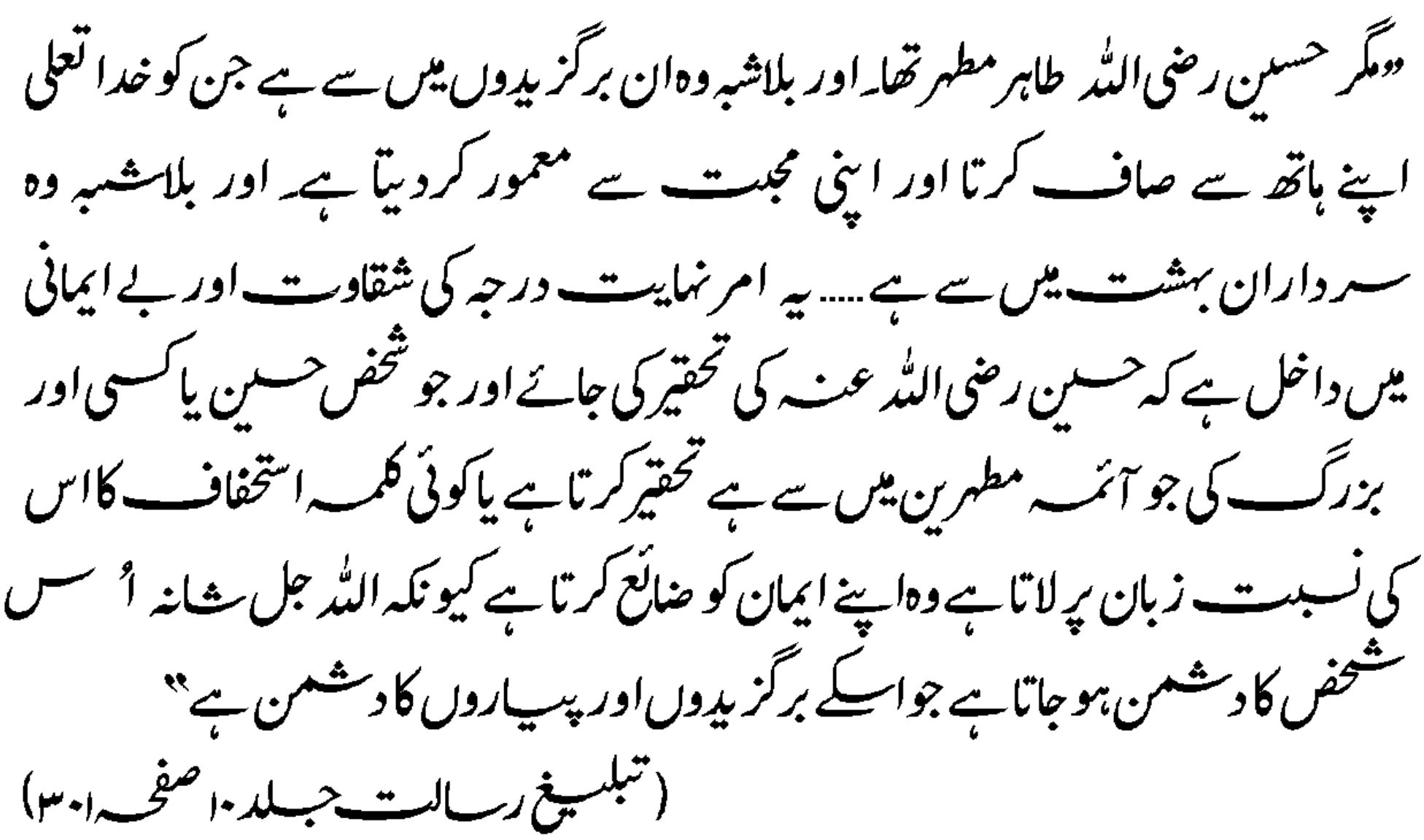
“Hazrat Hussain (may Allah be pleased with him) was pure himself and also had the capacity to purify others, and, no doubt, he was amongst Chosen Ones whom Allah purifies Himself and fills with His love. He was no doubt among the leaders of the inmates of Paradise … Only a stonehearted and faithless person could belittle him. Anyone who attempts to humiliate or utters a word of dishonour about him or about any other elder from among the ‘A’immah Muttahharin’ (the purified Imams), destroys his faith. Allah becomes the enemy of such a person who shows enmity towards His Chosen and Beloved ones.” (Tabligh-e-Risalat, Ruhani Khaza’in, Vol. 10 p. 103)
And about his love for Imams Hassan and Hussain and the progeny of the Holy Prophet (sas), the following verse speaks for itself:

“My heart and my soul are enamoured with the beauty of Muhammad (sas). May my entire self be sacrificed in the path of the descendants of Muhammad (sas)” (Majmu‘ah Ishtiharat, Vol. 1, p. 97)
All the same, according to Ahmadiyya understanding of the philosophy of Islam, no one inherits righteousness or virtue from his parents in such a way that the children of the righteous automatically become righteous and the children of the wicked become wicked.
The study of religious history does not support this notion. On the contrary, there is irrefutable evidence from the Holy Quran that Hazrat Ibrahim, one of the greatest prophets and a pinnacle of light, was born in an extremely idolatrous and ignorant family. The son of Noah, on the contrary, emerged from light and ended up in darkness.
The fountain of Islam sprang up from the idolatrous Arabia . The purest form of the Unity of God sprang up from the Arabian desert which had become the breeding ground of ignorance and idolatry and the verse:

(Disorder had truly encompassed both the land and the sea. [The Quran 30:42]), was more applicable to Arabia than to anywhere else in the world.
It reminds one of the universal truth expressed in the Holy Quran: The supreme principle which overrides every other consideration is as follows:

“Verily, the most honourable among you, in the sight of Allah, is he who is most righteous among you” (49:14)
Only those are most honoured in the sight of God who are the most God-fearing.
As a logical consequence of the same principle, although Ahmadis hold in high esteem all the Imams belonging to the Shia sect, this is because of their piety and religious knowledge and not by virtue of their birth and inheritance.
Last but not least, the Ahmadis do not believe in an absent Imam who is believed to be alive and in hiding for the last hundreds of years.
The Ahmadis believe that most probably that Imam came to a mysterious end, but because of the exigencies of the time it was not considered expedient by the Shia leadership to make it known to the public. For a while, he might have gone into hiding, but like all human beings he was called back by the Almighty. Therefore, waiting for the same Imam to reappear is like waiting for something which can never happen.
To help Shia brethren understand the grievousness of this error, Ahmadis politely point out that such tales about prophets or saints and other holy personages having disappeared only to return later are common everywhere in the world, in many countries and many religions. Many are believed to have either ascended to heaven, but none has ever reappeared personally anywhere in the world so far. So the Ahmadis try gently to persuade them to reconsider their views in the light of the realistic history of religions as described by the Holy Quran.
Any supernatural phenomenon which did not happen from the time of Adam to the time of the Holy Prophet Muhammad (sas) is most unlikely to occur afterwards.
The long-awaited Imam Mahdi therefore, as prophesied in the Traditions of the Holy prophet (peace and blessing of Allah be upon him) was meant to be born like all other holy personages before him like a humble human child and was destined to lead a life of humility and sacrifice like all other prophets.
To conclude, we most humbly point out that even scholars fall prey to hostile and one-sided propaganda against Ahmadiyyat.
Sometimes this hostility becomes so intense and infuriating that it would not allow them to read or listen to anything about Ahmadiyyat from the Ahmadiyya sources.
Recently, when an Ahmadi scholar went to Moscow to read his paper in a symposium, he also visited the central mosque of Moscow. There he found a group of ulema and their pupils busy in religious discussions. After the exchange of felicitations in the Islamic manner, they became interested in the message he had brought for them, which of course he readily conveyed.
In the beginning, all proceeded well and he was heard very cordially; but then something was said by the interpreter which changed the mood dramatically, and signs of displeasure appeared on every face. When he enquired as to what had brought this change, he was told by the interpreter, simply and frankly, that it was because he— the interpreter—had told them that the Ahmadis had changed the Holy Quran substantially. The interpreter said it so innocently that it was clear he obviously believed in this allegation.
Fortunately for the Ahmadi scholar, he was carrying a copy of the Russian rendering of the Holy Quran which had been recently published by the Ahmadiyya Muslim Jama‘at. He immediately presented this copy to the ulema for scrutiny and comparison with other copies which they had. It did not take them long of course to change their opinion and to apologize for this accusation.
Since a large majority of Russian Muslims have not even heard of the name of Ahmadiyyat hence the need for writing this brief introduction. Historically speaking, Ahmadiyyat is not altogether new to Russia. In 1919, an Ahmadi who was in the service of the British army was sent to Iran together with the members of his battalion. His name was Fatih Muhammad.
He was posted along with his battalion somewhere near the Iranian border with Russia. There, through his convincing preaching, another Muslim officer joined Ahmadiyyat. During one of the expeditions into Russian territory, Fatih Muhammad and this new Ahmadi happened to be members of an expeditionary force. It was quite common for the British army to send surreptitious fact-finding expeditions deep into the Russian territory. This new Ahmadi was also included in one of these expeditions.
It so happened that one day, they came upon a town where they found a domed building which looked very much like a mosque. But when they entered, they found a different type of arrangement inside: Instead of mats and carpets in the prayer hall, there were chairs which are not customarily provided in the prayer halls. Fortunately there were some people present who, when questioned about the presence of these chairs in the mosque, explained that they regularly held preaching sessions in the mosque which were attended frequently by members of other faiths, like Jews, Christians, etc.. As such, they considered it necessary that comfortable seating be made available for the visitors. Hence the chairs.
They were then questioned further as to who they were, and they said they were Muslims of course. Fatih Muhammad enquired whether they believed that Jesus was alive in heaven. They said that he had passed away like all prophets of God. Thereupon, Fatih Muhammad observed that since Jesus was to come back and what did they think of that. They replied that it would not be the same Jesus who was to be sent back but someone from the umma of the Holy Prophet (sas) was to be raised as Jesus (as), in the spirit and character of Jesus (as). As such he too would be entitled Jesus or the Messiah.
When questioned that Muslims were expecting the advent of Jesus himself, how could they explain this contradiction? If Jesus was dead, how could he come back? At their answer, Fatih Muhammad exclaimed that the beliefs they were holding were those of Ahmadiyya Muslim Jama‘at founded by Hazrat Mirza Ghulam Ahmad of Qadian. They responded, “We are his followers, of course.”
The name of this town was Ashkhabad. According to the account of these early Ahmadis, they were facing many difficulties because of the hostile orthodox clergy who referred to them as ‘sabi’.
This indicates clearly that the message of Ahmadiyyat had already reached Russia before the Second World War. But unfortunately, the ulema of India had also succeeded to some extent in spreading negative propaganda to poison the Russian minds against Ahmadiyyat.
Later, on December 10, 1924, a dedicated and zealous Ahmadi Missionary, charged with the spirit of service for Islam, Maulawi Zuhur Hussain, proceeded to Russia on his own to deliver the message of Ahmadiyyat to the people of Russia under the instructions of the Second Khalifa. His mission was very hazardous and challenging in nature, because in the wake of the newly established Bolshevik revolution, every British citizen was treated with great suspicion. Any such citizen who ventured to enter Russia was assumed to be a spy. No exception was made in the case of Maulawi Zuhur Hussain who was arrested.
Soon after his arrival, he was put through severe interrogation and mental and physical torture.
Although, later on, this Ahmadi Missionary lost his mind through unrelenting torture and extremely hard and trying conditions in Russian prisons in those days, but before that he continued delivering the message of Ahmadiyyat to the inmates of the prisons. There were also many other converts through the efforts of ‘Abdul Qadir, one of the later converts.
At last this pioneer missionary, in that precarious state of mind and body was thrown out somewhere across the Turkish border with Russia. Properly taken care of by the Turkish authorities, he slowly recovered and returned to Qadian. His book is a very interesting record of extreme hardship and hazards which religious movements face during their nascent periods.
Another Ahmadi, who undertook a journey to Russia on his own and voluntarily for the purpose of delivering the message of Ahmadiyyat was Muhammad Amin Khan. He too visited Russia in 1922 en route from Baluchistan and Iran. He was repeatedly imprisoned by the Russian police and escaped time and again with the help of Russian Muslims and thus delivered the message for about a year before he was ultimately thrown out of Russia. He was more fortunate than Maulawi Zuhur Hussain in having a smaller share of punishment and torture and having enjoyed a greater opportunity to travel more widely and successfully delivering the message of Ahmadiyyat.
During that time he visited Samarkand, Bukhara and Tashkent and made some converts there, especially someone called ‘Abdullah in Tashkent and another person called Muhammad Hussain in Bukhara. One wonders if their progeny still belong to the Ahmadiyya Muslim Jama‘at. One can only hope so.
The Head of the Ahmadiyya Muslim Jama‘at is incidentally referred to as Imam but it does not have the same connotation as that of the Ithna ‘Asharah or Isma‘ili Imams. It means only a spiritual and religious head. The correct title however is that of Khalifatul Masih, Successor to the Promised Messiah. This also gives Jama‘at Ahmadiyya a unique position in the community of Muslim sects. After the break of the institution of Khilafat in early Islam, it is only the Ahmadiyya Muslim Jama‘at in Islam which has been blessed with Khilafat. And the institution of Khilafat has been established and the Khalifa plays the same role of head and heart as was played by the Holy Successors of the Holy Prophet Muhammad (may peace and blessings of Allah be on him). He does not succeed the previous Khalifa after his death by virtue of inheritance but is elected by an electoral college and immediately after his election, the entire worldwide Ahmadiyya Muslim Jama‘at take the oath of allegiance at his hands as they had taken it at the hands of the earlier Khulafa’. He combines in his person religious, administrative and spiritual functions. There is a very strong bond of spiritual love between him and members of the Jama‘at from all over the world.
Ahmadiyya Muslim Jama‘at, despite all the hostility and gigantic efforts to obstruct its passage has progressed in the last 100 years so rapidly and widely that one is left with wonder and amazement.
Hazrat Mirza Ghulam Ahmad of Qadian raised a lone voice when he was commissioned by God on 23rd March 1889 to invite mankind to Islam and to rejuvenate and revive the Muslims and under divine guidance to rectify their beliefs and practices. These errors of belief and practice had strongly infiltrated into the Muslim umma particularly in the 13th century since the demise of the Holy Prophet (sas). Some of the major tasks assigned to him as Imam Mahdi were to revive the spirit and quality of Muslim faith and practice and to resolve their differences under divine guidance. In a short span of 100 years ending on 22nd of March 1989 that one man had grown into 10 millions according to some estimates and the Jama‘at had spread and got firmly rooted in 120 countries of the world. This reminds one of a promise given to him by God in the early days of his ministry when the world at large seemed to have rejected him. That promise gave him assurance:

‘I shall cause thy Message to reach the ends of the earth’
The end of the 1st Century of Ahmadiyyat did see without any doubt the fulfilment of that promise.
The spectacle of an organization as wide and as demanding as mentioned above may prompt people to ask where do the finances come from to support and maintain the work of this dynamic and progressive Jama‘at?
The brief answer to this question will be found in the following verse of the Holy Quran:

“Surely, Allah has purchased of the believers their persons and their property in return for the Garden they shall have.” (9:111)
All true religious movements not only require extreme financial sacrifices but also require personal sacrifice by way of dedication of one’s life for the sake of the noble ideals of religion. As such the worldwide Ahmadiyya Muslim Jama‘at is run entirely on the voluntary contributions of its members. But that is not all. Thousands of devout Ahmadis, men and women, young and old all offer and dedicate their lives unconditionally for the service of Islam.
They make no demands whatsoever about pay or remuneration. Whatever the Jama‘at deems fit they accept willingly and thankfully perform their duties and consider it a blessing of God to be able to do so. They constitute the central core of the Ahmadiyya workers who work in various capacities in the Centre and various countries of the world. They do not belong to any one country or class but hail from different countries, nationalities and different walks of life and get completely assimilated into one united brotherhood which is bonded together with the double bond of love for God and love for humanity.
A characteristic distinction of Ahmadiyya Jama‘at is its belief in the power of prayer and communion with God. By prayer we do not mean just the prescribed daily obligatory or supererogatory prayers.
The Ahmadiyya Muslim Jama‘at profoundly believes in a Living God Who cares for His servants and responds to their prayers and displays the Signs of His existence to every seeker by responding to their prayers.
The Jama‘at is unique in this respect. Its members pray to God whenever they face a difficulty or problem and whenever they stand in need of anything the first thought that crosses their mind is recourse to God.
As such it is not a few legendary saintly figures who are reported in every religion to have achieved communion with God, it is the experience of a large number of Ahmadis who establish personal, live and constant relationship with God and become witness to the Signs of His existence in their personal day to day experience.
Similarly they seek help from each other with regard to their problems, not by begging for material help but imploring them to pray for them and not infrequently God reveals to many of them through dreams, visions and revelations, the fulfilment of which as predicted immensely enriches the quality of Ahmadiyya faith.
This is the greatest blessing they are granted by responding to the call of the Imam who throughout his life is a living Sign of the power of prayer and teaches his followKhalifaers to directly reach God and make it a constant habit to remember Him, to pray to Him and to seek His help every moment of their lives.
Following is an excerpt from the writings of Hazrat Mirza Ghulam Ahmad (on him be peace) about the need and power of prayer:
“Have you any notion of the strange things that happened in the desert of Arabia when hundreds of thousands of the dead were revived within a short time and those who had been misguided through generations put on divine colour, and those who were blind obtained sight, and those who had been dumb began to speak of the understanding of the Divine, and the world underwent a revolution which had never been seen or heard of before. It was the supplications during dark nights of one who had lost himself in God which brought about this transformation, and manifested such wonders as appeared impossible in the case of that unlettered and forlorn prophet. Send down Thy blessings and peace O Allah on him and his people according to the amount of grief and sorrow he felt for his fellows and pour down upon him the light of Thy mercy for ever.” (Barakat-ud-Du‘a, Ruhani Khaza’in, Vol. 6, pp. 10-11)
1 Our master. [Publisher]
2 Allah and His angels send blessings on the Prophet. O ye who believe! you also should invoke blessings on him and salute him with the salutation of peace (33:57) [Translator]
3 By Hazrat Mirza Ghulam Ahmad (as). [Publisher]
