‘Arab-e-‘Āribah: Refers to the ancient and actual inhabitants of the country, which have then been further divided into two categories:
A) Those ancient inhabitants of Arabia who passed away prior to Islām. Due to the remoteness of their existence, their detailed particulars are obscured. Yet it is known that they consisted of many tribes who inhabited various parts of the country, and among them, some tribes possessed powerful and civilised governments. Among these tribes, the names of those well-renowned are ‘Ād, Thamūd, Ṭasm, Jadīs, and Jurhumul-Ūlā’. The homeland of ‘Ād was in Aḥqāf and Thamūd inhabited Jauf, which was located to the north of Ḥijāz. Due to the destruction of these ancient tribes they are also referred to as ‘Arab-e-Bā’idah1.
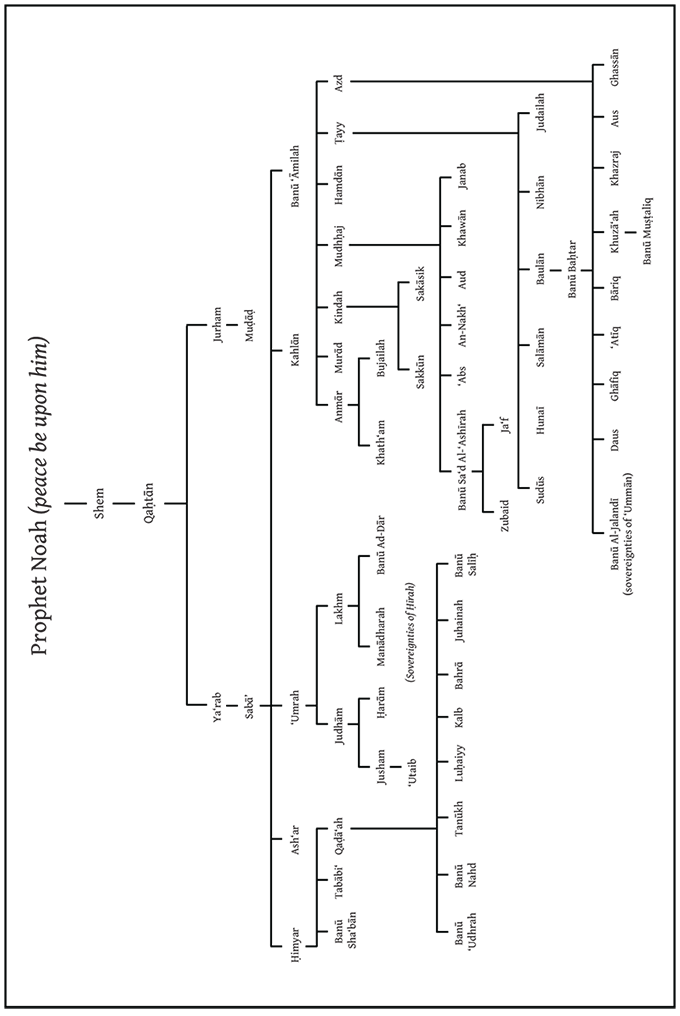
B.) The tribes referred to as the Banū Qaḥṭān, which from various narrations, were the children of Prophet Hūdas.2 Nonetheless, after ‘Arab-e-Bā’idah they dispersed throughout the country. Their actual homeland was Yemen, and from here, they disseminated throughout Arabia and were thus divided into various branches.
To the north of Arabia, next to the sovereignties of Persia and Rome, there were the prominent governments of Ḥīrah and Ghassān, respectively. Their rulers were also from the Banū Qaḥṭān. At the advent of Islām the Banū Qaḥṭān had expanded significantly and possessed strength within the country. A better part of the country was populated by them. The tribes of Madīnah known as the Aus and Khazraj were also from the Banū Qaḥṭān.
In certain instances the term ‘Arab-e-‘Āribah is used only to refer to the Banū Qaḥṭān, for which the reason seems to be that among the ancient and actual inhabitants of Arabia, it was this tribe alone who had continually resided in this country.
The genealogical tree of the tribes of the Banū Qaḥṭān is provided below:
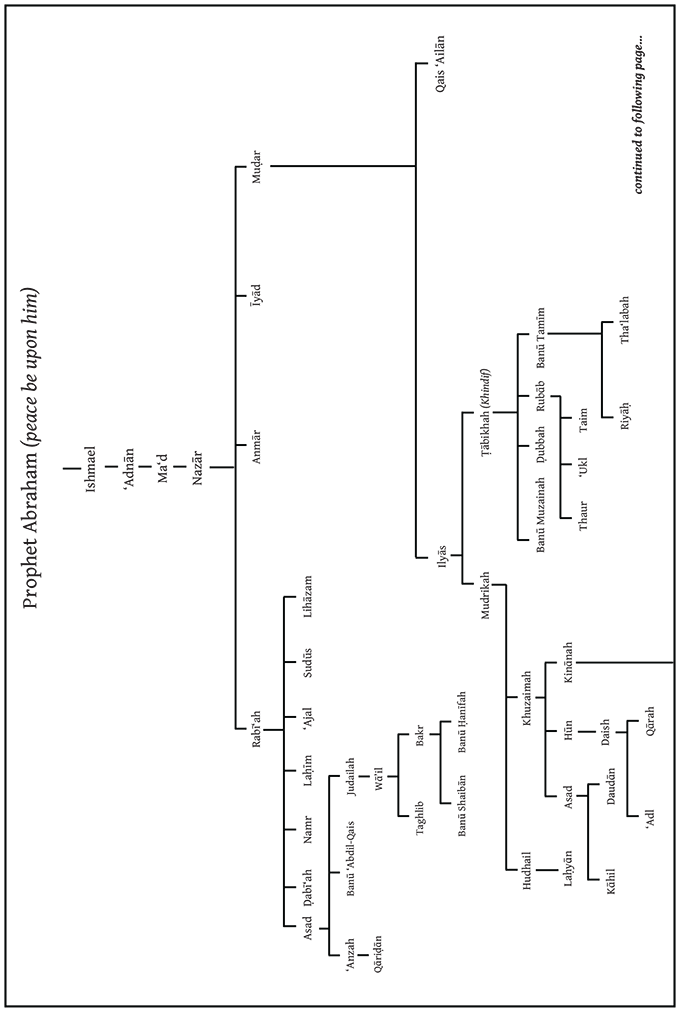
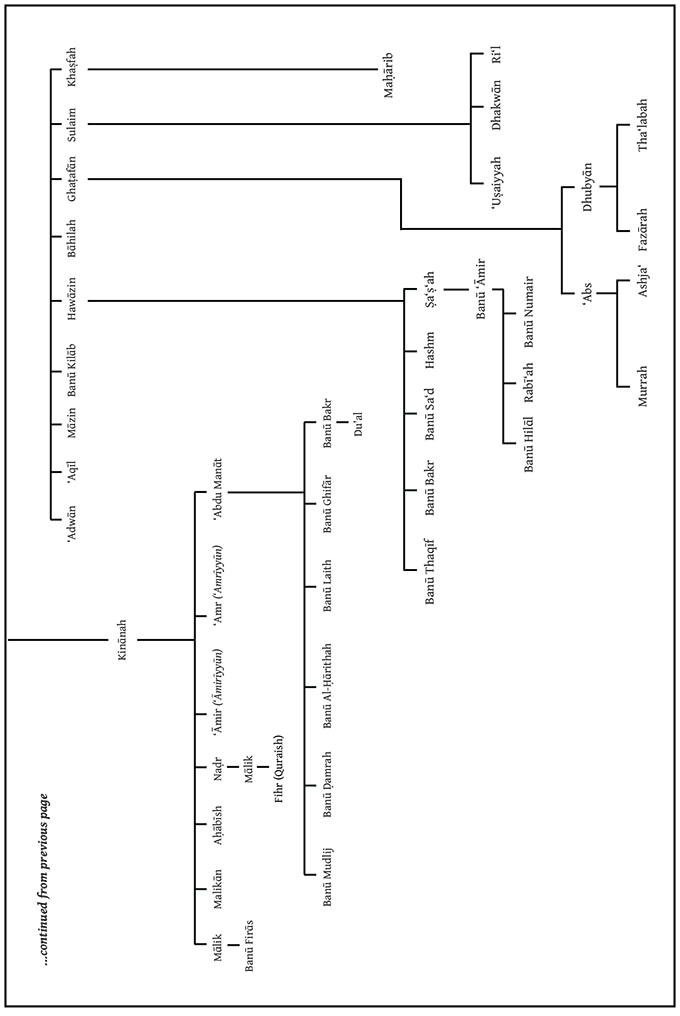
‘Arab-e-Musta‘ribah: Refers to the people who immigrated and thus inhabited Arabia. Among them are predominantly the children of Ishmaelas, son of Abrahamas, who settled in Ḥijāz. They are also referred to as ‘Adnānī, for among the children of Ishmaelas the most significant individual from which these people spread was a man named ‘Adnān. Gradually, the Banū ‘Adnān were also divided into many smaller branches and dispersed to various parts of the country. The Quraish, into which the Holy Prophetsa was born, were also a branch of the Banū ‘Adnān. As shall become apparent ahead, the Quraish were the most powerful and influential tribe among the ‘Arab-e-Musta‘ribah at the time of the advent of Islām.
In regards to the ‘Arab-e-Musta‘ribah it should be kept in mind that ‘Adnān was born many generations after the Prophet Ishmaelas. However, there is a disaccord in the narrations relevant to the genealogical links of Ishmaelas and ‘Adnān. Therefore, various non-Muslim historians have found the opportunity to raise objections as to whether the Holy Prophetsa was even among the descendants of Ishmaelas. However, the narrations of Arabia unanimously concur that Ishmaelas immigrated and settled in Arabia. Moreover, the narrations of Arabia are also unanimous in the fact that ‘Adnān was among the descendants of Ishmaelas. Therefore, with regards to the connecting genealogical links of these two individuals, a dissention in opinion does not at all affect the actual issue at hand.3
In any case, the genealogical tree of the eminent tribe of ‘Adnān is provided below: