Evidence from Islamic Literature concerning Jesus’ Journeys
On page 130-135 of Rauzat-us-Safaa, a well-known book of history in the Persian language, we find an account which, briefly translated, reads as follows:
Jesus was named the Messiah because he was a great traveller. He wore a woolen scarf over his head, and a woolen cloak on his person. Carrying a staff in his hand, he used to wander from country to country and city to city. He slept wherever the night found him. He ate vegetables of the jungle, drank fresh water, and travelled on foot. His companions, in one of his travels, once bought a horse for him; he rode the horse one day, but as he could not make any provision for feeding it, he returned it. Journeying from his country, he arrived at Nasibain, which lay at a distance of several hundred koses from his home. He was accompanied by a few of his disciples whom he sent into the city to preach. In the city, however, false and unfounded rumours were current about Jesus and his mother. The governor of the city, therefore, arrested the disciples and summoned Jesus. Jesus miraculously healed some patients and showed some other miracles. As a result, the king of the territory of Nasibain, with all his armies and his people, became his follower. The incident about the ‘coming down of food’ mentioned in the Holy Quran took place during his travels.
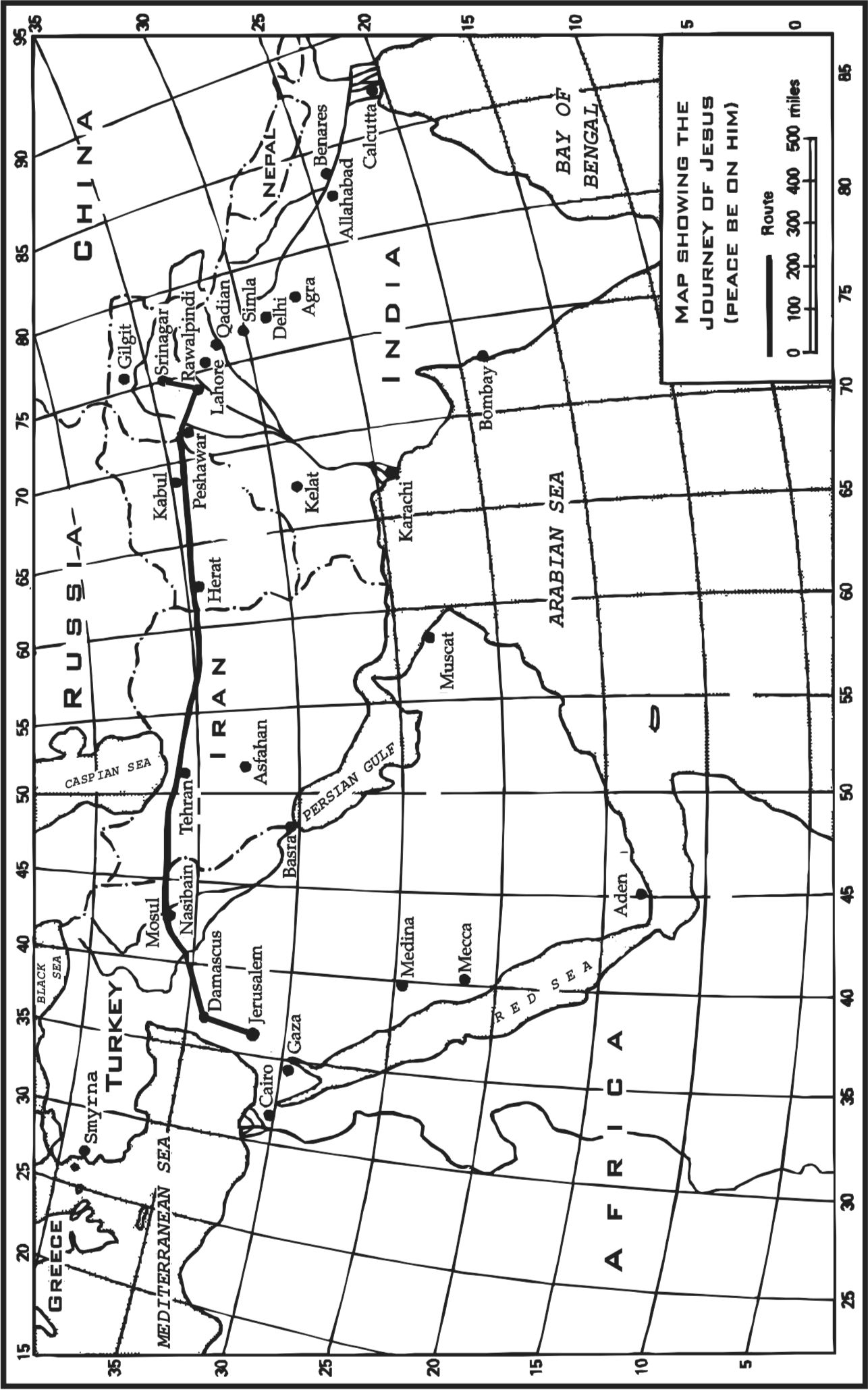
This, in brief, is the report given in Rauzat-us-Safaa. The author of the book, however, has also ascribed many an absurd and irrational miracle to Jesus, which I regret to leave aside, and keeping my account free from falsehood and senseless exaggerations, I turn to the real point at issue which leads to the conclusion that Jesus in the course of his travels, had arrived at Nasibain. Nasibain is a place between Mosul and Syria which, in English maps, has been shown as Nasibus. If one travels from Syria towards Persia, one would pass through Nasibain, which is at a distance of nearly 450 koses1 from Jerusalem. Mosul is nearly 48 miles from Nasibain and 500 miles from Jerusalem. The frontier of Persia lies at a distance of a mere 100 miles from Mosul. This means that Nasibain is 150 miles from the frontier of Persia. The eastern frontier of Persia touches the town of Herat in Afghanistan. Herat lies on the western frontier of Afghanistan in the direction of the Persian territory and is about 900 miles from the western boundary of Persia. From Herat up to the Khyber Pass, the distance measures about 500 miles. The map showing the route followed by Jesus is given here. It shows the route taken by Jesus in his journey to Kashmir. The object of his journey was to meet the Israelites whom the king, Shalmaneser, had taken as captives to Media.2
It should be noticed that in the maps published by Christians, Media is shown towards the south of the Sea of Khizar (Azov), where today we find Persia. This means that Media was at any rate a part of the land which today constitutes Persia. The eastern frontier of Persia is adjacent to Afghanistan; there the sea is towards the south and the Turkish Empire towards the west. If the report in the Rauzat-us-Safaa is correct, it appears that, by travelling to Nasibain, Jesus intended to go to Afghanistan through Persia, and to invite to the Truth the lost tribes of Jews who had come to be known as Afghans.3 The word ‘Afghan’ appears to be of Hebrew origin; it is a derivative which means ‘brave’. It appears that at the height of their victories, they adopted this name for themselves.
In short, Jesus came to the Punjab after passing through Afghanistan, with the ultimate intention of going to Kashmir after exploring the Punjab and Hindustan. It should be noted that Chitral and a strip of the Punjab separate Kashmir from Afghanistan. If one travels from Afghanistan to Kashmir, through the Punjab, one has to journey over a distance of 80 koses or about 130 miles, and via Chitral it would be 100 koses.4
Jesus, however, wisely took the route through Afghanistan, so that the lost tribes of Israel, known as Afghans, might profit from his presence. The eastern frontier of Kashmir touches Tibet. From Kashmir, he could easily go to Tibet. Having come to the Punjab, he had no difficulty in wandering through the important places of Hindustan before going to Kashmir or Tibet. It is, therefore, quite possible, as some old historical records of this country bear out, that Jesus may have been to Nepal, Benares, and other places. He then must have gone to Kashmir through Jammu or Rawalpindi. As he belonged to a cold country, it is certain that he stayed in these parts only through the winter, and, by the end of March or the beginning of April, must have set out for Kashmir. As Kashmir resembles Shaam,5 he must have taken up permanent residence in this land. It is also possible that he may have stayed for some time in Afghanistan and it is not improbable that he may even have married there. Since one of the tribes of Afghans is known as Isa Khel,6 it would not be surprising if they were descendants of Jesus. It is to be regretted, however, that the history of Afghanistan is in a confused state. It is, therefore, difficult to arrive at anything definite by studying their tribal chronicles. There is no doubt, however, that the Afghans are Israelites, like the Kashmiris. Those who have taken a contrary view in their writings have been misled in the extreme; they do not seem to have studied the matter closely. The Afghans admit that they are the descendants of Qais and that Qais belongs to the house of Israel. It is, however, not necessary to elaborate the point here. I have already dealt with this question at length in one of my books. Here, I am describing the journey of Jesus through Nasibain, Afghanistan, the Punjab and on to Kashmir and Tibet. It was on account of this long journey that he was named ‘the travelling prophet’, or even ‘the leader of travellers.’ A Muslim savant, Arif Billah Abi Bakr Muhammad bin Muhammad Ibn-ul-Walid Al-Fahri Al-Tar-tooshi Al-Maaliki, who is renowned for his learning, states about Jesus, on page 6 of his book Siraaj-ul-Muluk, published by the Khairiyah Press of Egypt in 1306 A.H.:

Where is Isa, the Ruhullah, and the Kalimatullah, the leader of the righteous, and chief of travellers?
This means that Jesus was dead, and that even a great man like him had departed from this world. It should be noted that this learned authority calls Jesus not merely ‘a traveller’ but ‘the chief of travellers’.
Likewise, on page 431 of Lisaan-ul-Arab it is stated:

Jesus was named ‘Messiah’, because he travelled about, and did not stay at one place.
The same is recorded in Taajul-Urus Sharah Qaamus. Therein it is also stated that the Messiah is one who has been blessed with innate righteousness and piety, so much so that even his touch is blessed and that God gave this name to Jesus because He gives it to whomsoever He pleases. Opposed to him is the so-called Messiah who is tainted with evil and accursedness. He is innately evil and accursed. His very touch results in evil, sinfulness, and imprecation. This name was, therefore, given to Dajjal, the Antichrist and to all those who are like him. The two names, Messiah the Traveller and Messiah the Blessed, are not antagonistic to each other. One does not invalidate the other. For, it is a divine practice that God names a man in more than one way and all such names rightly apply to him. In short, Jesus being a traveller has been so well proved by Islamic history that if all the references were copied from those books, I am afraid they would run into a huge tome. What I have stated, therefore, should suffice.
1 This is a misprint in the first edition. It should be 450 miles not koses. (Translator)
2 Note: There is a letter in the 14th section of the first chapter of the history in Greek of the 'Creed of Eusebeus', translated by a Londoner, Heinmer by name, in 1650 A.D., which shows that a king, Abgerus by name, invited Jesus from the land beyond the Euphrates, to his court. The letter sent by Abgerus to Jesus, and the reply to it, are full of fabrications and exaggerations. This much, however, seems to be true, that the king having been apprised of the cruelties of the Jews invited Jesus to his court to give him refuge. The king probably believed that he was a true prophet. (Author)
3 In the Torah there was a promise to the Jews, that if they believed in the 'last' prophet, they would, after passing through much suffering, have their own sovereign kings and rulers. That promise was fulfilled by the ten tribes of Israel adopting Islam. That is why there have been great kings among Afghans as well as among Kashmiris. (Author)
4 162 miles approximately. (Translator)
5 Syria and its neighbouring areas (Translator)
6 After the name of Jesus (Isa). (Translator)