The Good Deeds of Those Who Make Sacrifices to Win the Pleasure of Allah the Almighty Never Go to Waste
Friday Sermon, June 2, 1967, Mubarak Mosque, Rabwah.
“Having witnessed the bounties and blessings of the House of Allah the world will realize that those who make great sacrifices to win the pleasure of Allah, and turn their back on the world becoming solely His, their good deeds never go to waste. On the contrary, they receive sweet fruits and the best recompense of their accepted deeds, and their humble and lovingly performed deeds yield the best results.”
After Tashahhud, Ta‘wwuz and Surah Al-Fatihah, Huzoor said:
The sixteenth objective of building the Ka‘bah is discussed in  (and provide its dwellers with fruits). It was expressed that having witnessed the bounties and blessings of the House of Allah the world will realize that those who make great sacrifices to win the pleasure of Allah, and turn their back on the world becoming solely His, their good deeds never go to waste. On the contrary, they receive sweet fruits and the best recompense of their accepted deeds, and their humble and lovingly performed deeds yield the best results.
The Holy Quran itself claims that this objective also has found fulfilment in the person of the Holy Prophet (saS) and the Quranic shariah. As Allah says in Surah Al-Qasas:
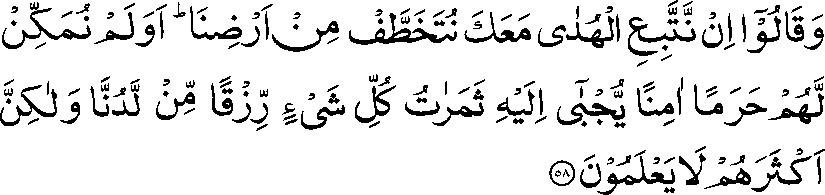
“And they say, If we were to follow the guidance with thee, we should be snatched away from our land.’ Have We not established for them a safe sanctuary, to which are brought the fruits of all things, as a provision from Us? But most of them know not.”1
That is, when the Quranic shariah, its guidance and its teaching is presented to the people it is meant for, they say: If we were to follow the guidance you have brought, we should be snatched away from our land. The world would become our enemy and adversary, and would take on to annihilate us. We cannot stand against them. Why should we cause the means of our destruction by embracing this teaching? God Almighty says:  (Have We not established for them a safe sanctuary.) That is, do they not know that We linked this Prophet and the shariah with Haram, and made the House of Allah an emblem of the fact that the Prophet and its followers would be under the protection of God Almighty, and that the responsibility of protecting the shariah, revealed to the Prophet, would also be only on Him.
The world history bears testimony that Allah the Almighty has kept His promise of protecting the Haram (precincts) of the Ka‘bah. The assaulters have always suffered disgrace and been routed. The world also bears testimony and will continue to do so that no power, no machination or conspiracy of the world can frustrate the Holy Prophet (sa) and his objective; nor can any interpolation find its place into the Quranic shariah.
Here Allah the Almighty says that do they not see that We have settled them in a protected and peaceful place: in the sanctuary of the Ka‘bah, in the sanctuary of the nobility of the Holy Prophet (sa) and in the sanctuary of the Islamic shariah, that is, the Holy Quran. All of these are protected entities, personages and places. If you establish a firm relationship with this Haram [the precincts of Ka‘bah] you, too, will come under the protection of God Almighty as the Haram is under His protection. And the notion will be dispelled that 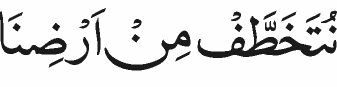 (we should be snatched away from our land) that is, any power in the world can ruin you. Then Allah the Almighty says,
  (to which are brought the fruits of all things) that is, We have associated with the Haram that every type of fruits are brought here. It implies that a person becomes able to perform all kinds of good deeds by establishing his ties with this House. A man is enabled to do this only by the help of God Almighty, and the best results thereof have been promised as well. Thus, anyone who is sincere in his intention and intends no mischief can achieve these fruits. In short, here Allah the Almighty has made it clear by associating
  (to which are brought the fruits of all things) with Haram and then by presenting Haram as an argument in refutation of their assertion
  (And they say, ‘If we were to follow the guidance with thee, we should be snatched away from our land’) that the fruits and rewards mentioned in the Ibrahimic prayers were, are, and will remain associated, as a matter of fact, with the Holy Prophet (sa) and his umma.
A detailed description of the fruits ( ) has been given in Surah Muhammad in the Holy Quran. Allah the Almighty says:


“A description of the Garden promised to the righteous: therein are rivers of water which corrupts not; and rivers of milk of which the taste changes not; and rivers of wine, a delight to those who drink, and rivers of clarified honey. And in it will they have all kinds of fruit, and forgiveness from their Lord.”2
Allah says in this verse that the righteous who carry out this direction, which has been termed as, “a guidance for the righteous” (in the beginning of Surah Al-Baqarah), their firm faith and true beliefs are transformed into a garden, or trees. Their faith and beliefs are transformed into trees metaphorically in this world and in reality in the next one. Allah the Almighty says here that those who, by following Our direction, become righteous in true sense, are bestowed upon a heaven that has all types of trees in it. And  (therein are rivers of water which corrupts not), that they are enabled to perform the good deeds and are bestowed upon such cheerfulness of heart that having tasted them once they do not bid farewell to those deeds at any cost. Allah says that the good deeds will be transformed into such canals, in this world and in the next as well, that their water will never contaminate, that is, once the righteous people become addicted to the good deeds, this addiction will never be beaten. When they start carrying out good deeds in true sense and with sincerity of heart, in accordance with the directives descended onto them from Allah the Almighty, further gates to Divine success would be opened to them. Things which were previously covered and were Divine secrets would be revealed and disclosed to them and as a result the spiritual station of a believer would improve. And this state
  (and rivers of milk of which the taste changes not) would take the form of such milk which would never go bad. Then as a result of these Divine sciences they would develop a true and sin-effacing bond with Allah. They would take a death onto their self; they would lose themselves in the love of Allah the Almighty, and remain intoxicated with His love, thus the state they are in would be transformed into
  (and rivers of wine, a delight to those who drink). This also implies that he who has no such experience would not approve of the taste. It is for this reason that such people do not incline to the Divine love, as thistles of various trials have also been planted by this canal. But whoso has tasted it once and has attained to the love of Allah the Almighty only he can tell that the pleasure he finds in the love of God is not found in anything else. And then Allah says that whoso consumes himself in the love of Allah the Almighty is destined to enjoy
  (and rivers of clarified honey) whereby he is cured of all the ailments. No disease can attack him thereafter. He is cured completely and becomes immune from all satanic attacks as if he has come in the lap of God and is safeguarded against all kinds of dangers. This state of (and rivers of clarified honey) will be produced in a form in this world and also in another form in the next world.
Then Allah the Almighty says,  (in it will they have all kinds of fruit) that you will get these fruits from Islam, that is, you will be given all kinds of fruit. All kinds of trees will be there, and the true beliefs will take the form of trees. On account of your faith you will perform good deeds bearing with every tribulation with zeal and pleasure. Then the good deeds will be transformed into water canals which will irrigate the orchards. An orchard cannot flourish without water, and a man cannot uphold correct beliefs without good deeds. One has to change his dogma when deeds are no longer good. The phrase
 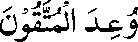 (the righteous have been promised) hints to this very fact. Therefore, we cannot say that the Quranic shariah can be corrupted, for no corruption can find its place into the Holy Quran. But it is man who has to act righteously on account of this belief. Thus, the Holy Quran says that only Allah can enable man to perform good deeds, and this ability will be so pure that
  (corrupts not). Then he will be forever safeguarded against any incitement from Satan to the opposite direction.
Thereafter the Divine sciences and secrets will be disclosed to him which will take the form of milk. Owing to the disclosure of the Divine secrets his heart will feel a very deep love for his Lord; and that love will take the form of  (rivers of wine, a delight to those who drink). Then as the outcome of that he will be safeguarded against every spiritual disease, that is, he would be endowed with
  (rivers of clarified honey). In short, these are the fruits that Islam offers him; and these are the fruits which have been mentioned in this verse and for which Ibrahim (as) had prayed
  (and provide its dwellers with fruits).
God Almighty says, 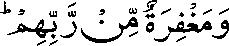 (and forgiveness from their Lord) that you could not have got the fruits only on account of your deeds unless you had also been granted forgiveness by Allah the Almighty. And the promise of this forgiveness also has been given only by Islam. The Promised Messiah (as) has not referred to the verse though, but so far as I have reflected, you, too, will reach the same conclusion if you go through it that the Promised Messiah (as) has expounded on the verse in the following extract which I am going to read to you. The Promised Messiah (as) says in A’inah’-e-Kamalat-e-Islam:
“Now, to some extent, I would like to enlarge upon as to what the fruits of Islam are. Be it known that when a true seeker of his Lord establishes himself fully on Islam, and all his faculties, not artificiality or with affectation but in a natural way, begin to tread upon the paths of God Almighty, then the ultimate result of this state of his is that the higher manifestations of Divine guidance, freed from all obstructions, are directed towards him. And diverse types of blessings descend upon him; and the commandments and doctrines, which were accepted as mere faith and hearsay, are now clearly manifested to him through true dreams and visions, and definite and certain revelations. The difficult points and obscurities of the shariah and faith and hidden secrets of the Ibrahimic millat (people) are revealed to him, and he is afforded a visit of the Divine kingdom so that he should attain the perfect station of certainty and realization. His tongue, his words, all his actions and his movements are blessed. He is invested with extraordinary valour, steadfastness and courage. And he is afforded a high level of conviction. The narrow-mindedness of human obstructions, meanness, miserliness, frequent stumbling, short-sightedness, servility to lasciviousness and lowliness of morals and every kind of egoistic darkness are totally removed from him and instead he is filled with the light of godly morals. Thereupon, undergoing an entire transformation he adopts the behaviour of a new birth and he hears through God Almighty, sees through God Almighty, moves with God Almighty and stops with God Almighty. His wrath becomes the wrath of God Almighty and his compassion becomes the compassion of God Almighty. At that station his prayers are heard as a token of his having been chosen and not as a trial; and he becomes Hujjatullah and Amanullah on the earth. Jubilation is celebrated in the heavens because of him; and the highest gift that is bestowed upon him is the Words and Discourses of God, which, free from any doubt, misgiving and dust, like the light of the moon, continue descending upon his heart; and carry an intensely effective sense of rapture with them and afford tranquillity, serenity and satisfaction.”3
These are the fruits that were promised to Hazrat Ibrahim (as) and these are the fruits which have been granted to the umma of Muhammad (sas) so abundantly that a man who has insight is dazzled to behold them.
The seventeenth objective was discussed in 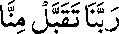 (Our Lord, accept this from us) and it was pointed out that the value of deeds is nothing until they are granted acceptance. Therefore, the achievement of spiritual heights is possible only by means of prayer. The verse contained a clue that a great Prophet would be raised here [in Mecca] by whose spiritual munificence an umma would be raised who would understand the fact that even utmost sacrifices are fruitless and futile until the grace of God is absorbed through humble prayers. Thus they would attain the higher station of realization only by means of prayers, and it is only through prayers that they would get the best results of their deeds.
The Holy Quran discusses these three objectives in great detail. In my view no other religion has shed light on prayer and its acceptance the way Islam has. Therefore, no other religion can be presented at all in comparison with Islam. Towards the end of Surah Al-Furqan Allah the Almighty talks about ‘Ibadur Rahman that they are those who carry out so and so deeds, or refrain from so and so deeds, etcetera. Ar-Rahman means, that Holy Being (Allah) Who, without the deed of any doer or without the entitlement of anybody, shows His favour on him. Next are discussed all the deeds of ‘Ibadur Rahman which look to be related to the attribute of Rahimiyyat.
Thus, the point of discussion here is that you may perform good deeds in as many a number as you want, but you will not receive any reward unless the bounties of Rahmaniyyat are added to Rahimiyyat. For this reason concluding the current topic He [Allah] said in very glorious terms:

“Say to the disbelievers: ‘But for your prayer to Him my Lord would not care for you. You have indeed rejected the truth, and the punishment of your rejection will now cleave to you.’”4
True that carrying out good deeds is essential and abstaining from evil deeds is also good for man; but remember, God would not care for you or gain anything from your good deeds at all 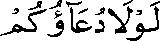 (but for your prayer to Him). But if you care about Him then you should try to absorb His grace through prayers. When you will have absorbed His grace through your prayers only then will your deeds truly benefit you. Mere prayer is useless if its acceptance is not acquired with it, and to achieve that man needs Allah’s grace, and again for that man needs to invoke prayer. Hence, one should always keep himself busy praying, O God! whether we do something good or not, our prayers for the acceptance of our good deeds can reach You only when You will have decided to accept our supplications. Thus, for acceptance of prayer, again supplication is entreated. Allah the Exalted says at this point that God does not care for you in the least; He does not at all care for your deeds; He does not care for your sacrifices at all; and He does not care for your charity at all that you give in His way. Are His treasuries empty that He should seek your wealth? You comply with His commands, endeavour to the best of your ability, and strive in His way, yet He does not care for you in the least. You can benefit from all these things only when you absorb His grace through prayer. Your humble efforts can take you to the seventh heaven only when the manifestation of Rahmaniyyat is added to the manifestation of Rahimiyyat. It will be a fallacy to think that you can reach even the first heaven without His grace. You may reach
  (the lowest hell) without His grace, and you may reach in the lap of Satan, but no one can go in the lap of the Rahman God without His grace and mercy.
 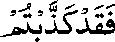 that is, you deny this reality. Some of you look to be very righteous and observe abstinence, but they pride themselves in their deeds, their supplications, their nightly prayers and the services they render to the people of the world. Allah the Exalted does not care for them in the least unless they supplicate fulfilling all the provisions of the prayer and unless Allah the Exalted accepts their deeds in the zeal of Rahmaniyyat by accepting their prayer.
The phrase 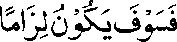 (and the punishment of your rejection will now cleave to you) means that the bad results of your denial will cleave to you. There are very diligent people among some of the Muslim sects who strive a great deal, but does their striving produce any good result for them? So far as we can see the efforts of such people are not producing the result as that of the good deeds of a righteous person, or even a thousandth part of his deeds.
The Promised Messiah (as) says in Barahin-e-Ahmadiyya:
“In fact the belief in these two things is essential for prayer: first, that God Almighty has all the power to foster, develop, have mercy and give reward and that these perfect attributes of His are always in operation. Secondly, that man can achieve nothing without the Divine help and support. These two concepts, without doubt, are such that when they have taken root in the heart at the time of prayer they promptly work such a change in the condition of man that, being affected by them, even an arrogant person falls on the earth, and tears start running from the eyes of a haughty and hard-hearted one. This is the mechanism that infuses a heedless dead person with life. Every heart is drawn towards praying through these two concepts. In short, this is the spiritual means through which the soul of a person turns towards God and realizes its own weakness and that it is always in need of Divine help. It is through this realization that a person arrives at such a stage of selflessness in which no sign of his own filthy existence is left anymore and the majesty of the only Great Being shines forth and only that Being appears as All-Mercy and Support of every being and Remedy of every ill and Source of every grace. At last, a condition of being lost in God manifests itself in consequence of which a person is left with no inclination towards the creation, or towards his own self, or towards his own designs, and is entirely lost in the love of God, and by the manifestation of the existence of that Reality his own existence and the existence of the rest of creation appear as naught.”5
The eighteenth objective pointed out was that as a result of setting up the Ka‘bah the world would acquire true realization of Allah the All-Hearing. An umma would be raised here who would introduce the All-Hearing Allah to the world. The world cannot deny the fact that only those people witness the manifestations of Allah’s attribute of All-Hearing who keep themselves engaged in supplications with humility. Allah the Exalted says in Surah Al-Mu’min:

 6
6
And your Lord says: Pray unto Me; I will answer your prayer. But those who are too proud and turn their back on My worship, that is, the worship that I accept, and about which I have said at another place in the Holy Quran that your worship must be accompanied by your supplications; and those who, out of their arrogance, do not elevate their worship to the state of submission will surely enter the hell despised. They will enter the hell of failure and My wrath and fury. Similarly Allah the Exalted says:

“And when My servants ask thee about Me, say: ‘I am near. I answer the prayer of the supplicant when he prays to Me. So they should hearken to Me and believe in Me, that they may follow the right way.’”7
O Prophet! When My servants ask thee about Me as to what is the proof of the existence of God Almighty, and how to acquire the knowledge of His attributes? Say, God is near to you. Knock at His door, it will be opened for you. Pray to Him (as per conditions given by Him), your prayers will be answered. As a result of the acceptance of your supplications you will acquire the knowledge of the Person and Attributes of the Creator. And after this realization and having obtained true understanding, your hearts will become lost in His love.
Hence Allah the Exalted says,  that is, they should believe in Me, in My Person, and in My attributes so that they may be guided to the right path. The Promised Messiah (as) says in Barakat-ud-Du‘a in this regard:
“Prayer, in essence, means a relationship of mutual attraction between a righteous person and his Lord. This means that God’s grace first draws a person towards Himself, and then, through the magnetism of the person’s sincerity, God draws closer to him. In the state of prayer this relationship reaches a point where it manifests wonderful qualities. When a man in grave difficulty falls down in prayer with perfect certainty, perfect hope, perfect fidelity, and perfect resolve; and when he becomes perfectly alert and advances far into the field of self-annihilation, tearing aside all veils of heedlessness, lo and behold, he finds before him the Divine threshold, and he perceives that God has no associate. His soul then prostrates itself at the Divine threshold and the power of attraction that is invested in him draws the bounties of God Almighty towards him. It is then that the Glorious God attends to the fulfilment of the desired objective, and casts the effect of the prayer on all the preliminary means, which, in turn, produce the means that are essential for the achievement of the objective.”8
The nineteenth objective was that not only the attribute of All-Hearing but the world would also see the manifestations of the attribute of All-Knowing through this umma. Non-acceptance of some of the supplications, or acceptance of some but not in the sense they were made, does not prove that our Glorified and Exalted God is not All-Hearing, or He is not the Possessor of all the faculties and powers. On the contrary, it will prove that He is not only Mighty, Strong and All-Hearing, He is also All-Knowing, and the acceptance of supplications is very closely knit with His attribute of All-Knowing. The Promised Messiah (as) says in this regard:
“One should also remember that humility and anguish alone is not enough for prayer to be accepted, for it also requires righteousness, purity, truthfulness, perfect certainty, perfect love and perfect attention. Moreover, it is also essential that the object prayed for should not be opposed to the Divine scheme of things and should not be against the welfare of the supplicant, or the one on whose behalf he prays, both in this world and the hereafter. It often happens that although all other conditions have been fulfilled, the object prayed for happens to be against the Divine scheme of things with regard to the supplicant, and no good can come of granting such a prayer.”9
The conditions of acceptance of supplications laid out here by the Promised Messiah (as), that is, righteousness, purity, perfect certainty and perfect love etcetera are about the acceptance which is like a chosen one. But the acceptance of a supplication which has to be a trial has nothing to do with these conditions. The Promised Messiah (as) has expounded on this topic at length. He says that sometimes Allah shows true dreams even to prostitutes so as to provide them means for guidance, and so that He may inspire them to come out of the filth and rush towards this fountainhead and source of purity and strive to purify themselves. But if the heart of a supplicant is not enlightened with the light of righteousness; or his bosom is devoid of the scent of purity; or his tongue is not tend to speaking the truth and his heart is not imbued with perfect certainty and perfect love; or his mind does not prostrate before his Lord with full and perfect attention; or the thing supplicated for does not bear him good in the sight of (the Possessor of the knowledge of the unseen) in all these circumstances the prayer is met with rejection. But in the last case Allah the Exalted recompenses such prayer in some other way. The Promised Messiah (as) says in this regard:
“Is this not a convincing proof that, from time immemorial, it is God’s Divine scheme that He responds to prayer with a zeal which imparts tranquillity, satisfaction and true happiness. If we are not wrong in praying for the achievement of an objective, in such a case that very objective is granted. But if we are wrong in our prayer and in asking for a thing, like an erring child who asks his mother for a snake or a piece of fire, then [in its stead] God Almighty grants us that which is good for us. And invariably in both the cases He also increases us in our faith. Because, through prayer we obtain foreknowledge from God, and it so much increases our conviction as if we have seen our God. Right from the outset and ever since man has been created there exists a bond between prayer and its acceptance. When the will of God is favourably inclined towards doing a thing, the Divine practice is that one of His sincere servants engages himself in prayer with anguish, unease and concern, and devotes all his efforts and attention to achieve it. Then the prayers of this mortal being draw Divine grace from the heavens and God Almighty creates such new circumstances that help achieve the task.”10
Thus, Allah the Exalted communicates to us three principal points with regard to prayer in the Holy Quran:
Firstly, we must not rejoice and be content with our deeds until we absorb the grace of Allah through that supplication which is accepted by the Almighty. However, we cannot say for sure whether Allah the Exalted will grace our prayers with acceptance. For, in very clear and magnanimous terms He says:  that is, my Lord does not care for you, your virtues, or your deeds if you do not prostrate before Him with supplication.
But we do care for Him. And if we want Him to continue the manifestation of His love for us, it is incumbent upon us to absorb His grace through prayers, the prayers that fulfill all the requisite conditions. If we do not do so, then our deeds will not be worth even as much as that of the foot of an ant in the sight of the world.
Secondly, Allah the Exalted says that Islam has given us such a teaching that if we keep it before our eyes and comply with it, we can expect that our God, Who is All-Hearing, will listen to our prayers and accept them and will cause the means of His benevolence for us.
Thirdly, of course Allah the Exalted is All-Hearing but He is also All-Knowing. A man may deceive the world; may wear a saintly robe; may make a declaration of his saintliness with great ceremony; but he can never deceive God. Therefore, only that person is accepted by God and only his supplications are answered whose heart is free of any mischief, evil and impurity. He should not exercise pride, vanity, vainglory, conceit, self-will, haughtiness and superciliousness; on the contrary, all of his shortcomings and sins would have been burned to ashes by the true love which is sin-effacer; and he should prostrate before his Lord with a purified heart, a cleansed bosom and a tear-shedding eye, only then his prayer is answered.
But our God (God forbid) is not ignorant. Nothing is concealed from Him. As the Holy Quran very clearly says that He is aware of what goes on in hearts and knows who is truly righteous and who is not. He knows as to who our foe is and who is our friend. He knows what is good for us and what is harmful. Thus, He responds to our supplications in the capacity of the All-Knowing. He (God forbid) is not like a silly mother who, on demand of an ember from her child, sometimes in peevishness gives it to the child and consequently burns his hand. God is more loving than a mother can be, and is more affectionate than a father. When He comes to accepting supplications He accepts them in a way they are beneficial to us.
But if the thing sought for in the supplication is not good for us He turns down that supplication. In its stead, out of His grace and benevolence, He manifests His benevolence in some other form and way. He is a very loving and very compassionate Lord. We are under the obligation to pass our days being His grateful servants, and we should always live in unity and concord in the Jama‘at, and never lose sight of the fact that all holiness and all Wilayat is under the foot of Khilafat-e-Rashida. He who, out of this fold, deems himself something, and if his supplications are answered they are not in the sense of acceptance of the selected ones; that acceptance is a trial and a test. Thus, one should always fear his Lord.11