(Excerpt from Friday Sermon, July 2, 2004)
In this Friday sermon, Huzoor(aba) gave very important advice about being a leader from a very famous Hadith of the Holy Prophet(sa) with regard to taking care of family members. Huzoor(aba) said:
“Hazrat Abdullah bin Umar(ra) relates that I heard the Holy Prophet(sa) say that each one of you is a guardian and each one will be asked about his responsibilities. Imam (leader) is a guardian and he will be asked about his responsibilities. Man is a guardian over his family and will be asked about his responsibilities towards them. Woman is a guardian over her husband’s household and she will be asked about her responsibilities. A servant is a guardian over his master’s wealth and he will be asked about these responsibilities. The narrator says that he recalls that the Holy Prophet(sa) also said a man is a guardian over his father’s wealth and he will be asked about these responsibilities. He said, each one of you is a guardian and will be asked about your responsibilities.”1
Different classes of people are mentioned in this narration, who are guardians in their own sphere, but because I am talking about men at this time so I want to give a little explanation. It has become a custom for men to say they have responsibilities outside of the house and they are busy in their business and jobs, so they cannot pay attention to the home and watching children is the responsibility of women. They should remember that as men and head of the family, they are responsible to keep an eye on the household. A man should fulfil the rights towards his wife and children. He should spend time with them, even if it is only on the two days in the weekend. He should get them connected with the mosque and encourage them to participate in Jama’at activities. He should arrange some recreational programs and should also take interest in their activities so they can share their problems with him like a friend. He should talk to his wife and children about their problems and should help solve these issues; this is the only way he can have the status as head of the family.
Any leader who is unaware of the problems of the people can never be successful; therefore, the best guardian is one who knows the problems that exist around him. It is worrisome that many people want to run away from or overlook their responsibilities, and this number is increasing. They try to live their lives in their own world, but a faithful Ahmadi Muslim should stay away from these things. Faithful Muslims are commanded that if they are ignorant of worldly affairs and busy in their worship or other responsibilities and have made such a routine that they are unaware of their surroundings, they are not fulfilling their duties towards their wives and children, and ultimately are not fulfilling their responsibilities towards society. They are on a wrong path and cannot establish higher standards of Taqwa. If you want to achieve higher standards, then you have to fulfil your duties towards Allah and fellow human beings.
It is narrated by Abdullah bin Umar(ra) that the Holy Prophet(sa) addressed him and asked if it is true that he fasts all day and offers Salat all night. Upon this, Abdullah bin Umar(ra) said yes. The Holy Prophet(sa) said not to do this, and to keep fast at one time and skip at another, and to pray at night but also sleep, because your body has a right on you, and your eyes have a right on you, and your wife has a right on you, and people who come to see you have a right on you.2
As a head of the household, the Holy Prophet(sa) fulfilled his duties towards his family. Hazrat Aswad(ra) narrates that he asked Hazrat A’isha(ra) what the Holy Prophet(sa) used to do at home. She said he would stay busy helping his family and when it would be time for Salat, he would go for Salat.3 Who could be busier than the Holy Prophet(sa) and who worshipped Allah more than him? But when we look at his character, he had taken an interest in household affairs, did chores at home, and took part in other activities. The Holy Prophet(sa) used to say “the best of you is he who treats his family best” and he said “I am the best in treatment of my family.”4
We should check ourselves to see if we are following his beautiful model. Some complaints come that a man was sitting on a chair reading the newspaper; when he got thirsty he called his wife to get him cold water or juice from the refrigerator, even though the refrigerator was close to him and he could easily take it out himself. And if the wife brings the drink late due to being busy elsewhere, he starts yelling and screaming. On one hand, people claim they love the Holy Prophet(sa) and on the other hand, they cannot show even basic courtesy. Such examples come to light and, when asked, they respond by saying the Holy Qur’an has given them permission to scold women. It should be very clear that the Holy Qur’an has not given such permission. They should not defame the Holy Qur’an for their personal interests.
Regarding domestic affairs, Hazrat A’isha(ra) narrated that the Holy Prophet(sa) was the most soft-spoken of all people. He used to live in the house like a common person. He never frowned and was always smiling. Hazrat A’isha(ra) also relates that the Holy Prophet(sa) never raised a hand on his wife or servants. He never said anything to his servants.5
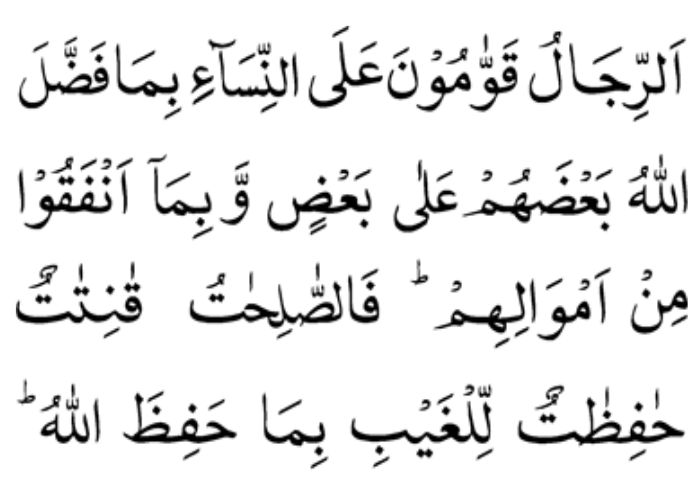
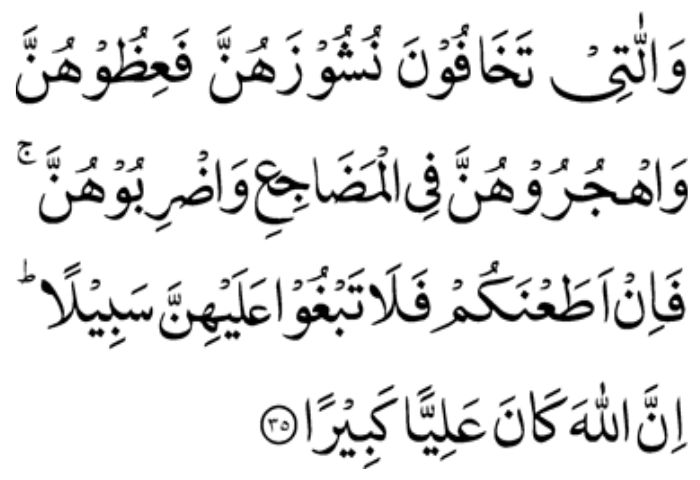
Nowadays, women are hit over trivial matters. When permission is given to punish women, there are some conditions along with it; there is no permission to do so of your own free will. Perhaps there are no Ahmadi women who need punishment due to these conditions. Therefore, instead of finding faults in women, fulfil your responsibilities and fulfil the rights of women. It is said in the Holy Qur’an:
“Men are guardians over women because Allah has made some of them excel over others, and because men spend on them of their wealth. So virtuous women are obedient and guard the secrets of their husbands with Allah’s protection. And as for those, on whose part you fear disobedience, admonish them and keep away from them in their beds, and chastise them. Then if they obey you, seek not a way against them. Surely Allah is high and great.”6
Men are guardians over women and Allah has blessed some of them with excellence because they spend their wealth on their wives. But the men who sit home and do nothing are not guardians. Thus, pious women are obedient and safeguard that in their [husband’s] absence which Allah has commanded them to safeguard. Those women who become rebellious should first be counseled. A bad reputation amongst the neighbors may have caused this. So first admonish them, then leave them separate in their beds and then you may bodily punish them. If a woman reforms herself from her rebellious behavior, do not find excuses or reasons to punish her. Remember, if you do not have fear of Allah, and think you are everything and woman has no status in your eyes, then keep in mind that there is Allah who can punish you for your actions. So act according to the appointed measures of punishment. The commandment to punish comes into effect when you see no sign of reformation and [wrong] behavior from the woman continues. It should never be the case that you start hitting a woman over every trivial matter. Do not be so cruel that you look for excuses and categorize a pious woman as an immoral one and start punishing her. Such men should remember that the Nizam-e-Jama‘at, which has been established by God, also punishes such men. Do not try to defame the Holy Qur’an, and reform yourself.
The Promised Messiah(as) said:
“Our Perfect Guide, the Holy Prophet Muhammad(sa) said, ‘The best among you is he who is best towards his wife.’ How can one claim to be pious when he does not behave well towards his wife? Only the one who treats his wife in the best manner can do good acts and show kindness towards others.”
There are some who appear pious but have many shortcomings; they are not kind to their wives and their families. Society should not just look at the outward appearance, but look deeply at such individuals. He said,
“…. Only the one who treats his wife in the best manner can do good acts and show kindness towards others, not the one who hits his wife over the slightest excuse. There have been instances where an enraged husband hit his wife over some slight matter, and hit her at some delicate part [of her body] and killed her. This is why God Almighty has said, there is no doubt that admonition is necessary if a woman behaves improperly.”7
The Holy Prophet(sa) advised husbands and wives to find good in each other. He said, if you find faults in each other, or do not like some habits, you may like some other of their habits that you will admire. Adopting selflessness, those good things should be kept in mind to keep a friendly and reconciliatory atmosphere at home. This advice is for both husband and wife. If both keep control on their emotions, then those petty small fights, which are always happening in the homes will stop and children will not be distressed. Sometimes these petty matters become very painful, and one is left wondering if there are some people in this world who are worse than animals.8
After living fifteen years with the Holy Prophet(sa), Hazrat Khadijah(ra) gave witness at the time of the first revelation. When the first revelation occurred, the Holy Prophet(sa) was very distressed. Hazrat Khadijah(ra) said, “Allah will never let you go in vain because you fulfil obligations of kinship (Sila Rehmi) and are kind to your relatives, and you burden yourself with the needs of the poor, and you are keeping alive all the good things which are not seen anymore. You are steadfast on truth despite all the challenges faced by speaking the truth, that is, you say the right thing and you are hospitable.”9
The morals stated by Hazrat Khadijah(ra) about the Holy Prophet(sa) are the ones that should be found in a human being, especially in a man, which can lead to the establishment of a pure society. That is, he fulfills obligations of kinship and treats his relatives well and takes care of their needs, and takes away their troubles. Sila Rehmi (fulfilling obligations of kinship) has vast meanings. It gives the same rights to the relatives of the wife as there are for the man’s relatives. It is just as important to extend Sila Rehmi to them as to the relatives of the man. If you adopt that habit and establish Sila Rehmi with both sides, then arguments or fights will not happen in such homes. Most conflicts happen over this issue. Men immediately get mad over trivial matters or if there are there are some complaints against parents or if a mother or father said something, albeit jokingly, men say I will never talk to your father or mother… or I will never talk to your brother. Then blame starts to be hurled around. These trivial altercations lead to major fights.
The Holy Prophet(sa) used to treat the relatives and friends of his wives in a very good manner. Of the many examples, I will relate one here:
“A narrator relates that whenever the Holy Prophet(sa) heard the voice of Hala, sister of Khadijah(ra), he would welcome her by standing up and announcing very happily that the sister of Khadijah(ra) had come. It was the Holy Prophet’s(sa) custom that if any animal was slaughtered, he would make sure that the meat was sent to the friends of Hazrat Khadijah(ra).”10
Let me explain and elaborate on this, and I need to do so as some matters [of concern] have emerged. These days, men and women have started mingling in the society. No one should assume from this that they have permission to sit in women’s gatherings or that they can freely sit with their wife’s friends. There is a difference between being respectful and becoming friendly with the friends of one’s wife, as this only creates a lot of problems. Sometimes such incidents happen that the wife is left behind and the friend becomes the wife. The man makes a new life for himself and the first wife is left grieving. This behavior is very cruel and Islam has not given such permission. The men say Islam has given them permission to do this. There is a need for extra vigilance in these societies and men should understand their responsibilities. They should take care of that wife who has passed a long time with them, both good and bad. Now that the times are better, are you just going to reject her? This is not justice.
Hazrat A’isha(ra) related that one time she said to the Holy Prophet(sa) that Allah had blessed him with very good wives, now he should not miss that old woman (Hazrat Khadijah(ra)). The Holy Prophet(sa) said:
“No, Khadijah(ra) became my companion when I was alone; she became my support when I was helpless. She showered her wealth on me and Allah blessed me with children from her; she validated me when everyone called me a liar.”11
This was the model of our beloved Holy Prophet(sa), but I have to say with great sorrow that it grieves me to hear such matters, and I become anxious that some of us have gone in the wrong direction. These people forget the sacrifices of their wives and some become so mean that they put pressure on the wife and demand money from her parents for their business. Sometimes they demand a share in the house that the wife has bought with her own money and sometimes they threaten her. It is very surprising that sometimes men from very noble families are the ones doing this. Such people should fear Allah and reform themselves. They should be clear that if some matters are brought to the Nizam-e-Jama’at, it will never support them and has never done so in the past. They should remember that they have daughters who could one day be treated like this. If they do not have daughters and cannot feel the pain, they should remember that their life will end and they will have to go before Allah Almighty.
Hazrat A’isha(ra) related that if the Holy Prophet(sa) came home late in the night, he would not wake anyone up and he would eat his food by himself, or he would drink milk himself.12
This was the character of the Holy Prophet(sa). But now we see examples [contrary to this]. Some men regularly come home late from work and if the wife eats earlier because of feeling unwell, the husband raises havoc in the house and stays in a very bad mood because she did not wait for him. This issue has become greater in our Pakistani, Hindustani and eastern societies. It was always there, but with education it should have reformed; yet it has increased instead. Even if only 2% of such people exist, it is worrisome and it can become a greater number. When a husband gets mad with his wife, then his parents get mad with her too, [complaining] that you did not wait.
There is a tradition about the Holy Prophet’s(sa) wife, Safiyyah(ra), who was the daughter of the Jewish tribe leader, Hayi bin Khittab, a great enemy of the Holy Prophet(sa). While returning from the battle of Khaiber, the Holy Prophet(sa) took off his gown, folded it and put it on the camel where Hazrat Safiyyah(ra) was going to sit. He then bent his knee for her and told her to step on and climb onto the camel.13
See, how he took care of this wife. The Holy Prophet(sa) has given us these examples to follow. Nowadays, some men do not take care of their wives because they fear people will call them ‘slaves to their wives’. I am surprised that elders and relatives of men tell them not to become slaves instead of instructing them on how to increase their love and affection. They do not give them the advice consistent with how they are acting themselves.
Another narration explains how the Holy Prophet’s(sa) family life was exemplary in every aspect. He used to take care of all the needs of his family. Even before his death, he gave special instructions about the needs of his family and that their expenses should be paid regularly after his death.14
The men who have eyes on the wealth of women should remember that it is their responsibility (to take care of the family) and they have no right on their wife’s money; they are responsible to fulfil the expenses of their wives and children. Even if they have to work as a laborer, it is their duty to take care of the household. If they work hard and pray, God will bless them with prosperity.
There is a tradition related by Hazrat Salman bin Awwa(ra) that his father was present at the time of the last pilgrimage of the Holy Prophet(sa). On this occasion, the Holy Prophet(sa) advised the audience, after praising Allah. The Holy Prophet(sa) said to always look after the welfare of women because they are connected with you like prisoners, and you have no right of ownership on them, except when they openly commit immorality (that is you have no right of ownership that you may start hitting them when you like, or treating them in a manner that you like, except when they commit immorality), but they have a right on you that you take care of their clothing and food.”15
The Promised Messiah(as) has said that the Holy Prophet(sa) is a perfect role model for us. If we look at the life of the Holy Prophet(sa), we can see how he treated women. I consider that man a coward who competes with women, and he is not a real man. If you study the life of the Holy Prophet(sa), you will know how good his conduct was. He had a dignified presence; yet if an elderly woman stopped him, he would stay there (with her) until she would give permission [to go].16
There is a tradition related by Hazrat Abu Hurairah(ra) that the Holy Prophet(sa) said to treat women kindly. Woman has been created from a rib and the most crooked part of the rib is the uppermost. If you try to straighten it, you will break it and if you leave it alone it will remain crooked. So treat women kindly. Another narration states that a woman is like a rib. If you try to straighten it, you will break it. If you want to gain benefit from it, you can do so despite its crookedness.17
The angle of the rib, or the curvature, is the reason for its strength, and the most delicate part of the body is protected by it i.e. the heart, and some other organs. Man is taking advantage of Allah’s creation. You can see in buildings and bridges, wherever they have to make them strong, they give them curvature. If you want to get benefit from the strong character of women, then do not try to change them according to your liking. Otherwise, they will be no good for you. It is proven that women are given a virtue of sacrifice. If you treat them well, they will always be ready to sacrifice themselves for your desires. You cannot gain any benefit by being tough or harsh, but with love and kindness.
Allah told the Promised Messiah(as) in a revelation, “This way is not good; stop the leader of the Muslims, Abdul Karim, from this. Be polite. Be polite because kindness is the key of virtues…” He said, “The first duty of the faithful is to treat everyone kindly. Sometimes using a few bitter words is okay.”18
In the footnote to this revelation, the Promised Messiah(as) has said:
“This revelation is a lesson for the entire Jama’at on treating your wives with love and kindness. They are not your maids. In fact, marriage is a contract between a man and a woman. Thus, try not to betray this contract. Allah instructs us in the Holy Qur’an to treat our wives in a good manner, and a Hadith states: ‘One who treats his wife well is the best among you.’ Therefore, be good with your wives, physically and spiritually. Pray for them and avoid divorce because the worst person in the sight of Allah is one who is hasty in divorce. Allah made you a couple; do not break it like a dirty dish.”19
He also said:
“People have made mistakes in their treatment of their wives and children, and they have gone astray from the right path, and their actions are against the teachings of the Holy Qur’an. The Holy Qur’an says treat your wives with love and kindness but they are acting against it. There are two types of people. One group are such people who have given total freedom to women, so much that they have become immodest. They do not care for their religion and they openly act against Islam and no one questions them. The other group is very harsh and strict with them and makes no distinction between them and animals. They hit them in a cruel way without considering that they are hitting a living thing. They treat them worse than animals and maids: hence they treat them really badly. There is a very famous Punjabi phrase that a woman is like a shoe; take one off and wear the other one. This is a very dangerous statement and completely against Islamic traditions. The Holy Prophet(sa) is the perfect example. Look at his life and how he treated women. In my opinion the man who competes with a woman is a coward and not a man at all.”20
Sometimes minor conflicts happen at home. Women as mothers-in-law have such habits that they will say throw the daughter-in-law out of the house. But we get surprised when the fathers-in-law, who are men and who have been given wisdom by Allah, listen to their wives, and then talk to their daughters-in-law badly and will even raise a hand on them without any reason. Then they ask their sons to beat the wife and, if she dies, it does not make any difference; they will bring a new wife. May Allah give wisdom to such men; they should remember that the Promised Messiah(as) has called such men cowards and not ‘men’.
The Promised Messiah(as) has said:
“Husbands and wives should have the relationship of real, truthful friends. The first witness to a man’s good character and relation to Allah are these women. If they do not have good relations with them, then how is it possible they have good relations with Allah? The Holy Prophet(sa) has said, “One who treats his wife well is the best among you.”21
“Once, a conversation was going on in the masjid about women where it was mentioned that a well-known Ahmadi member had a very bad temper and used to treat women like prisoners. If they came out of the house, he would beat them. But according to Shariah (Islamic jurisprudence), it is commanded to treat them well.22 We should pray for women, for their reformation, and have fear of Allah, but should not treat them like butchers, because nothing can happen until Allah wants it to…”23
The Promised Messiah(as) said that a man who does not treat his wife and her relatives with kindness and gentleness is not of my Jama’at.
1 Sahih al-Bukhari 893, Book 11, Hadith 18
2 Sahih al-Bukhari 1975, Book 30, Hadith 82
3 Sahih al-Bukhari 676, Book 10, Hadith 70
4 Ibn Majah Vol. 3, Book 9, Hadith 1977
5 Jami’at Tirmidhi, Chapter on virtues of Holy Prophet(sa), Hadith 6
6 Holy Qur’an 4:35
7 Mirza Ghulam Ahmad, Malfoozat, Vol. 1, Pages 403-404
8 Sahih Muslim, Book of Virtues
9 Sahih al-Bukhari 3 Book 1, Hadith 3
10 Sahih Muslim Book 44, Hadith 108
11 Masnad Ahmad bin Hanbal Vol. 6, Page 118
12 Sahih Muslim, Book of Sharia
13 Sahih Bukhari 4211 Book 64, Hadith 251
14 Sahih Bukhari 2776 Book 55, Hadith 3
15 Sunan Ibn Majah, Vol. 3, Book 9, Hadith 1851
16 Mirza Ghulam Ahmad, Malfoozat, Vol. 2, Page 387
17 Sahih al-Bukhari 3331, Book 60, Hadith 6
18 Mirza Ghulam Ahmad, Arbaeen, Ruḥani Khaza’in, Vol. 17, Pages 428-429
19 Mirza Ghulam Ahmad, Zamima Tohfa Golrawiya, Ruḥani Khaza’in, Vol. 17, Page 75
20 Mirza Ghulam Ahmad, Malfoozat, Vol. 2, Page 396
21 Mirza Ghulam Ahmad, Malfoozat, Vol. 3, Page 300-301
22 Holy Qur’an 4:20
23 Mirza Ghulam Ahmad, Malfoozat, Vol. 3, Page 1