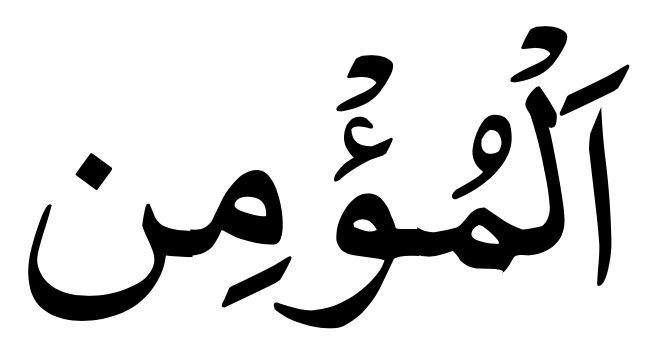
(Revealed before Hijrah)
With this Surah begins a group of Chapters all of which have the same abbreviated letters, Ha Mim, affixed to them and which open with the subject of the revelation of the Qur’an, and belong to the same period. According to Ibn ‘Abbas and ‘Ikrimah, all these Surahs were revealed at Mecca at a time when opposition to Islam had become persistent, organized and bitter (vv. 56 & 78) and the Holy Prophet’s enemies were even seeking to kill him (v. 29). Towards the close of the last Surah the Holy Prophet was comforted with the assurance that very soon Divine judgment will issue forth between him and his enemies. The forces of darkness will be routed; idolatry will disappear from Arabia, and the whole country will reverberate with the praises of God. The present Surah opens with the most welcome declaration that the Great and Mighty God has revealed the Qur’an in order that Divine Majesty and Holiness be established in the world and disbelief obliterated from it.
As mentioned above, the Surah opens with a firm declaration that the time has come when truth will triumph over falsehood and righteousness over evil, and the praises of God will be sung in the land where idolatry had been rampant. This great consummation will be brought about by means of the Qur’an. The enemies of truth will strain every nerve and use their influence and powerful resources to nip the tender plant of Islam in the bud. But they will fail in their evil designs and endeavours. The Holy Prophet is told not to be deceived and overawed by the glamour of power and great material resources of disbelievers, because they are destined to come to a sad end. He is further told that his opponents are not the only and the first people to oppose truth. There have been people before who also sought to kill their Prophets and exterminate their missions. But God’s punishment overtook them. So will punishment seize his opponents. The Surah then refers to the case of Moses as an illustration of the sad end to which the opponents of the Holy Prophet are bound to come. While Pharaoh rejected Moses’s invitation to truth, a 'believing man' from his own household gave a most pathetic but convincing speech, exhorting his people not to seek to kill a man (Moses) whose only fault was that he said that Allah was his Lord, and who possessed sound and solid proofs to support and establish his case. He further warned them that they should not be misled by their wealth, power and material resources, for all these were transitory things. But instead of benefiting by his sincere advice Pharaoh mocked at him. Next, the Surah makes pointed reference to the invariable Divine law, viz. that help and succour of God are always with His Messengers and with their followers and that failure and frustration continue to dog the footsteps of disbelievers till the end of time. This Divine law operated in the time of every Prophet and it will see its fullest manifestation in the time of the Holy Prophet. The disbelievers are then told that they have no reason to reject the Holy Prophet. His advent is not a novel phenomenon. Just as day follows night in the physical world, so does spiritual awakening follow a period of moral decadence in the spiritual realm. As the world had become spiritually dead, God raised the Holy Prophet to give it a new life. The Surah closes on the note that when God has made adequate provision for the physical needs of man, He could not have ignored to make a similar provision for his spiritual needs. He has been making this provision from time immemorial. He sent His Messengers and Prophets in the world who invited men to their Lord and Creator; but out of ingratitude and folly the sons of darkness rejected the Divine Message in every age and earned God’s displeasure.