My genealogy runs as follows:
My name is Ghulam Ahmad, son of Mirza Ghulam Murtada Sahib, son of Mirza ‘Ata Muhammad Sahib, son of Mirza Gul Muhammad Sahib, son of Mirza Faid Muhammad Sahib, son of Mirza Muhammad Qa’im Sahib, son of Mirza Muhammad Aslam Sahib, son of Mirza Muhammad Dilawar Sahib, son of Mirza Alah-Din Sahib, son of Mirza Ja‘far Beg Sahib, son of Mirza Muhammad Beg Sahib, son of Mirza ‘Abdul Baqi Sahib, son of Mirza Muhammad Sultan Sahib, son of Mirza Hadi Beg Sahib, who is our common ancestor.
[Kitab-ul-Bariyyah, Ruhani Khaza’in, Vol. 13, p. 172, sub-footnote]
My family history is as follows: My name is Ghulam Ahmad and my father's name was Ghulam Murtada and my grandfather's name was ‘Ata Muhammad and my great grandfather's name was Gul Muhammad. As stated elsewhere, our family is Mughal Barlas and it appears from my ancestral documents, which are preserved to this day, that they arrived in this country from Samarqand and that they were accompanied by about two hundred followers and servants and members of the family.
Our ancestor arrived here in the capacity of a respected chieftain and settled down in this place, which was at that time an uninhabited wasteland, situated approximately 50 kose2 North-East of Lahore. He established at this place a town, which he called Islampur and which subsequently became known as Islampur Qadi Majhi. In the course of time people forgot the word Islampur, and Majhi was also dropped and the name remained simply as Qadi, which later became Qadi and was finally converted to Qadian.
The reason why this place was called Qadi Majhi was that this tract of land, which was about 60 kose3 in length, was known as Majha probably because buffaloes abounded here, and buffalo is majh in Hindi. As our ancestors were not only the landlords of the whole of this tract but were also invested with ruling powers over this area, they became known as Qadi.
I am not aware why our ancestors migrated to this country from Samarqand, but ancient documents indicate that in their county of origin they were also respected chieftains and rulers and that they had to leave their country on account of some tribal rivalry and conflict. On their arrival here, the reigning monarchs granted them several villages by way of estate and they established a permanent state in this neighbourhood.
In the early days of Sikh rule, my great grandfather Mirza Gul Muhammad was a well-known chieftain in this area and his estate comprised eighty-five villages. In consequence of continuous raids by the Sikhs, he lost several of his villages and yet such was his generosity that, as a gesture of sympathy, he gifted several of his remaining villages to some Muslim landlords who had been evicted from their land, and these remain in their possession till this day. In those disturbed times he was an independent chieftain and about five hundred people were entertained at his table. About one hundred scholars, divines and Huffaz4 stayed with him and were paid sufficient stipends. In his company the talk mostly revolved around religious subjects. All his dependents and relatives were regular in their worship of God. Even the maidservants who ground corn were regular in their five daily prayers and Tahajjud.
The respectable Muslims of the neighbourhood, most of whom were Afghans, referred to Qadian, which was then called Islampur, as Mecca, because in those disturbed times this blessed town was a place of refuge for every Muslim. Most other places were full of disbelief, disobedience and tyranny, while Qadian was well-known for its adherence to Islam, piety, purity and justice. I have myself heard from those who had lived close to that time that in those days Qadian was like a garden in which flourished hundreds of supporters of the faith, divines, scholars and brave and respectable men.
There were many tales current in this neighbourhood that Mirza Gul Muhammad Sahib, the late, was an outstanding personality among the righteous people from whom proceeded many astonishing acts which bordered on the miraculous. Many seekers after God, scholars and pious men had come to Qadian to be among his associates. It is surprising that some of his near miraculous actions are so well-known that they were vouched for by a large number of irreligious people. In short, in addition to this position as chieftain, he had great reputation for integrity, righteousness, manly courage, high resolve, support of the faith, and sympathy for the Muslims. All his associates were pious people of good conduct, jealous for the faith, averse to disobedience and evil, and possessing courageous and commanding personalities.
I have often heard my father relate that on one occasion a Minister of the Mughal Government—whose title was Ghiath-ud-Daulah—came to Qadian. Having observed the statesmanship, intelligence, courage, high resolve, perseverance and wisdom of Mirza Gul Muhammad Sahib, and having witnessed his righteousness and piety and the decorum of his audience, and finding him inspired by the spirit of support for Islam and help for the faith, and seeing that those who were associated with him were pious and courageous people and carried themselves with dignity, he was much overcome with emotion. He said that if he had known that in this backward tract there lived a member of the Mughal family who was well equipped with all the royal qualities, he would have endeavoured that in these times, when the royal family was afflicted with indolence, inability and corruption, such a one should have been seated on the throne at Delhi to fully safeguard the Islamic Kingdom.
It might be of interest to mention that my great grandfather, the said Mirza Gul Muhammad, died of hiccups and some other complications. When his illness overpowered him, his physicians became unanimous in their opinion that if he were to use liquor for a few days, it might prove helpful in his treatment, but no one had the courage to mention this to him. Finally some of them indicated this to him indirectly. He replied that if God Almighty desired to heal him He could bring about the healing through any of several medicines and that he was not willing to seek his recovery through the use of such a vile thing as liquor. He added that he was quite reconciled to the Divine decree. He finally died after a few days of the same disorder. His death had been decreed but he left behind the pious memory that he preferred death to the use of liquor. People have recourse to every kind of device in order to escape death but he preferred death to disobedience of God. Sad indeed is the plight of some Nawabs and some wealthy and affluent people who, during their brief span of life, set at naught God and His commandments, sever all relationships with Him and disobey Him openly and use liquor like water. Thus they not only lead sinful lives but also cut down their days on earth and die quickly in consequence of various fearful disorders and leave behind an ill example for coming generations.
In short, when my great grandfather died he was succeeded by his talented son, my grandfather Mirza ‘Ata Muhammad. During his time, in God’s wisdom, the Sikhs overcame him after a struggle. My late grandfather had recourse to various devices for the safeguarding of his estate but as the Divine decree was not favourable he failed of his purpose and none of his projects were fulfilled and the Sikhs gradually deprived him of all his estate, leaving him in occupation of Qadian alone. Qadian at that time was like a citadel with four towers, which were manned by soldiers and a few cannons. It was surrounded by a wall twenty-two feet high and wide enough for three carts being driven along it side by side. It came to pass that a party of Sikhs known as Ram Garhias obtained entrance into Qadian by permission and then treacherously took possession of it. At that time our family faced ruin. They were taken captives like the Israelites, and all their belongings and properties were looted. Several mosques and fine houses were demolished and gardens were cut down out of ignorance and bigotry. Some of the mosques were turned into Dharamsalas5. One of these is still in their possession. A library belonging to our family was burnt down. It contained five hundred manualscript copies of the Holy Qur’an, which were disrespectfully burnt. In the end, upon second thoughts, the Sikhs directed our family to depart from Qadian and all men and women were seated in carts and expelled, whereafter they took refuge in one of the Punjab states. After a short while my grandfather was poisoned by his enemies. Then, during the latter part of Ranjit Singh's rule, my father Mirza Ghulam Murtada returned to Qadian and five of the villages, which had belonged to his father, were restored to him. In the meantime, Ranjit Singh had suppressed the smaller states and had consolidated them into a large state for himself. He had also captured all our villages and his rule now extended from Lahore to Peshawar and down to Ludhiana. Thus, after having been dispossessed of our estate, the remaining villages were also taken over by Ranjit Singh and we were left with only five of them. Nevertheless, as head of an ancient family, my father Mirza Ghulam Murtada was a well-known Chieftain in this neighbourhood … Sir Lepel Griffin in his book Chiefs of Punjab has made mention of my father. He was very popular with the officials of Government and, as a gesture of approbation, the Deputy Commissioner and Commissioner often came to visit him. This is a brief account of my family.
I was born around 1839 or 1840, during the latter part of the Sikh rule. In 1857, I was 16 or 17 years of age and had not reached manhood. My father had been beset by great difficulties before my birth and at one time he even had to travel through Hindustan on foot. But with my birth he began to experience a change for the better in his circumstances. It was by the sheer mercy of God Almighty that I did not partake of any of the misfortunes of my father. Nor did I participate in any of the days of rule and statehood of my ancestors. Like Jesus (as), who had the nominal title of Prince because of his descent from David (as), and who had lost all the insignia of statehood, I too can say that I am descended from rulers and heads of state. Perhaps this has happened so that I should have this resemblance with Jesus (as) as well. Though I cannot say like Jesus (as) that I have nowhere to lay my head, yet I know that all the rule and statehood of my ancestors has nearly come to an end. This happened so that God Almighty might establish a new hierarchy as indicated in a revelation vouchsafed to me by the Holy One, and which is mentioned in Barahin-e-Ahmadiyya:
That is, Holy is Allah, Blessed and High. He will raise thy status above thy ancestors. From now on, He will cut off all reference to thy forefathers and will begin with thee.
Also, He revealed to me the glad tiding:
… I received my elementary education at home. When I was 6 or 7 years old, a teacher who was learned in Persian was employed as my tutor. He taught me the Holy Qur’an and a few Persian books. His name was Fadl Ilahi. When I was about 10 years old, an Arabic teacher, whose name was Fadl Ahmad, was appointed as my tutor. I conceive that since my elementary education was by way of sowing the seed of Divine Fadl [Grace], the names of both my tutors begin with Fadl. Maulavi Sahib, who was a pious and respectable gentleman, taught me with great attention and diligence. From him I learnt some rules of Arabic grammar. When I was 17 or 18, for a few years I studied under another Maulavi Sahib whose name was Gul ‘Ali Shah. He too had been employed by my father for my tuition at Qadian. From him I acquired further knowledge of Arabic grammar, logic, philosophy, etc., according to the then current syllabus and as far as God Almighty so willed. My father was an expert physician and under him I studied some books on medicine.
By this time I had become so fond of reading that I gave little attention to anything else. My father repeatedly admonished me to cut down on my study of books for he was afraid that too much devotion to them might affect my health and he was also anxious that laying aside books I should begin to take an interest in his affairs and should share his responsibilities. And this is what happened. He was at that time engaged in litigation in the British Courts for the recovery of some of our ancestral villages and finally succeeded in employing me in that pursuit. For a long time I remained so occupied. I have always regretted that a good deal of my precious time was wasted in this useless pursuit. My father also committed the management of our landed property to me. But as I was by nature and disposition averse to such occupations, my father would sometimes be annoyed with me. He was most kind and affectionate towards me but he desired that I should become a man of the world like my contemporaries, but this was something I was much averse to.
On one occasion, the Commissioner was coming to Qadian and my father asked me repeatedly that I should go out two or three kose7 to welcome him. But I was wholly disinclined to do so and was also not feeling well. Therefore I could not go. This also became a cause for my father's displeasure. In short, he wished me to completely occupy myself with worldly affairs, which I could not do. Nevertheless, out of goodwill and in order to earn spiritual merit, but not for the sake of any worldly gain, I devoted myself to serving my father and for his sake I occupied myself with worldly affairs and also supplicated for him. He believed fully that I was dutiful towards my parents and often used to say that he desired me to participate in worldly affairs out of a sense of sympathy for me though he realized that faith—the thing in which I was most interested—was alone worth pursuing and that he himself was only wasting his time.
In the same way, while I was under his care I had most unwillingly spent a few years in the employment of the British Government, but he found that separation from me sat heavy on him and so he directed me to resign from my post. This I gladly did and returned home. My brief experience of official life made me realize that most people in that position lead very undesirable lives. Very few of them carry out their religious duties properly and few of them restrain themselves from indulgence in the illicit pleasures which are meant as a trial for them. I was surprised with their way of life. I found that most of them were eager to collect money lawfully or unlawfully and all their efforts in this brief life were directed towards the world. Only a few did I find who, out of regard for the Divine majesty, cultivated the higher moral values like meekness, nobility, chastity, courtesy, lowliness, humility, sympathy for mankind, purity of heart, eating lawful food, speaking the truth and righteousness. I found most of them afflicted with arrogance, transgression, neglect of religious values, and all types of evil morals. As the wisdom of God Almighty had decreed that I should have experience of all types of people I had to keep company with those of every kind. All this time I spent in great constraint and unease. As the author of Mathnawi Rumi says:
When I returned to my father I became occupied with the management of our land but the greater part of my time was devoted to the study of the Holy Qur’an and its commentaries as well as Hadith. I would often read out portions from these books to my father, who was mostly melancholy on account of the failure of his efforts to recover a part of his patrimony. He had spent some seventy thousand rupees in the prosecution of those cases, but the result was failure. We had lost those villages long ago and their recovery was a chimera.
On account of this failure my father was always restless and melancholy. Observing these conditions, I was enabled to carry out a pure change in my own life. The bitter life led by my father taught me to value a clean life free from all worldly impurities. Although my father still owned a few villages and was in receipt of an annual stipend from the British Government and also enjoyed a pension for his services, all this was as nothing compared to what he had experienced in his younger days. This is why he was always sad and melancholy and often said that had he striven for the faith as much as he had striven for the world he would have been a saint of some repute. He often recited the verse:
And I often saw him recite this verse which he had written, and he would be greatly moved:
Sometimes I heard him recite his own verse:
With each passing day, he was more and more grieved by the thought that he would face his Creator empty-handed. He often regretted that he had wasted his life in the pursuit of useless worldly objectives. On one occasion, he related that he had seen the Holy Prophet (sas) in his dream proceeding in great dignity towards his house like a mighty monarch. My father advanced to welcome him and, when he had come close to him, he thought that he should make a present to him and put his hand in his pocket in which he found only one Rupee. Examining it closely, he discovered that it was a false coin. Perceiving this my father's eyes became wet and he woke up. He interpreted this dream as meaning that love of God and of the Holy Prophet (sas) mixed with worldly ambition was like a false coin.
My father used to say that the last days of his father's life had also been spent in grief and sorrow, just like him. In whatever direction he advanced he met with failure, and he would often recite this couplet of his father (my great grandfather), of which I remember only one line:
In his old age my father's grief and sorrow multiplied manifold. About six months before, he built a mosque in the middle of the town—which is now the town’s main mosque—and directed that he should be buried in a corner of that mosque so that he should constantly hear the name of God Almighty being glorified, and this might perchance become the means of procuring forgiveness. It so happened that when the construction of the mosque was almost completed and just a few bricks remained to be laid in the courtyard, my father died of dysentery after a few days illness and was buried in the corner of the mosque which he had specified.
He was 80 or 85 years of age when he died. His sorrow over wasting his life in the pursuit of the world still affects me painfully and I realize that everyone who seeks the world must carry this sorrow with him. Let him who seeks understanding understand this.
I was 34 or 35 years of age when my father died. In a dream, I had been warned that his death was approaching. I was then in Lahore and hastened to Qadian. He was suffering from dysentery but I had no apprehension whatsoever that he would die the day after my arrival. In fact, there had been some change for the better in his condition and he could even sit for long hours. The following day, we were all with him at noon when he kindly suggested that I should go and have some rest, for it was the month of June and the heat was intense. I retired into an upper room and a servant began to knead my feet. Presently I fell into a light slumber and then came to me the revelation:

That is, We call to witness the heaven where all decrees originate, and We call to witness that misfortune which will fall today after sunset.
I was given to understand that this revelation was by way of commiseration on behalf of God Almighty, as my father would unfortunately die that very day after sunset. Holy is Allah! How glorious is the Great God that He commiserates on the death of a person who died sorrowing over his wasted life! Most people would be surprised at this interpretation of mine that God Almighty commiserated with me. It should, however, be remembered that when God, glorified be His name, treats someone mercifully, He deals with him like a friend. We read in the traditions that on certain occasions God Almighty laughed. This also is a similar kind of expression.
To sum up, when I received this revelation, which presaged the death of my father, the thought passed through my mind, because I was only a human, that some of the means of income which were linked to my father would now be closed and we might be confronted with all sorts of difficulties. Thereupon I received another revelation:

That is to say, is not Allah sufficient for His servant?
This revelation conveyed great comfort and satisfaction to me and it firmly fixed itself in my heart like an iron nail. I swear by God Almighty in Whose hand is my life that He has fulfilled this comforting revelation in a manner that was beyond my imagination. He has provided for me as no father could have provided for anyone. I have been the recipient of His continuous bounties, which I find impossible to deny.
My father died the same day after sunset. This was the first day on which I experienced a sign of Divine mercy through revelation concerning which I cannot imagine that it would ever cease to have effect during my lifetime. I had the words of the revelation carved on a semi-precious stone and set it in a ring, which I have with me securely. Nearly 40 years of my life passed under the care of my father, and with his departure from this life, I began to receive Divine revelations continuously and abundantly.
[Kitab-ul-Bariyyah, Ruhani Khaza’in, Vol. 13, pp. 162-195, footnote]
1 The remaining part of the chapter is a continuous narration; headings have been added by the Publisher. [Publisher]
2 Approximately 75 miles. [Publisher]
3 Approximately 90 miles. [Publisher]
4 Huffaz: People who have committed the Holy Qur’an to memory. [Publisher]
5 Charitable rest houses.
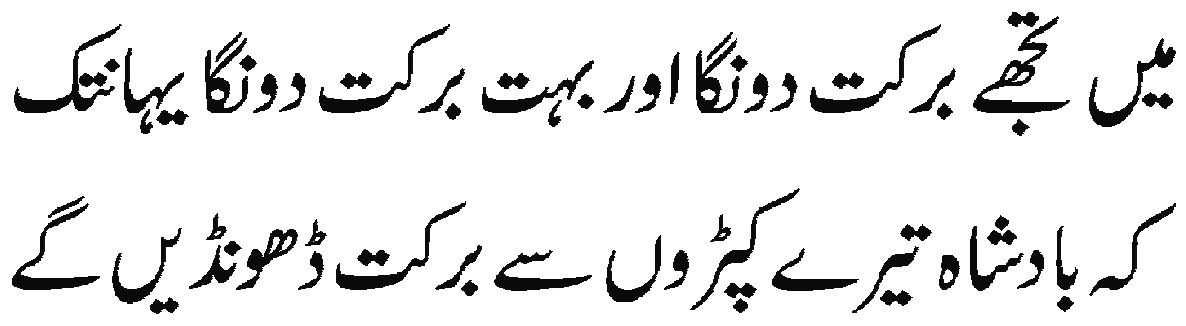
6 “I shall grant thee blessing upon blessing, until kings shall seek blessings from thy garments.” [Translator]
7 Approximately 3 to 5 miles. [Publisher]
8 I joined every kind of company—those who lived well and those who lived ill. Everyone in his own concept became a friend of mine but none of them sought to discover my inner secret. [Translator]
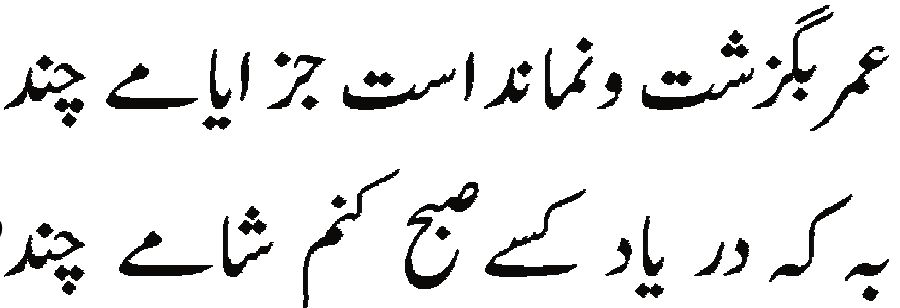
9 My life is past and only a few days remain. It would be better if I were to spend my nights in the remembrance of God. [Translator]
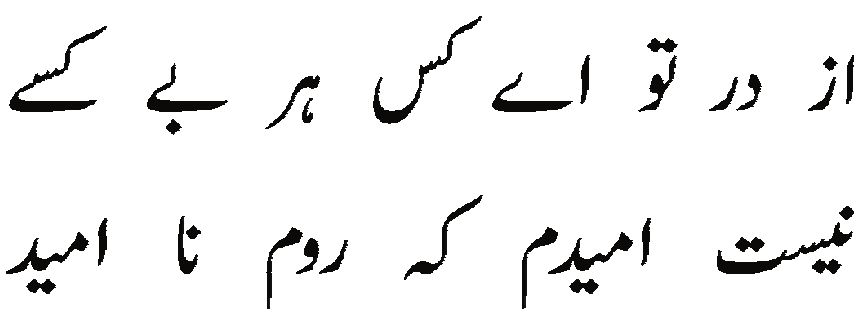
10 O Succour of every helpless one! Surely, I can’t return empty-handed from Thy door! [Translator]
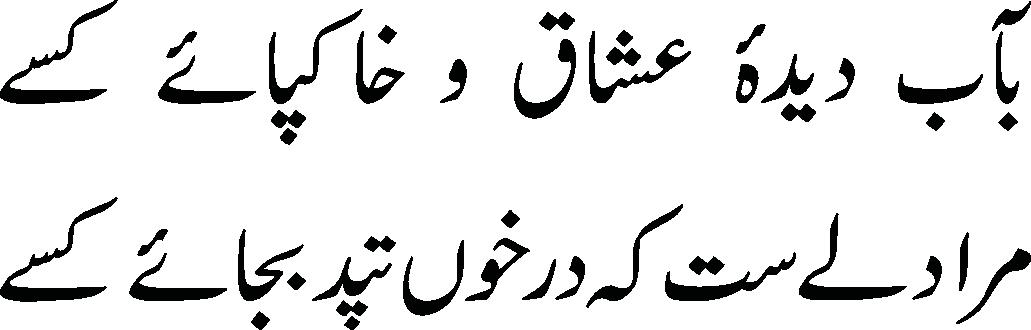
11 With the tears of a lover and being the dust of someone's feet, my heart beats in blood in place of someone else. [Translator]
12 Whenever I contrive to do something, destiny mocks me. [Translator]
13 O Allah, have mercy upon him and usher him into Paradise. Amin. [Translator]